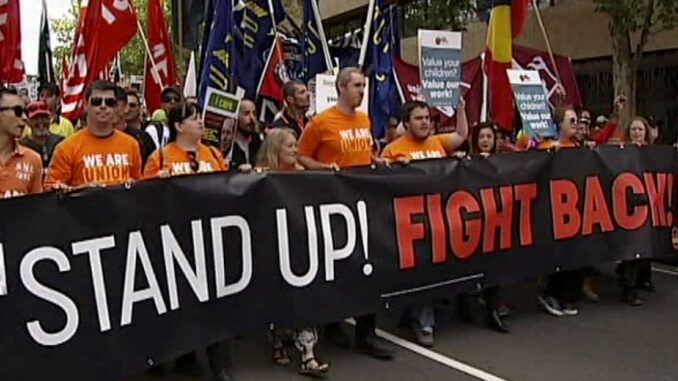
Why You Can’t Strike in Melbourne (But You Can in Caracas)
Australia has built the democratic world’s most sophisticated legal architecture for preventing workers from exercising collective power. We didn’t ban strikes. We just made them impossible.
It’s easier to hold a legal strike in Caracas, Venezuela, than in Melbourne, Australia. Think about that for a moment. A country we’re constantly told is a authoritarian nightmare has less restrictive labour laws than our flourishing democracy. We’ve achieved something remarkable: the criminalisation of solidarity dressed up as workplace relations reform.
How did we get here? And why does almost nobody understand how completely we’ve gutted the fundamental right to withdraw labour?
The Slow Strangulation of Industrial Action
In 1983, when the Hawke government came to power, unions represented 50 per cent of the workforce and industrial action, whilst regulated, was a normal part of workplace relations. Strikes happened. Workers had genuine power to withdraw their labour when negotiations failed. Employers knew this and negotiated accordingly.
Today, union membership has collapsed to 13.1 per cent. Among workers aged 20 to 24, it’s just 5 per cent. Unless radical action is taken, unions face irrelevance within a generation.
But the numbers don’t tell the full story. What changed wasn’t just membership; it was the legal framework that made unions effective. Australia systematically constructed a legal cage around industrial action, making it so procedurally burdensome, so riddled with penalties, so constrained by requirements and prohibitions, that most workers don’t even know they theoretically have the right to strike.
The genius of this system is that it maintains the appearance of democratic rights whilst making them practically unexercisable. We haven’t banned strikes. We’ve just made them require more legal expertise than a corporate merger.
The Kafkaesque Architecture of “Protected Action”
Here’s how you strike legally in Australia today:
First, you need to be in a bargaining period for a new enterprise agreement. You can’t strike over anything else: not working conditions generally, not solidarity with other workers, not political issues, not health and safety beyond what’s in your enterprise agreement. Your industrial action must be about your specific enterprise agreement and nothing else.
Second, you must give at least three days’ notice to your employer and the Fair Work Commission, specifying exactly what action you’ll take and when.
Third, you must hold a secret ballot of affected workers, with at least 50 per cent participation and a majority vote in favour.
Fourth, the action must not involve partial work bans unless explicitly allowed. You can’t refuse to do a specific task; you must withdraw all labour.
Fifth, the Fair Work Commission can suspend or terminate your action if it threatens to endanger life, cause significant damage to the economy, or cause significant damage to the employer or third parties.
Sixth, you cannot engage in pattern bargaining: coordinating your enterprise agreement with workers in other companies, even if they do exactly the same job for the same industry.
Seventh, secondary boycotts are banned. You cannot refuse to handle goods or services to support other workers’ disputes.
Eighth, any action outside these narrow parameters is “unprotected,” meaning workers can be sued for damages, union officials can face penalties up to $110,000, and unions can face penalties up to $550,000.
Try explaining that to a worker who just wants their boss to stop cutting penalty rates.
The Venezuela Paradox
In Venezuela, workers wanting to strike need to notify the labour inspector and attempt conciliation. If conciliation fails, they can strike. That’s it. The process takes days, not months. There’s no requirement for secret ballots, no three-day notice periods, no narrow definition of what constitutes legitimate industrial action, no Fair Work Commission with power to terminate action on economic grounds.
Venezuela’s labour laws, for all the country’s problems, maintain something closer to genuine freedom of association and the right to strike than Australia’s supposedly world-leading industrial relations system.
The same is true across much of Latin America. Brazil, Argentina, Chile: all have more permissive strike laws than Australia. Even France, which we mock for its industrial disruption, simply allows workers to strike with minimal procedural requirements.
Australia, meanwhile, has constructed a legal labyrinth that would make Kafka proud. We’ve turned the right to strike into the right to apply for permission to potentially take limited action within narrowly defined parameters subject to tribunal oversight and employer veto.
As Dario Fo might have staged it: a tragedy where the audience has been convinced they’re watching a comedy, and the actors have forgotten they’re in a play at all.
Enterprise Bargaining as Atomisation
The destruction of pattern bargaining was crucial to breaking union power. Under the old award system, improvements won in one workplace flowed to all workers in that industry. Unions could coordinate across employers, building industry-wide solidarity and preventing companies from playing workers off against each other.
Enterprise bargaining shattered this. Now every workplace negotiates separately. Unions can’t coordinate demands across companies without facing pattern bargaining restrictions. Workers doing identical jobs at different companies can’t support each other’s campaigns without risking secondary boycott penalties.
The system atomises workers into isolated units, unable to exercise collective power beyond their specific workplace. It’s union-busting through legal architecture: you don’t destroy unions directly; you just make it impossible for them to do what unions do, which is build solidarity across workplaces and industries.
Fast food workers can’t coordinate their campaigns across McDonald’s, Hungry Jack’s, and KFC. Warehouse workers can’t build industry-wide standards. Nurses in different hospitals can’t bargain together for better conditions across the sector.
Each workplace becomes an island. Each agreement becomes a separate negotiation. Each group of workers must fight alone.
The Fair Work Commission as Industrial Policeman
The Fair Work Commission has extraordinary powers to terminate industrial action. If the action threatens to:
- Endanger life, welfare, or personal safety
- Cause significant damage to the Australian economy or an important part of it
- Cause significant damage to the employer
- Cause significant damage to third parties
The Commission can order workers back to work. Note those criteria: not just danger to life, but damage to the employer’s business. Not catastrophic economic harm, but “significant damage” to any “important part” of the economy.
In practice, this gives the Commission power to terminate almost any effective industrial action. An effective strike, by definition, damages the employer’s business. That’s the point. That’s how workers exercise leverage. But under Australian law, this becomes grounds for the Commission to shut it down.
The Commission has used these powers repeatedly to terminate strikes in transport, construction, and education. The message is clear: you can strike, as long as it doesn’t actually inconvenience anyone or threaten the employer’s interests.
It’s like being granted freedom of speech but only in a soundproof room.
Wage Theft as Business Model
Whilst workers face this legal labyrinth to exercise their rights, employers face virtually no consequences for systematically underpaying them.
Between 2019 and 2023, Australian companies stole an estimated $1.35 billion from workers through wage theft. Not disputed pay rates. Not good-faith mistakes. Systematic, deliberate wage theft.
The roll call of shame includes some of Australia’s most prominent companies: Woolworths underpaid workers $300 million. Coles underpaid workers $115 million. Qantas underpaid workers $7.8 million. Commonwealth Bank underpaid workers $16 million. Wesfarmers underpaid workers $47 million.
And what happened to these companies? Did their executives face criminal charges? Did the corporations face penalties proportionate to their theft? Did the legal system treat wage theft with the same severity it treats welfare overpayments?
They said “oops, our bad,” paid back some of what they stole (sometimes without interest), and continued operating without meaningful consequence. Some paid relatively small penalties. None faced criminal charges until very recently, and only after sustained pressure forced some states to criminalise wage theft.
Compare this with Centrelink’s robodebt scheme, which pursued vulnerable people for alleged welfare overpayments with terrifying efficiency, garnishing payments, threatening legal action, and in some cases contributing to suicides. The state’s capacity to police and punish the poor is extraordinary. Its capacity to police and punish employers who steal from workers is virtually non-existent.
The message is clear: steal from your employer and you’ll face criminal charges. Steal from your employees and you’ll face a stern letter asking you to give some of it back.
The Penalty Rates Massacre
In 2017, the Fair Work Commission cut Sunday penalty rates in hospitality, retail, and fast food. The decision directly cut wages for some of Australia’s lowest-paid workers, transferring wealth from workers to business owners under the rhetoric of “flexibility” and “job creation.”
Labor, then in opposition, opposed the decision. They promised to restore penalty rates if elected. When they finally won government in 2022, with control of both houses of Parliament for the first time in years, they did… nothing.
The cuts remain in place. The lowest-paid workers continue to work Sundays for less money. The promised restoration never came. Labor’s first budget could have included legislation restoring penalty rates. It didn’t. The second budget could have. It didn’t.
Why? Because business objected. Because it would be “costly.” Because Labor has lost the ability to say: “We represent workers, business will have to adjust.”
A worker who had their Sunday rate cut from double time to time-and-a-half lost about $100 per Sunday shift. Over a year, that’s $5,000 or more. For someone earning $25 an hour base rate, that’s a 10 per cent pay cut for Sunday work.
Multiply that across hundreds of thousands of workers, and you have one of the largest wealth transfers from workers to capital in recent Australian history. And Labor, the party of the worker, couldn’t be bothered reversing it when they had the chance.
The Union Membership Death Spiral
Union membership has fallen from 40 per cent of employees in 1992 to 13.1 per cent in 2024. Since the 1970s peak when unions represented more than half the workforce, we’ve plunged to the lowest level in nearly 120 years.
Among workers aged 20 to 24, just 5 per cent are union members, compared to 21 per cent of those aged 60 to 64. The young have been taught that collective action is as outdated as a rotary phone, that solidarity is something their grandparents believed in before they got wise.
Union decline has tracked the collapse of blue-collar jobs, with membership now concentrated in professional and semi-professional employment in publicly funded sectors: teachers, nurses, university staff, public servants. These are important workers doing vital jobs, but they’re not the precarious workers in retail, hospitality, and the gig economy who most desperately need union protection.
The workers who most need unions can’t access them. The industries with the worst wages and conditions have the lowest union density. It’s a death spiral: weak unions can’t recruit in precarious industries, so precarious industries stay weak and unorganised, so unions weaken further.
The legal framework ensures this continues. How do you organise casual workers across multiple workplaces when enterprise bargaining prevents coordination? How do you build union density when workers can free-ride on union-negotiated agreements without paying fees? How do you recruit when young workers have never seen effective industrial action and don’t believe unions can actually win anything?
The system was designed to produce exactly this outcome: unions too weak to challenge employers, workers too atomised to build collective power, and both trapped in a legal framework that prevents the solidarity that built the labour movement in the first place.
What We Lost
There was a time when Australian workers had genuine industrial power. Not perfect power. Not unchecked power. But real leverage that forced employers to negotiate in good faith, to share productivity gains, to treat workers as partners rather than cost inputs to be minimised.
That time is gone. The legal architecture built over forty years has caged the labour movement so completely that most workers don’t even understand what’s been taken from them. Young workers have never known anything else. To them, this is just how things are: you can’t strike, you can’t coordinate with workers in other companies, you negotiate individually or you take what you’re given.
The tragedy isn’t just that we lost industrial power. It’s that we’ve forgotten it ever existed. We’ve normalised our powerlessness. We’ve accepted that employers have the whip hand, that workers must compete against each other for scraps, that solidarity is naive and militancy is counterproductive.
We built a system that protects employers from workers more comprehensively than it has ever protected workers from employers. And we call it industrial relations reform.
Don’t tell me I’m wrong. For that you’ll need an official permit to dissent in public, three days’ notice, a secret ballot with 50 per cent participation, and Fair Work Commission approval. Better hope your boss doesn’t object. Wouldn’t want to cause significant damage to their business interests, would we?
Continued tomorrow… Working in the Lithium Mine (We’re Already There)
Link to Part 1:
Building the Cage: How Labor Built Neoliberalism and Called it Partnership (Part 1)
Keep Independent Journalism Alive – Support The AIMN
Dear Reader,
Since 2013, The Australian Independent Media Network has been a fearless voice for truth, giving public interest journalists a platform to hold power to account. From expert analysis on national and global events to uncovering issues that matter to you, we’re here because of your support.
Running an independent site isn’t cheap, and rising costs mean we need you now more than ever. Your donation – big or small – keeps our servers humming, our writers digging, and our stories free for all.
Join our community of truth-seekers. Donate via PayPal or credit card via the button below, or bank transfer [BSB: 062500; A/c no: 10495969] and help us keep shining a light.
With gratitude, The AIMN Team


Spot on! Thank you for the article, as this’s been common knowledge for decades, you can’t be persecuted for whistle blowing.
I knew Hawke and Keating had betrayed workers from the moment the Accord was announced. I was working in the HR Dept of a factory. Our Manager literally did a tap dance in the foyer to celebrate the neutering of the unions.
Hotspringer: this may be “common knowledge” but amongst whom? Most people have no idea about all this. That is how we have come to this place. Even Labor politicians will not agree that it is easier to strike in Caracas than in Melbourne. I certainly had no idea, but then I was not a wage-worker in the usual sense of the term.
Industrial relations has remained unstable and a political football for decades.
In my view this is largely a result of the fact that unions significantly form and control the ALP.
The reaction of the Liberals is to attack their political enemies through undermining their relevance and financial strength. Weaken unions and you weaken the ALP.
The reaction of the ALP is to seek to legislate and protect their financial supporters and power brokers.
All this is an unnecessary politicisation of an important issue, and contrary to the public interest.
As the ALP luminary, John Button, said – it is time the ALP and unions had an amicable divorce
“A Commentator.” There’s a kernel of truth here; but the conclusion is the wrong one.
The instability is not because unions are “political.”
The instability exists because in Australia capital is political.
Business lobbies literally write legislation.
Every major IR reform of the last 30 years has been driven by employers trying to shift bargaining power down the wage ladder and push labour costs onto the worker and off the balance sheet. The Liberals didn’t attack unions because they are “enemies.” They attacked unions because unions are the only organised counter-power to capital in the labour market.
You weaken unions; you don’t “depoliticise IR.”
You simply deliver unilateral power to the employer.
Button’s line only holds if we live in a world where corporate capital has also agreed to disarm.
It hasn’t.
Unions are not perfect; but they are the only structure that:
• negotiates on behalf of workers
• resists wage theft
• enforces safety
• protects time, dignity, and limits
The public interest is not neutrality.
The public interest is balance.
The only way IR stops being a “football” is if both sides are demilitarised.
Right now in Australia; only one side is being told to drop its weapons. And it’s the side that doesn’t hold the capital. For the benefit of those who have not read part one, let’s get that “side” into proportion. Unionism? It’s already been knee-capped. Today, at best 12.5% of workers are unionised.
Here’s a quick recap:
Let’s be clear about what the Accord delivered:
Union membership in 1976: 50% of the workforce
Union membership in 1986 (three years into the Accord): 46%
Union membership today: 12.5%
Union membership among workers under 25: 5%
David T .
I commend your brilliant summary of the decline of labour as the working class party of Australia ,your attention to detail in out lining its slippery slope to compromise after compromise to the point of it being over run and controlled and manipulated from with in ,A slow take down ( Wolves in Labours sheep clothing came in un – noticed and took over the Joint ) .. !!
You have described in great detail this gradual demise of workers rights and the take over by a gradule slow burn to Neo-liberalism ( Wage theft as a business model ) divide Unions and workers against each other ,create confusion and disruption ..etc .
This great division and ploy was the Weaponisation and down fall of the once great party who represented and stood shoulder to shoulder in solidarity with workers , but sadly, captive to shadow goverments ,bankers , IMF. Ulluminati and secret societies and the Elite ..Etc, etc ……
David , in great vivid detail Exposes the labour Party as a Carcass of it former self , so compromised and un regonisable – its stuck up Shit Creek in a barbed wired Canoe – waiting to be rescued and the Swamp to be drained of the Non – working class influnce under its Spell ! , so that the Evil influencing barbed wires can be laid open to bare and exposed for all Australia to see ! ………..
Thank you , David ,
your attention to detail on this matter is extradinary ..
Jano, thank you for this. Comments like yours that remind me why I keep long hours at this keyboard.
You’ve captured exactly what I was trying to expose: the wolves didn’t arrive with fanfare. They came in suits, carrying briefcases full of focus group research and donor contact lists. They spoke the language, sang the anthems, and slowly; so slowly nobody quite noticed, they changed what those words actually meant.
The tragedy isn’t that Labor lost its way. The tragedy is that it found a new way — a way that leads straight to the boardrooms and donor dinners, not the factory floor.
You’re absolutely right: this was a slow-burn takeover. The great con of neoliberalism wasn’t just wage theft as a business model (though you’ve nailed that). It was convincing Labor that representing workers meant managing workers; managing their expectations downward, managing their demands into silence, managing their solidarity into isolation.
Divide and rule. The oldest trick in the book. And Labor stopped resisting it and started implementing it.
But here’s what gives me hope: people like you see it. You see through the spin. You remember what Labor was supposed to be. You haven’t forgotten that solidarity isn’t a slogan; it’s a practice. And once enough people see what you see, the jig is up.
The swamp won’t drain itself. But the fact that we can now see the swamp; that’s the first step.
Keep reading. Keep questioning. Keep refusing to accept the official story.
And thank you for taking the time to engage so deeply with the work. It means more than you know.
Solidarity,
David
Fair Work Commission, my sweet not-so-little arse.
Gotta compliment Jano from the Gong. Bewdy.
Sad to see A commenter trying stitch up the unions again. I think, the likes of Clive Palmer and Gina Rinehart a much worse threat.
The unions were attacked thirty years ago by Howard at Webb Dock and I’ve see no major move forward for democracy since.
Paul, yes indeed.
In the modern world, dominated as it is by liberal economic theory, I believe there are at least two apparatuses or institutions that are necessary to establish whether a system is “civilizational,” for want of a better word.
The first is the provision of affordable health care.
The second is a healthy union movement.
We have not lost the second yet, but we are moving in that direction, as David Tyler points out.
Leefe,
“Fair Work” is an oxymoron. The “Commission” is just an added extra.
Class struggle/war anyone? Any other options? A good article of W. Buffet is instructive here: “We won the class war” or something to this effect…
David, a very pertinent, and important, quote from your thoughts:-
"The state’s capacity to police and punish the poor is extraordinary. Its capacity to police and punish employers who steal from workers is virtually non-existent."
Everybody share these 2 concise sentences far and wide.
The decline of working conditions is this country award once again goes to John Howard and his bastard actions during the 1998 waterfront dispute and his accomplice Chris Corrigan https://en.wikipedia.org/wiki/1998_Australian_waterfront_dispute
The secondary boycott ban emerged post a legal action from Santos; and all the changes to date are Machiavellian moves from Howard et al which Government, legislators, lawyers, regulators, judges and the court system regularly eviscerated without any future considerations or consequences, as we are seeing in USA by a captive SCOTUS.
Someone may be able to find some buried treasure within this article and publisher https://kangaroocourtofaustralia.com/2013/03/24/justice-iain-ross-fair-work-commission-president-accused-of-bullying-and-bastardisation-of-judicial-officers/
Something to make the day flow https://www.youtube.com/watch?v=iyI9r0CCu74
My comment is hardly union bashing.
My view I’d that protection of employment rights and collective bargaining is particularly important, and should stop being a battleground for political parties.