Nuclear weapons have made the world safe for hypocrisy and unsafe in every other respect. Astride the nonsense that is nuclear apartheid – the forced separation of the states that are permitted to have nuclear weapons and those that do not – sits that rumpled, crumpled creature called the Treaty on the Non-Proliferation of Nuclear Weapons (NPT). For decades, the nuclear club has dangled an unfulfilled promise to eventually disarm their arsenals by encouraging non-nuclear weapons states to pursue peaceful uses of the atom. Preference, instead, has been given to enlarging inventories and developing ever more ingenious and idiotic ways of turning humans, and animal life, into ash and offal.
Little wonder that some countries have sought admission to the club via the backdoor, avoiding the priestly strictures and promises of the NPT. The Democratic Republic of North Korea is merely the unabashed example there while Israel remains even less reputable for its coyness in possessing weapons it regards as both indispensable and officially “absent”. Other countries, such as Iran, have been lectured, and bombed into compliance. Again, more hypocrisy.
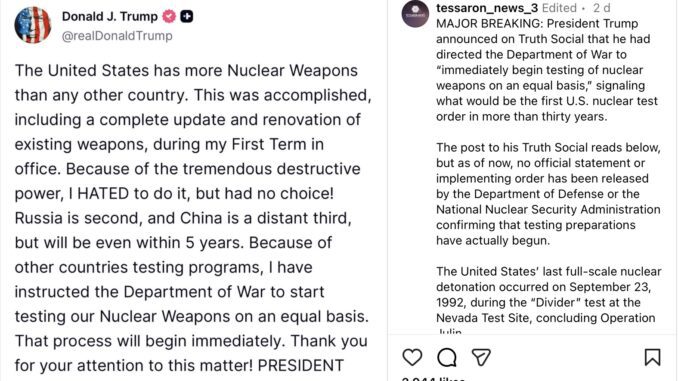
On such rocky terrain, the US President’s instruction to his newly named Department of War to resume nuclear testing is almost prosaic, if characteristically inaccurate. On social media, Donald Trump declared that, “Because of other countries testing programs, I have instructed the Department of War to start testing our Nuclear Weapons on an equal basis. That process will begin immediately.” Strictly speaking, North Korea remains the black sheep of an otherwise unprincipled flock to consistently test nuclear weapons since the late 1990s, while 187 states have added signatures to the Comprehensive Test Ban Treaty (CTBT).
Other streaky details included the assertion that the US had a nuclear weapons inventory larger than that of any other state, something “accomplished” through “a complete update and renovation of existing weapons” during Trump’s first term.
The announcement did cause a titter among the nuclear chatting classes. “For both technical and political reasons,” remarked Heather Williams, Director of the Project on Nuclear Issuesand a Senior Fellow in the Defense and Security Department at the Center for Strategic and International Studies, “the United States is unlikely to return to nuclear explosive testing any time soon.” She did concede that Trump’s post pointed “to increasing nuclear competition between the United States, Russia, and China.” Whatever the bluster, and however many bipartisan calls to do so, the current administration had been “slow to seriously invest in this nuclear competition.”
This line of reasoning is telling. The issue for Williams is not to decry the resumption of a type of testing – the explosive, high-yield variety – less than to chide the President for not taking a serious interest in joining the great game of nuclear modernisation with other powers. “Nuclear testing is not the best step forward in that competition, but it should raise alarm within the administration about the state of the United States’ nuclear enterprise and the urgency of investing in nuclear modernization.” And there you have it.
Rebeccah L. Heinrichs of the Hudson Institute does some speculative gardening around the announcement with the same sentiment. Trump might have meant, she writes in the Wall Street Journal, “conducting flight tests of delivery systems.” Maybe he was referring to explosive yield-producing tests. And those naughty Russians and Chinese were simply not behaving in terms of keeping their nuclear arsenals splendidly inert. With the familiar nuclear hawkishness that occupies the world of stubborn lunacy, Heinrichs is unequivocal about what the administration should do: “Whatever Mr. Trump means by ‘testing,’ the US should work urgently to improve and adapt its nuclear deterrent. To do this, Mr. Trump should let the last arms-control treaty between the US and Russia – the New Strategic Arms Reduction Treaty, or New Start – expire in February.” This, it seems, counts for good sense.
Other commentators tended to fall into the literal school of Trump interpretation. There is no room for allegory, symbolism or fleeting suggestion there. Tilman Ruff, affiliated with the International Physicians for the Prevention of Nuclear War, among other groups, offers his concerns. “If Trump is referring to the resumption of explosive nuclear testing, this would be an extremely unfortunate, regrettable step by the United States,” he fears, writing in that blandest of fora, The Conversation. “It would almost inevitably be followed by tit-for-tat reciprocal announcements by other nuclear-armed states, particularly Russia and China, and cement an accelerating arms race that puts us all in great jeopardy.”
Ruff points out the obvious dangers of such a resumption: the risks of global radioactive fallout; the risk, even if the tests were conducted underground, of “the possible release and venting of radioactive materials, as well as the potential leakage into groundwater.” Gloomy stuff indeed.
Others did the inevitable and, in Trump’s case, inconsequential thing of trying to correct America’s highest magistrate by appealing to hard boiled facts. “Nothing [in the announcement] is correct,” grumbled Tom Nichols from The Atlantic. “Trump did not create a larger stockpile by ‘updating’ in his first term. No nation except North Korea has tested nuclear weapons since the 1990s.”
At The New York Times, W. J. Hennigan took some relish in pointing out that the province of nuclear testing lay, not with the Pentagon, but the Energy Department. But then came the jitters. “The president’s ambiguity is worrisome not only because America’s public can’t know what he means, but because America’s adversaries don’t.”
The problem goes deeper than that, and Hennigan admits that the breaking of the moratorium on nuclear testing is always something peaking around the corner. The US, for instance, is constructing the means of conducting “subcritical nuclear tests, or underground experiments that test nuclear components of a war head but stop short of creating a nuclear chain reaction, and therefore, a full weapons test.”
Even if the Trump announcement was to be taken seriously – and there is much to suggest that it be confined to a moment of loose thinking in cerebral twilight – dangers of any resumption of full testing will only marginally endanger the planet more than matters stand. The nuclear club, with its Armageddon fanciers and Doomsday flirters, remains snobbishly determined to keep the world in permanent danger. An arms race is already taking place, however euphemised it might be.
Keep Independent Journalism Alive – Support The AIMN
Dear Reader,
Since 2013, The Australian Independent Media Network has been a fearless voice for truth, giving public interest journalists a platform to hold power to account. From expert analysis on national and global events to uncovering issues that matter to you, we’re here because of your support.
Running an independent site isn’t cheap, and rising costs mean we need you now more than ever. Your donation – big or small – keeps our servers humming, our writers digging, and our stories free for all.
Join our community of truth-seekers. Donate via PayPal or credit card via the button below, or bank transfer [BSB: 062500; A/c no: 10495969] and help us keep shining a light.
With gratitude, The AIMN Team


Seems to me that most nations that remain nuclear free and politically un-aligned have the least issues with foreign relations. Except of course if you are Venezuelan or Libyan where you are cursed with enormous gas and oil reserves that greedy hegemons crave.
As for the Nuclear Non-proliferation Treaty, most Australians don’t remember or don’t know that a foreign power detonated multiple nuclear bombs and devices on our sovereign territory during the 1950s-60s. It took 5 decades before that power acceded to cleaning up their nuclear detritus that was dispersed by the explosions. The conservatives are still reluctant to discuss their involvement in this “peace seeking” project.
If your are curious or unbelieving Google: Emu Plains,SA, Maralinga, SA and Monte Bello Island, WA.
Trump and his usual, “We’re the bestest and have the mostest. We’re No. 1 at everything.” Slightly off track, that’s why he wouldn’t run for VP at the next election, the idea of being (though we most certainly know he is) Number 2 even for few days would be a horrific and unthinkable to him.
https://brilliantmaps.com/number-of-nuclear-weapons-per-country-in-2025/
Best intents become a shemozzle when paranoid conservative madmen became involved.
1968 July NPT – Treaty on the Non-Proliferation of Nuclear Weapons
(191 Countries. Not Israel, India, Pakistan, South Sudan. North Korea withdrew 2003)
1969 – 1979 SALT Agreements – Strategic Arms Limitation Talks
(SALT I lead to ABM. SALT II neither USA or Russia ratified but lead to STARTs)
1972 ABM – Anti-Ballistic Missile Treaty
(USSR USA in force for 30 years. USA (GW Bush) unilaterally withdrew June 2022)
1987 Dec – 1991 Aug INF – Intermediate-Range Nuclear Forces Treaty
(USSR / Russian Federation & USA in force until USA (Trump) withdrew 20 Oct 2018)
1991 July START I – Strategic Arms Reduction Treaty
(Expired 5 Dec 2009)
1992 Jan START II – Strategic Arms Reduction Treaty
(Abandoned when US withdrew from ABM Treaty)
1994 Budapest Memorandum
(Associated with 1968 NPT – still contentious because of NATO expansion & Russian annexations)
1996 Sept Nuclear Test Ban – Comprehensive Nuclear-Test-Ban Treaty
(Not effective, not ratified by USA, China, Egypt, Iran, Israel & Russia)
1997 START III – Strategic Arms Reduction Treaty
(Not signed – mainly due to NATO US actions – resort to SORT Treaty)
2002 May SORT – Strategic Offensive Reductions Treaty
(In force June 2003 – Feb 2011, superseded by NEW START Treaty)
2010 Apr NEW START – New START – ‘Reduction of Strategic Offensive Arms’
(Effective 5 Feb 2011 due to expire Feb 2026. Russia suspended on 21 Feb 2023)
2017 Sept Nuclear Weapon Ban – Treaty on the Prohibition of Nuclear Weapons
(Effective 22 Jan 2021. Not voted on by all nuclear weapons states and all NATO members. 122 countries in favor, 1 against (Netherlands), 1 abstention (Singapore))