Greenpeace Australia Pacific Media Release
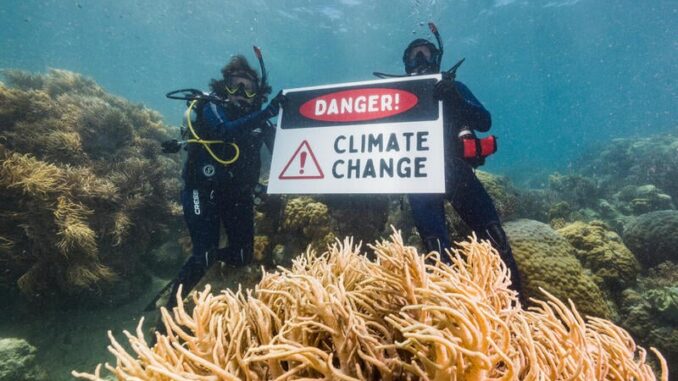
More than 100 Australian scientists and researchers have called on the Labor Government to address deforestation in the new nature law reforms, warning that the impacts under the current Act “compound the damage caused by repeated mass bleaching events driven by climate change” to the Great Barrier Reef.
Environment Minister Murray Watt will soon table the draft bill to reform Australia’s broken nature law, the Environment Protection and Biodiversity Conservation (EPBC) Act. Leading environmental groups Greenpeace Australia Pacific, the Australian Marine Conservation Society, and the Australian Conservation Foundation coordinated the open letter with 112 leading Australian scientists, calling for the reforms to close loopholes in the Act that allow for rampant and unchecked deforestation, especially in the Great Barrier Reef catchment.
Read the letter here.
Elle Lawless, senior campaigner at Greenpeace Australia Pacific, said:
“Now is the time to act decisively for nature, and design a nature-first nature law that will do what it is set out to do: protect our environment. Toxic runoff from deforestation in the Great Barrier Reef catchment is poisoning the reef and suffocating the precious and fragile marine ecosystem. The Great Barrier Reef is a global icon, and we need a strong, robust EPBC Act that will safeguard and protect it. This is one of the most important pieces of legislation our country and our environment has and, done right, has the power to make serious and desperately needed positive changes to protect nature.”
Professor James Watson FQA, from UQ’s School of the Environment, said:
“Australia’s State of the Environment report, released by the federal government in 2021, shows that our oceans, rivers and wetlands are in serious decline. That report, and the Samuel review of the EPBC, make the point that there is a desperate need for stronger national nature laws that help protect these precious places for generations to come.
“Australia’s top environmental academics and experts have been sounding the alarm for decades: the large-scale destruction of Australia’s native woodlands, forests, wetlands and grasslands is the single biggest threat to our biodiversity. It’s driving an extinction crisis unlike anywhere else on Earth — and it’s threatening the Great Barrier Reef, one of the world’s seven natural wonders, right before our eyes.”
Continued mass deforestation threatens the Great Barrier Reef’s World Heritage status. In 2026, the World Heritage Committee will review Australia’s progress in protecting the reef and may consider placing it on the World Heritage in Danger list if major threats like deforestation are not addressed.
Recent figures from the Queensland Government show deforestation in Queensland is the worst in the nation and worsening under the current national environment law. Deforestation in the Great Barrier Reef catchment accounted for almost half (44%) of the state’s total clearing, an increase on the previous year.
Greenpeace Australia Pacific is calling for the EPBC reforms to meet four key tests:
- Stronger upfront nature protection to guide better decisions on big projects, including National Environmental Standards.
- An independent Environmental Protection Agency (EPA) to enforce the laws and make decisions about controversial projects at arm’s length from politics.
- Closing deforestation loopholes that allow for harmful industries to carry out mass bulldozing across Australia.
- Consideration of the climate impacts on nature from coal and gas mines when assessing projects for approvals.
“We will continue to engage with the government constructively in the reform process but also hold decision-makers to account over these critical tests,” Lawless said.
Keep Independent Journalism Alive – Support The AIMN
Dear Reader,
Since 2013, The Australian Independent Media Network has been a fearless voice for truth, giving public interest journalists a platform to hold power to account. From expert analysis on national and global events to uncovering issues that matter to you, we’re here because of your support.
Running an independent site isn’t cheap, and rising costs mean we need you now more than ever. Your donation – big or small – keeps our servers humming, our writers digging, and our stories free for all.
Join our community of truth-seekers. Donate via PayPal or credit card via the button below, or bank transfer [BSB: 062500; A/c no: 10495969] and help us keep shining a light.
With gratitude, The AIMN Team

Pushed by mining and ag adventurers, rent-seekers and banks, in Oz, govts of all stripes have an appalling track track record of ignoring the work & warnings of scientists, and preferring unregulated extraction in a ‘plough it, dig it and ship it’ frenzy for money only, rather than a properly reasoned protection of environment and ecology.
The EPBC Act is one of the most important legislations in this country. Oz has a grim history of extraction at any cost to ship the resources off to the colonial masters who have devastated their own lands, and used our unfamiliar lands to bolster their greedy consumerist economies.
The EPBC Act extant is an appalling piece of dysfunctional ad hoc legislation, deficient in benchmarks based on science, operational controls and powers of enforcement. It has given rise to strangulation of processes between states and federal govts allowing damage to be done, uncertainty and protraction of decision making regarding both economy/resource and environment/ecology.
The entire Oz community is on tenter hooks after Tanya Plibersek almost forged cross-party agreement to enable a Bill to be introduced, but Albo intervened, bringing the notorious Murray Watt in to re-negotiate, and drive through a new Bill. Particularly after Watt’s first actions (and obscurities) in fossil-fuel processing in NW Western Oz. And not forgetting Albo’s rush on critical minerals and energy deals to give a raison d’être to the ‘Future Made In Australia Innovation Fund’ and geopolitical alignments.
Watt is playing politics hard, drip-feeding the draft Bill, splitting out (future) regulation (containing national environmental standards) and operation of the new national EPA. And playing both sides against the middle, running separate negotiations with LNP and Greens who publicly express ideological polaric interests. And saying the final 25-30% of the Bill is work-in-progress.
And today (29 Oct) it is mooted by Environment Victoria, “Labor’s environment laws look set to fast-track development, whether it’s mining, fossil fuels or housing developments, by handing approval powers back to state governments who have shown they can’t be trusted to protect the environment or listen to communities.”
Suffice it to say, the new EPBC Act is urgent, and Labor says it wants it through before the new year. A scary proposition given the current state of play, and where Watt can choose to assign blame for failures and delays.