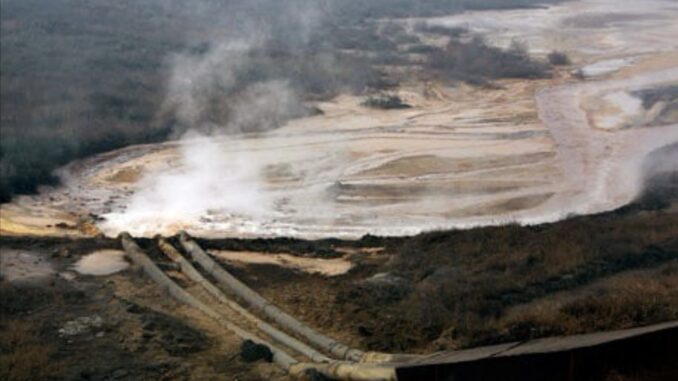
Joy and delight! Australia is to have a booming rare earths industry, mining and PROCESSING – jobs, jobs jobs! Money, money money! And we can stick it up to China, confronting its near monopoly on the industry!
The reality is something very different.
Apart from the enormous and time-consuming problems involved in establishing this industry, and in competing economically with China, there’s that other unmentionable problem – RADIOACTIVE WASTES.
Western Australia’s Lynas Rare Earths company knows all about this. They’ve had no end of trouble with their rare earths processing and its radioactive wastes. They were smart enough, had the foresight, to set up processing in another country. Lynas moved its rare earths processing to Malaysia because of Malaysia’s less stringent laws. But what they didn’t reckon with, was Malaysia’ ‘s history, and awareness of radioactive waste danger. As Lynas’ plant started operations in 2012 – in Kuala Lumpur: 10,000 marched for 13 days, rally against Lynas rare earths processing plant. Former Malaysian Prime Minister Mahathir Mohamad imposed stringent conditions on Lynas’ operations.
Malaysians remember the environmental and health disaster of Bukit Merah; where, early this century, rare earth processing left a toxic wasteland.
The Malaysian Town Still Haunted By Radioactive Pollution 30 Years After Rare Earths Refinery Shut
A longer explanation is provided in this documentary:
It is very hard to get information on Lynas’ processing operations in Malaysia. I remember that a few years ago, there was a controversy, and an Australian protest movement against Lynas’ plan to dump these wastes into an old growth forest in Malaysia. I can now find no record of this. And indeed, many news items of the controversies of Lynas’ Malaysia operations have now vanished from the internet.
But this Malaysian issue has not gone away – pollution issues and controversy over rare earth company Lynas.
If Malaysia’s history of radioactive pollution from processing of rare earths is scandalous – what about China’s history?
I know that in recent years, China has cleaned up its act on industrial pollution. But its history is shocking – with a legacy of “cancer villages.”
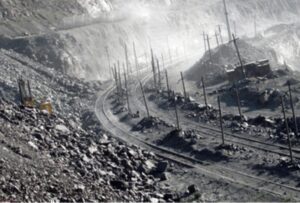
“Whole villages between the city of Baotou and the Yellow River in Inner Mongolia have been evacuated and resettled to apartment towers elsewhere after reports of high cancer rates and other health problems associated with the numerous rare earth refineries there.” (China’s legacy of radioactive pollution from rare earths processing).
Well, is everybody now pretending that to introduce rare earths processing in Australia is a good thing, no problem, it’s progress – blah blah?
This new development comes just as Australia’s government introduces its new reforms to the Environment Protection and Biodiversity Conservation Act – including the aim to simplify and speed up approvals for development. We wait to see what that entails – could it be the weakening of environmental standards?
Coincidentally, Mr Trump’s USA is changing the standards on radiation safety. An Executive Order from the White House states:
“In particular, the NRC shall reconsider reliance on the linear no-threshold (LNT) model for radiation exposure and the ‘as low as reasonably achievable’ standard, which is predicated on LNT. Those models are flawed,” – ORDERING THE REFORM OF THE NUCLEAR REGULATORY COMMISSION.
This will likely result in a significant weakening of the current standards at a time when the evidence strongly suggests that they are in need of further tightening.
The environmental movement fights on – but with a wave of enthusiasm for renewable energy development. A recent article discussed recycling of rare earths from our many digital devices. That’s an idea that seems to be ahead of its time, especially given the extreme difficulty of retrieving those elements from mobile phones, laptops etc.
Well, it’s the (?) futuristic idea of the circular economy. It fits in with those unfashionable concepts of energy efficiency, energy conservation. We used to hear about them, in the early days of action on climate change.
These concepts are anathema to our billionaire leaders, as we are all drawn into the mindless rollercoaster of ever more artificial intelligence, with its ever more energy use.
Australia, federally and in each State has strong restrictions on radioactive processes. The nuclear lobby has tried for decades to weaken or overthrow those restrictions, and to introduce radioactive waste dumping in a big way.
We’ll be pitched the story that the radioactive wastes from rare earths processing are “minor” “low key” – acceptable. Let’s not worry – after all, the whole rare earths thing is so complex, and so far into the future.
But Albanese so readily agreed with Trump, that Australia can have both the mining and the processing of rare earths – it opens the door up to radioactive waste dumping,
Meanwhile, the issue is also relevant to Australia’s agricultural industry, particularly in Victoria. Victoria being blessed with rich agricultural land, regions like the Wimmera and Gippsland could be threatened by these new industries. The nuclear lobby, too, has long salivated on the possibility of a thorium industry there, too.
It’s a sad thing – that history is forgotten, in these days of super-fast “progress’ into the Age of AI. We are being led by the nose by those techno billionaires surrounding Donald Trump – to believe that we don’t need to do much working, or thinking – as we race into this golden age, and embrace this new radioactively-polluting industry.
Keep Independent Journalism Alive – Support The AIMN
Dear Reader,
Since 2013, The Australian Independent Media Network has been a fearless voice for truth, giving public interest journalists a platform to hold power to account. From expert analysis on national and global events to uncovering issues that matter to you, we’re here because of your support.
Running an independent site isn’t cheap, and rising costs mean we need you now more than ever. Your donation – big or small – keeps our servers humming, our writers digging, and our stories free for all.
Join our community of truth-seekers. Donate via PayPal or credit card via the button below, or bank transfer [BSB: 062500; A/c no: 10495969] and help us keep shining a light.
With gratitude, The AIMN Team


Most Australians, both old and new, either have forgotten or don’t know about the Menzies Liberal Government’s acquiescence to Britain in the 1950’s that resulted in multiple atomic bomb “test” detonations at Maralinga S.A. and Monte Bello Island, W.A. ie; atomic bomb blasts on sovereign Australian soil without a popular vote from unsuspecting Australian civilians!! It took multiple decades before an un-sympathetic Britain finally agreed to clear up radioactive detritus from the detonation sites.The nuclear industry went very quiet about this, especially when it was subsequently revealed that uninformed Aboriginal settlements were within the radiation fall out zone and a nuclear contaminated cloud went over south east S.A. and the Sunraysia districts. Such matters were revealed years later. The proposed rare earth industry’s radioactive waste management process will be seen as the door opening to Australia’s nuclear energy industry waiting patiently to engineer changes to our anti-nuclear legislation. The political duopoly in Canberra will not oppose such changes because Australia will also be tied into nuclear waste management related to the AUKUS submarines.
Thank you, Mediocrates
You have hit on the central problem – the “political duopoly in Canberra”. There was a long period during which the Australian Labor Party officially opposed the nuclear industry, (though there were always some pro-nukers working away in there) From 1975 on, it was clear that the Labor politicians were, as a body, weak as water in their “nuclear-free” stance. Anthony Albanese , to give him credit over that period, was a staunch opponent of the nuclear industry.
But what happens when Albanese becomes Prime Minister? Faced with having to make a speedy decision on AUKUS nuclear submarines – what is his dilemma? To stand up for principle, or to stay in power?
This is what happens to people in power. The goal is no longer “the public good”. The goal is STAYING IN POWER- mustn’t let the Opposition portray me as weak. SO – we end up with a huge financial burden, no Australian submarines, (which would be obsolete anyway), and nuclear waste.
Thank you, Mediocrates
You have hit on the central problem – the “political duopoly in Canberra”. There was a long period during which the Australian Labor Party officially opposed the nuclear industry, (though there were always some pro-nukers working away in there) From 1975 on, it was clear that the Labor politicians were, as a body, weak as water in their “nuclear-free” stance. Anthony Albanese , to give him credit over that period, was a staunch opponent of the nuclear industry.
But what happens when Albanese becomes Prime Minister? Faced with having to make a speedy decision on AUKUS nuclear submarines – what is his dilemma? To stand up for principle, or to stay in power?
This is what happens to people in power. The goal is no longer “the public good”. The goal is STAYING IN POWER- mustn’t let the Opposition portray me as weak. SO – we end up with a huge financial burden, no Australian submarines, (which would be obsolete anyway), and nuclear waste.
The term ‘critical minerals’ is certainly a catch-all designed to ‘greenwash’ and create ambiguity in the notion of deadly dangers inherent in ‘critical mass’, ‘criticality’ and ‘super-criticality’ in the nuclear industry vs that they are ‘critical’ to the progression of high-tech products that we have become used to and are, irrespective of anything, necessary for our ongoing convenience.
It’s all been made as a necessary high-speed global tech race, but the framing neglects that it is a hasty rush of the Gung-Ho! kind.
These ‘critical minerals’ aka ‘Rare Earths’ are abundant, but where mineable are usually accompanied by known and feared carcinogens, in addition to the risks of the ‘rare earths’ themselves.
China has decades more experience in mining AND processing of these minerals. And along the way has paid a huge price in environmental, agricultural and human health catastrophes, and continues to pay hugely to dominate the industry globally, as reported July 2025 by New York Times China’s rare earth environment & clean-up. It should be noted however, that any comparisons in the article to the ‘blue sky’ cautions of the ‘West’ ought be taken with a grain of salt.
A May 2024 article in Synergy a publication of American Industrial Hygiene Association (AIHA), pulls no punches about what little is understood and accounted for clinically AND in OHSE legislation and regulation regarding the dangers and preventive / protective measures associated with the mining / transport cycles, let alone the much more hazardous processing cycles. The Hazards of Critical Minerals.
And yet, Albo and Trump are rushing into it all with gay abandon, just like in the AUKUS deal, as if it’s the geopolitical savior of the land of Oz, and the yellow brick road in the land of hope and glory – with Trump even proposing to eviscerate associated regulation.
Of course our craven desk-top warriors and war-mongers of the mainstream media wouldn’t even think of penning any objective cautionary tales. They’d rather ignore deadly waste problems, because they know their articles quickly get used to wrap up chips after which they get turfed as the garbage they are.