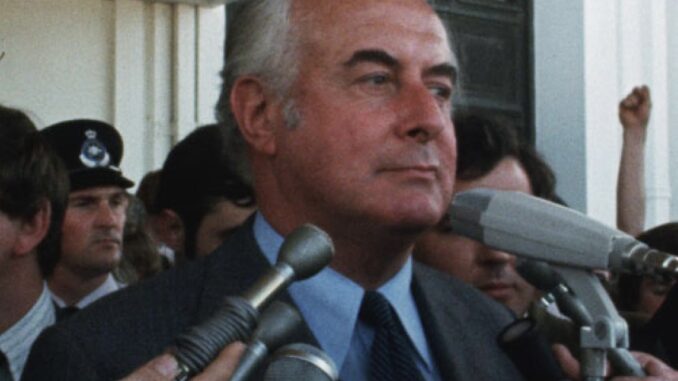
In Australian politics, the “greater good” has often been a convenient cloak for transformative and controversial decisions. From the seismic Whitlam Dismissal to the sweeping neoliberal reforms of Hawke, Keating, and beyond, the pursuit of stability and prosperity has left enduring scars on the nation’s democratic and social fabric. This article explores how these pivotal moments, justified as serving the collective interest, continue to haunt Australia’s political memory, perpetuated by a media ecosystem that shapes what we remember – and what we forget.
⚖️ The Whitlam Dismissal: The Coup for “Stability”
The 1975 constitutional crisis stands as the foundational trauma of modern Australian politics, a masterclass in how the machinery of state can be invoked for a supposed “greater good.”
The Event: In November 1975, Governor-General Sir John Kerr dismissed the elected Whitlam Labor government. The trigger was the Opposition, led by Malcolm Fraser, using its Senate majority to block the government’s supply bills, effectively starving it of money to govern.
The Justification: Fraser and his coalition argued this drastic action was necessary to resolve a political deadlock and provide stable government. They presented themselves as reluctant actors forced to act for the nation’s stability.
The Haunting Reality: I note, this was a raw political act that used the state’s reserve powers to remove a government the public had elected. Gough Whitlam’s own words echo through history: “Well may we say ‘God save the Queen’, because nothing will save the Governor-General.” The dismissal created a lingering wound in Australia’s democratic confidence, a ghost that questions the neutrality of its institutions.
🌐 The Hawke-Keating Revolution: The “Reform” That Transformed the Nation
The Hawke and Keating governments (1983-1996) oversaw a profound restructuring of the Australian economy, a project famously defended as being for the nation’s long-term “greater good.”
The Embrace of “Economic Rationalism“: This period saw the Australian Labor Party pioneer a rapprochement between social democracy and a watered-down form of free-market neoliberalism. Key policies included financial deregulation, floating the Australian dollar, tariff reductions, and the beginnings of privatisation.
The Justification: Leaders like Paul Keating argued that to avoid becoming a “banana republic,” Australia had no alternative but to embrace this agenda to become internationally competitive. The “greater good” was future prosperity in a globalised world.
The Haunting Legacy: The search results suggest a mixed and contested legacy. While these changes integrated Australia into the global economy, they came with significant social costs, including poorer wages and conditions for workers. The promise that everyone would benefit has been shadowed by rising inequality and the erosion of worker security, a debt that continues to be paid by segments of the population today.
⛓️ The Neoliberal Ascendancy: Hardening the Doctrine
The principles embraced by Hawke and Keating were hardened under subsequent conservative governments, which more fully adopted the neoliberal playbook of Reagan and Thatcher.
John Howard’s Tenure (1996-2007): While the specific search results do not detail Howard’s embrace of Reagan and Thatcher, his government’s prolonged tenure is widely understood to have entrenched neoliberal policies, focusing on industrial relations reform, tax changes, and a rhetoric of “self-reliance”.
The Weaponisation of Welfare: Neoliberal think tanks and Coalition governments have increasingly advocated for a conditional welfare state, arguing that adequate social security payments create dependency. This ideology has driven policies like Work for the Dole and compulsory income management, which are justified as being for the “greater good” of encouraging people into work.
The Haunting Reality: As critics point out, these policies are “rarely based on research evidence.” Instead, they often create shame and stigma, ignoring the structural barriers to employment and increasing the demand for crisis services like homelessness programs and mental health treatment. The “greater good” here masks a punitive approach to the most vulnerable.
🗞️ The Murdoch Media: The Engine of Forgetting
No analysis of political power in Australia is complete without acknowledging the role of the media, particularly the Murdoch empire.
Shaping the Narrative: The Murdoch-owned press, including The Australian newspaper, is a powerful advocate for neoliberal orthodoxy. It consistently promotes “small government” rhetoric, attacks welfare measures, and champions “incentives to work” while often ignoring evidence of policy harm.
The Greater Good of the Market: This media ecosystem tirelessly promotes the idea that market values are synonymous with the national interest, creating a narrative that makes alternative policies seem unviable or radical.
This media dominance is a primary tool for ensuring the public “forgets” the broken promises and human costs of past policies, allowing the cycle to repeat.
Rinse and repeat. Rinse and repeat.
Some of us remember.
Keep Independent Journalism Alive – Support The AIMN
Dear Reader,
Since 2013, The Australian Independent Media Network has been a fearless voice for truth, giving public interest journalists a platform to hold power to account. From expert analysis on national and global events to uncovering issues that matter to you, we’re here because of your support.
Running an independent site isn’t cheap, and rising costs mean we need you now more than ever. Your donation – big or small – keeps our servers humming, our writers digging, and our stories free for all.
Join our community of truth-seekers. Donate via PayPal or credit card via the button below, or bank transfer [BSB: 062500; A/c no: 10495969] and help us keep shining a light.
With gratitude, The AIMN Team


Having read and having often studied, at least generally, all forms of government, histories, systems, social and economic areas, I declare that Murdochery is waste, error and often deliberate filth in intent, which is coercive profitable power positioning to suit the bent owner. Donors and fellow travellers, old networking types, are in that mix of unthinking and uncaring right wing ideologues. It stinks, eternally.
I won’t go [ast “The Whitlam Dismissal” which was wrong in every way. What we had was a correctly and legally elected people’s government, dismissed by the Crown!! High lighting the fact that we are not a Democracy, rather we are a Monarchy. Nothing has changed and this could occur again.
The cause was the decision of the Liberal/National opposition in breaking with tradition and blocking supply.
Until such time as our electoral system is changed, there is no pint in the people voting, because if the Crown does not like the electorates decision, our elected government can always be dismissed.
This isn’t relevant to this thread, but…
A number of media outlets are promoting a bogan/racist narrative about St Vincent’s Hospital providing immediate/priority care to indigenous people.
I’ve posted a number of times in reply (on their Facebook articles) to the point where it seems I’ve been blocked by some.
Perhaps a few here might like to also push back on the crap.
Racist bogans should not be respected
AC, Carol told me about that earlier. We expect it’s rubbish, but as you suggest, worth a pushback.
AC, I asked Grok: A number of media outlets are promoting a bogan/racist narrative about St Vincent’s Hospital providing immediate/priority care to indigenous people. Is that verifiable?
I would have been happy with a “yes” or “no”, but here’s the answer:
Yes, the claim is verifiable: St Vincent’s Hospital Melbourne (part of St Vincent’s Health) implemented a policy in April 2024 that assigns all Aboriginal and Torres Strait Islander (Indigenous) patients presenting to its emergency department (ED) a minimum triage category of three (urgent), requiring them to be seen by a clinician within 30 minutes of arrival. This can result in them being prioritized over non-Indigenous patients in lower categories (four: semi-urgent, or five: non-urgent), though the hospital maintains that triage still prioritizes the clinically sickest patients first and that the policy has not negatively impacted overall ED wait times or flow.
Key Verifiable Details
• Policy Rationale: Internal research at the hospital found that Indigenous patients were waiting longer on average to be seen than non-Indigenous patients and were more likely to leave without completing treatment (a national issue, with Indigenous “incomplete treatment” rates at ~8.6% vs. 6.1% for others in 2019 data). The goal is to improve engagement and health outcomes, as early treatment reduces risks like readmission or death. Indigenous patients make up ~5% of ED presentations at St Vincent’s—the highest rate among Victorian hospitals.
• Outcomes: Post-implementation, category three wait times for Indigenous and non-Indigenous patients are now comparable (a ~4-minute difference), and the hospital was nominated for a Victorian Public Healthcare Award for this. No evidence shows increased waits for non-Indigenous patients; in fact, overall ED efficiency has improved.
• Implementation: This builds on broader Indigenous health initiatives at St Vincent’s (e.g., Aboriginal Health Units in Melbourne and Sydney, flexi-clinics to reduce incomplete treatments). Similar efforts exist elsewhere, like in Western Australia for pediatric ear surgeries.
Media Coverage and the “Bogan/Racist” Narrative
Multiple outlets, particularly conservative-leaning ones, have amplified the story since late October 2025 (initially broken by Herald Sun on October 27), framing it as discriminatory “fast-tracking” based on race rather than need. This has fueled online backlash, including polls (e.g., 95% opposition in a Herald Sun reader survey) and accusations of “reverse racism” or “dividing society.” Coverage often ties it to Victoria’s proposed Indigenous treaty legislation, suggesting it’s a preview of race-based policies.
• Examples of Coverage:
• Daily Mail (Oct 28): “Hospital orders staff to prioritise Aboriginal patients… sparking blunt response from Indigenous leader” (Warren Mundine called it “not very good for reconciliation”).
• Noticer.news (Oct 27): “Major hospital fast-tracks aboriginal patients over others,” labeling it “discriminatory and divisive.”
• Human Events (Oct 28): “Indigenous patients to be treated FIRST… to counter bias,” quoting critics like U.S. podcaster Ben Shapiro (“idiot policies”).
• 3AW Radio (Oct 28): Interview with Mundine criticizing it as undermining triage equality.
• Other mentions: Mirage News (Family First party condemning it as “colour-blind” violation); social media/X posts echoing “racist” outrage, e.g., users calling Victorian Premier Jacinta Allan a “full blown racist” for defending it as a “good example” of improving outcomes.
Defenders, including the hospital, Health Minister Mary-Anne Thomas’s office, and Premier Allan, emphasize it’s evidence-based equity work to address systemic biases (e.g., historical distrust of hospitals leading to higher “did not wait” rates). Shadow Health Minister Georgie Crozier (Liberal) called it discriminatory, linking it to treaty fears.
Broader Context
This isn’t isolated—Australian hospitals have long targeted Indigenous health disparities (e.g., Closing the Gap initiatives). Similar policies at St Vincent’s Sydney reduced incomplete treatments from 19.5% to 1.6% via flexi-clinics, with no harm to other patients. The current controversy appears amplified by cultural/political tensions post-Voice referendum, with media (and social) narratives leaning into populist “bogan” (working-class resentful) or explicitly racist angles to drive clicks/engagement. No evidence supports claims of “immediate” care overriding critical cases; it’s a targeted adjustment within standard Australasian Triage Scale rules.
Michael, I don’t doubt the accuracy of your comment, so thank you for your post. I am of the belief that one is either an Australian or they are not, having said that when it comes to health, accident and injury, medical treatment should be based on the degree of urgency. Medical treatment in a public hospital should not be compromised by money, ethnicity, or religion, the only criteria should be NEED.
Actions such as this are the cause of the great divide and any government, political or religious organisation the supports or promote such a system needs to be hung by the balls.
Thanks for that follow up Michael.
I hadn’t researched the background, but it doesn’t surprise me.
My main contention is that indigenous people have a life expectancy about a decade shorter than the average Australian
Understanding that simple fact is proof that our health system has failed them.
While Australia ranks 6th, indigenous life expectancy would rank somewhere around 120th.
This is absolutely shameful, and if a hospital has been able to see its way clear to improve medical treatment, they deserve a huge thanks.
Loud mouth flag waving racist bogans annoy the hell out of me.
Our current national hero is Jenny Hocking who has persisted with retrieving documentation relating to “The Dismissal”. Her quest for the truth is being obstructed by the National Archives who took 13 years to release (heavily redacted) evidence that proves the iniquitous activities of Sir John Kerr and the Monarchy in removing Gough Whitlam from office. Recent revelations obtained from Canadian archives not only support such assertions but prove beyond doubt that Australia’s National Archives are not immune from political and Monarchic control. It is 50 years since Whitlam was forced from office – we are not children – we are entitled to know the truth of this matter.