By James Moore
“The flower that smiles today, tomorrow dies; all that we wish to stay, tempts and then flies.” (Percy Bysshe Shelley).
We were driving a road down the bottomlands of cotton fields and pecan groves next to the Mississippi River not too far south of Memphis. Whenever Daddy had enough money for gas, which was not often, he pointed the old Studebaker away from Michigan and toward his homeland. Although I was only eight-years-old, I remember this trip with great detail because it was the first time I had ever encountered institutionalized racism.
My father pulled into a Deep Rock filling station, pumped gas, and told my brother and I to use the restroom while he finished. My brother followed me to the corner of the building where Daddy had pointed. A small metal sign on the door said, “White Men.” Down at the end of the wall, a crude, hand-painted arrow pointed around the corner above the word, “Colored.” I went out back and discovered a single restroom, door open, filth and excrement on the floor, and smell of sewage rising in my direction. I had never even imagined such a thing. I had to ask questions.
“Daddy, why can’t colored people use the clean bathroom with us?”
We were barely back on the road, turning toward Philadelphia, the town where so much racial hatred and violence and death was to destroy lives. Daddy did not hesitate to respond.
“Because they’s different from us, buddy boy. They ain’t clean or smart like white people.”
“Who said that, Daddy?”
“Hell, it’s a known fact. It’s why they’s laws to let us live apart from each other.”
Daddy’s southern drawl was an attenuated baritone and it gave authority even to his most uneducated assertions, especially in my boyhood. I had already heard him use epithets to describe Black people but I did not know why. Our small community of Dixie Diaspora, poor white Southerners come north to work the factories, had managed to segregate ourselves from Blacks. There was not a single Black student in my high school, which thousands attended, when I graduated and left for university.
Daddy was steeped in the racism of Mississippi. When he discovered years later I had dated a black girl briefly in college, he explained neither nature nor god had intended such a thing.
“Hell, buddy boy,” he said. “You don’t see horses matin’ up with dogs, do ya? Or squirrels and birds havin’ sex? Chickens don’t lay eggs after bein’ with raccoons. They’s things was never meant to be.”
My father was taught his racism, like every young White Mississippi boy of his generation, and he was a damn fine student. His brother, who became a county district attorney and a state senator, sent his children to a private school to avoid exposure to contemporaries with darker skin. The Civil Rights movement in his family did not change their convictions; instead, it only inflamed their burning commitments to a profound and false difference between the races. Generations of lynchings and murders of people who looked and thought differently did not truly change the minds of Mississippians, either, and the historical scarring across our culture is still visible.
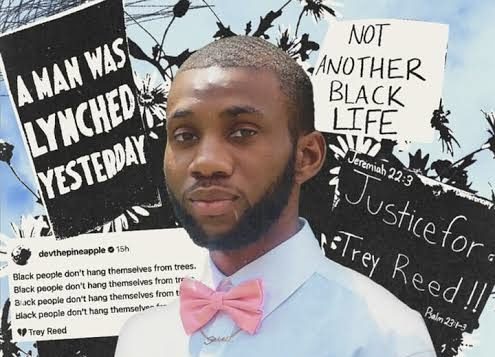
These are just a few of the reasons skepticism is required when authorities in Cleveland, Mississippi say Demartravion “Trey” Reed committed suicide by hanging himself from a tree on the campus of Delta State University. Blacks are not known to hang themselves. When it has happened, there have tended to be Whites involved, angry, racist Whites. The long, slow geography of our racial history seeds doubt when a Mississippi coroner says there were no lacerations, contusions, compound fractures, or other injuries consistent with assault, no foul play, authorities said. Another, much different story, was, however, already emerging.
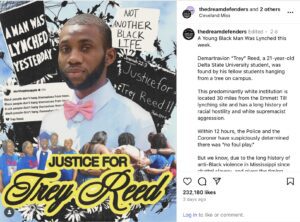
Words mean different things in different mouths. Reed’s family heard from an alternate office on a contradictory timeline and were initially told their son was found in his dorm room. Lawmen later claimed he was discovered outside near the pickle ball courts, hanging by the neck from a tree. That kind of discrepancy might be a small clerical error in another state, but not in Mississippi; it is a crack through which memory, history, and fear rush. The family did what other families have long had to do when answers feel insufficient. First, they hired civil rights attorney Ben Crump, and then asked for available video, which investigators say exists, and they demanded an independent autopsy. Requesting the FBI and the Department of Justice to intervene, which they also did, is not a response born of paranoia, either, but a reaction to precedent. Mississippi institutions, and most of the South, have historically treated Black grief as a problem to be managed rather than a plea to be answered.
There is an obvious reason a Black’s body hanging from a tree in Mississippi cannot be processed as private, isolated tragedy; it is a symbol with lineage. If you want to understand why a Black community and family will not accept a neat, early conclusion, take a moment and contemplate memory. Mississippi is the place that taught the nation the lesson of lynching and that a black young man can be murdered just for looking at a white girl. That is not merely an historical exhibit, it is a fact that lives in the bones of that state. When the sight and the setting of Reed’s death are the same as the terror that once enforced racial order, people hear echoes. The first story offered by officials is not always the exact, or even the whole, truth. The institutions of power have not built a reputation of trust.
But it is not just Mississippi. President Obama’s ascension had many analysts arguing America had finally arrived in a post-racial epoch. The evidence of a Black man in the White House did not mean what they insisted it did, however. Instead, we have, in fact, landed in a post-truth environment, where people believe lies because they comfort and reinforce their prejudices. Truth is rarely produced any more in the U.S. in a transparent manner where any honest person can see, and not in a way that comforts those already in power. A fine example is the radical right-wing talk show host Charlie Kirk, who was the kind of racist who might have made even my father blush. While he is being lionized by leaders of businesses and the American government, recordings of his racial spewings are circulating the web and correcting the record.
The simplest explanation is often the most likely, but how does any Black family living in Mississippi accept official law enforcement’s version of events in a state with such a history? They are also living in a nation where blatant racism has stepped proudly out of darkness and has decided to celebrate as cultural heroes its practitioners like Charlie Kirk. People who have never had their trust betrayed, especially Whites, may struggle to understand the Reed family’s posture of suspicion, but it is simply memory armored for protection. When a death like Reed’s arrives wrapped in the imagery and legacy of a lynching, the demand for an independent autopsy, the demand to see the footage investigators say they have, is not melodrama. It is survival logic.
The lament of this moment, for me, is not just about the loss of a young man’s life, whether by suicide or assault. The sadness grows from the facts of what we have become as Americans when compassion for one life is filtered through the lens of race and status. A white public figure’s death is often met with immediate assumption of external violence, civic mourning and institutional affirmation; a Black life found swinging from a limb is dealt with by both official calm and communal alarm. That double standard is not a quirk: it is still a raw, gaping wound.
The antecedents are plainly obvious that confront the Reed family as powerfully as their son’s death. Mississippi is not just a state on the map but is also a ledger of American racial violence, which includes lynchings, terror, and a long history of official indifference or obfuscation. When, over and over, families must litigate grief to learn a fuller truth, distrust calcifies into an informed ethic that knows the first, convenient answer tends to not be the final one. Full transparency is the only method to honor public mourning with public accountability.
Reed’s death has served as a catalyst to remind Americans of a broad, social ache we have still not resolved, but it also makes understandable a family’s refusal to accept tidy answers from officialdom. When parents must beg for footage, and autopsy results are announced before they are even consulted, and inconsistent statements multiply, we have to acknowledge we are still a nation where the presumption of victimhood or innocence is negotiated not only by the facts of a case but by the biography of the person whose life ended. We grieve Trey Reed because he was a son and a student with a future but also because his death reopens a national bruise. We grieve because the American story still asks Black families to prove the value of their dead, to litigate truth from silence, and demand that their sorrow be met with honesty rather than administrative smoothing.
The truth of Trey Reed’s end, however it came about, has to be as urgently cared for as the facts about Charlie Kirk’s life. Political assassination is as vile as racial animus, and we have arrived at a strange place in U.S. history when we find ourselves hoping that there is proof a young man committed suicide. We are still using old, exhausted scripts to measure our democracy and decency, and they just do not work, and maybe never have. The entire world now knows what we have become but we have in our hands the power to create a better thing to be.
But who still thinks we can we accomplish that?
This article was originally published on Texas to the world.

James Moore is the New York Times bestselling author of “Bush’s Brain: How Karl Rove Made George W. Bush Presidential,” three other books on Bush and former Texas Governor Rick Perry, as well as two novels, and a biography entitled, “Give Back the Light,” on a famed eye surgeon and inventor. Mr. Moore has been honored with an Emmy from the National Academy of Television Arts and Sciences for his documentary work and is a former TV news correspondent who has traveled extensively on every presidential campaign since 1976.
He has been a retained on-air political analyst for MSNBC and has appeared on Morning Edition on National Public Radio, NBC Nightly News, Last Word with Lawrence O’Donnell, CBS Evening News, CNN, Real Time with Bill Maher, and Hardball with Chris Matthews, among numerous other programs. Mr. Moore’s written political and media analyses have been published at CNN, Boston Globe, L.A. Times, Guardian of London, Sunday Independent of London, Salon, Financial Times of London, Huffington Post, and numerous other outlets. He also appeared as an expert on presidential politics in the highest-grossing documentary film of all time, Fahrenheit 911, (not related to the film’s producer Michael Moore).
His other honors include the Dartmouth College National Media Award for Economic Understanding, the Edward R. Murrow Award from the Radio Television News Directors’ Association, the Individual Broadcast Achievement Award from the Texas Headliners Foundation, and a Gold Medal for Script Writing from the Houston International Film Festival. He was frequently named best reporter in Texas by the AP, UPI, and the Houston Press Club. The film produced from his book “Bush’s Brain” premiered at The Cannes Film Festival prior to a successful 30-city theater run in the U.S.
Mr. Moore has reported on the major stories and historical events of our time, which have ranged from Iran-Contra to the Waco standoff, the Oklahoma City bombing, the border immigration crisis, and other headlining events. His journalism has put him in Cuba, Central America, Mexico, Australia, Canada, the UK, and most of Europe, interviewing figures as diverse as Fidel Castro and Willie Nelson. He has been writing about Texas politics, culture, and history since 1975, and continues with political opinion pieces for CNN and regularly at his Substack newsletter: “Texas to the World.”
Dear reader, we need your support
Independent sites such as The AIMN provide a platform for public interest journalists. From its humble beginning in January 2013, The AIMN has grown into one of the most trusted and popular independent media organisations.
One of the reasons we have succeeded has been due to the support we receive from our readers through their financial contributions.
With increasing costs to maintain The AIMN, we need this continued support.
Your donation – large or small – to help with the running costs of this site will be greatly appreciated.
You can donate through PayPal or credit card via the button below, or donate via bank transfer: BSB: 062500; A/c no: 10495969

A powerful and compelling read, James.
Racism in the USA is a living, growing culture, even though the few indigenous are suppressed and paid off or down. Afican Americans and Hispano-Americans are there, plus other scraps and offcuts. From Abraham to Zion, superstitions and myths, fears, deceits, beliefs, we can find enough mental garbage to choke an enquiring mind. “Democracy” remains an elusive concept, a good idea, a generally abused term and in today’s USA under President Mal Odorous-Stench, things rapidly worsen.