Chapter 14: Comparisons – Jim Crow in the U.S. South
The Origins of Jim Crow
After the U.S. Civil War (1861–65) abolished slavery, white southern states introduced a new system of control: Jim Crow laws. From the 1870s through the mid-20th century, these laws enforced racial segregation across nearly every aspect of public and private life.
“Separate but equal” was the official justification. In practice, it was separate and unequal. African Americans were barred from the same schools, restaurants, transport, and jobs as whites. Violence and terror – especially lynching – enforced this racial order.
What Jim Crow Looked Like
In daily life, Jim Crow meant:
- Schools: Separate schools for Black children, underfunded and inferior.
- Transport: Black passengers forced to sit at the back of buses and trains.
- Housing: Neighbourhoods divided by race, with discriminatory laws and lending practices.
- Voting rights: Poll taxes, literacy tests, and intimidation kept many Black citizens from voting.
- Public facilities: Parks, swimming pools, even water fountains were racially segregated.
The system was explicit, visible, and backed by law. Everyone knew the colour line, and crossing it was dangerous.
Violence as Enforcement
Jim Crow was not maintained by law alone. It was enforced through violence:
- Lynchings: Thousands of African Americans were murdered by mobs, often publicly, as a warning to others.
- Police brutality: Law enforcement upheld segregation with beatings and arrests.
- Terror groups: The Ku Klux Klan and others carried out intimidation campaigns, burning crosses and targeting activists.
This combination of law and terror ensured Black Americans remained politically, economically, and socially marginalised.
The Australian Parallels
Australia never had formal “Jim Crow laws” written into a federal constitution. But in practice, the parallels are striking:
- Schools: Aboriginal children excluded or segregated, often until the 1960s.
- Housing: Families forced into reserves or fringe camps, segregated from towns.
- Hospitals: Aboriginal patients denied admission or confined to separate wards.
- Employment: Permit systems and stolen wages replicated economic control.
- Voting rights: Many Aboriginal and Torres Strait Islander people were denied the vote until the 1960s.
The difference lay in language. Where America openly legislated segregation, Australia cloaked it in the language of “protection” and “welfare.” The effect – exclusion and inequality – was much the same.
One Key Difference: Visibility
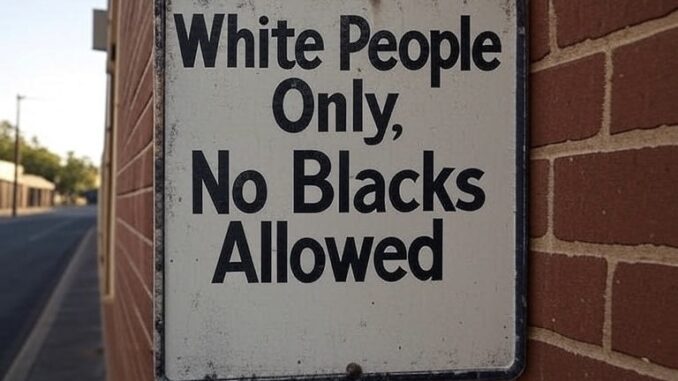
In the U.S., segregation was highly visible: “Whites Only” signs, separate water fountains, and explicit laws. In Australia, segregation often operated through unwritten rules:
A cinema owner refusing Aboriginal patrons, a pub serving only white customers, and a teacher quietly turning away Aboriginal children at the school gates.
This invisibility allowed many Australians to deny segregation existed at all – a denial that persists today.
Civil Rights Struggles Compared
In both countries, civil rights movements emerged to challenge segregation:
- U.S.: Martin Luther King Jr., Rosa Parks, and countless grassroots activists led the struggle, culminating in the Civil Rights Act (1964) and Voting Rights Act (1965).
- Australia: Aboriginal activists such as William Cooper, Jack Patten, Pearl Gibbs, and later the Freedom Ride (1965, led by Charles Perkins) exposed segregation and fought for equal rights.
Both movements were met with resistance, but both showed the power of collective action to dismantle unjust systems.
Why These Comparisons Matter
Comparing Australia to Jim Crow America is not about equating experiences but about recognising patterns:
- Colonisation everywhere created racial orders to maintain power.
- Segregation, whether overt or subtle, was a tool of control.
- Violence and humiliation were used to enforce inequality.
For Australians, the comparison matters because it shatters the myth of “at least we weren’t like America.” In truth, Australia had its own Jim Crow – it just didn’t call it that.
Where This Leads
The United States was not alone in building a system of racial separation. South Africa created apartheid, a regime of control so infamous it became synonymous with racial injustice.
To fully understand Australia’s place in the global story of colonisation, we turn next to apartheid – and the unsettling parallels between South Africa and Australia.
Continued tomorrow…
Link to Part 13:
From Ignorance to Understanding: Facing the Truth of Colonisation (Part 13)
Link to Part 15:
From Ignorance to Understanding: Facing the Truth of Colonisation (Part 15)
Dear reader, we need your support
Independent sites such as The AIMN provide a platform for public interest journalists. From its humble beginning in January 2013, The AIMN has grown into one of the most trusted and popular independent media organisations.
One of the reasons we have succeeded has been due to the support we receive from our readers through their financial contributions.
With increasing costs to maintain The AIMN, we need this continued support.
Your donation – large or small – to help with the running costs of this site will be greatly appreciated.
You can donate through PayPal or credit card via the button below, or donate via bank transfer: BSB: 062500; A/c no: 10495969


To me the anti woke brigands here in Oz ,have hijacked the original use of being “woke “