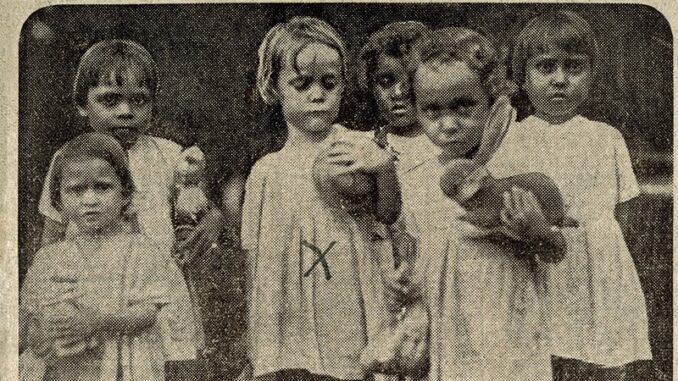
Chapter 12: Assimilation and the Stolen Generations
From “Protection” to “Assimilation”
By the early 20th century, colonial authorities had shifted their policy language once again. Where the 19th century had emphasised “protection,” the 20th century turned to assimilation.
The idea was simple and devastating: Aboriginal and Torres Strait Islander peoples were not expected to survive as distinct nations. Governments believed that by removing children, banning culture, and enforcing European norms, Aboriginal identity would eventually disappear.
Assimilation was not just an ideology. It became government policy, carried out through missions, reserves, laws, and the forced removal of children – now known as the Stolen Generations.
The Removal of Children
From the late 1800s through to the 1970s, tens of thousands of Aboriginal and Torres Strait Islander children were forcibly taken from their families.
- Targets: Children of mixed descent were particularly singled out, under the belief that they could be “absorbed” into white society. But full-descent children were also taken.
- Methods: Police and welfare officers arrived without warning, often in the dead of night. Children were seized from homes, camps, and even hospitals. Parents had no legal recourse.
- Destinations: Children were sent to missions, orphanages, or fostered/adopted into white families. Siblings were often separated, never to see each other again.
This was not isolated or accidental. It was systemic, organised, and widespread across every state and territory.
Justifications
Authorities claimed these removals were in the “best interests” of the child. Reports and parliamentary debates reveal the underlying motives:
- Eradication of identity: Officials wrote openly about “breeding out the colour.”
- Labour needs: Many children were trained for domestic service or farm work, feeding into the same stolen wages system.
- Cultural superiority: Aboriginal families were deemed unfit simply because they were Aboriginal.
The removals were not about welfare. They were about eliminating Aboriginal people as distinct peoples.
Life for the Stolen Generations
Children taken from their families endured profound trauma:
- Institutional life: Missions and orphanages imposed harsh discipline, poor food, and compulsory Christianity.
- Loss of identity: Children were forbidden to speak their languages or learn their culture. Many grew up not knowing their real names, families, or Country.
- Abuse: Many suffered physical, emotional, and sexual abuse in institutions or foster homes.
- Disconnection: When they became adults, many could not find their families again. Entire family trees were broken.
For those who survived, the wounds never healed. For those who did not, their stories remain untold.
Intergenerational Trauma
The trauma of child removal did not end with the children themselves. It rippled through generations.
Parents and grandparents left grieving, often never recovering. Survivors grew up without parenting models, carrying unresolved pain into their own families. Communities were fractured, kinship networks disrupted, cultural knowledge lost.
Cycles of disconnection contributed to ongoing disadvantage, mistrust of government, and social challenges.
This trauma is not “in the past.” It is alive in families today.
Voices of the Stolen
When the Bringing Them Home Report was released in 1997, it collected testimonies from Stolen Generations survivors. The stories were harrowing:
- “They took us from Mum at the riverbank. She was screaming and they hit her with a stick.”
- “I grew up thinking I was nothing. I didn’t belong anywhere.”
- “When I found my family again, I was a stranger to them. I didn’t know my language or law.”
These voices make clear: the Stolen Generations were not an accident of misguided policy. They were the lived reality of systemic assimilation.
Denial and Resistance
For decades, governments denied that children had been stolen. When the Bringing Them Home Report recommended apologies and reparations, many politicians resisted.
Some insisted removals were acts of “care,” not cruelty.
Others argued that apologising would create legal liability.
For many Aboriginal and Torres Strait Islander families, this denial was a second wound: being told their suffering wasn’t real.
Resistance, however, continued. Survivors spoke out, communities organised, and campaigns for truth-telling grew stronger.
National Apology
On 13 February 2008, Prime Minister Kevin Rudd delivered the National Apology to the Stolen Generations. The speech was a turning point, acknowledging the pain and injustice of child removals.
For many, it was a moment of recognition and healing. For others, it was bittersweet – too late for those who had already passed, and not accompanied by full reparations.
The apology mattered, but it did not close the book. It opened a new chapter in the fight for justice.
Why This Matters Today
When people say, “That was a long time ago,” the Stolen Generations show otherwise. Many survivors are still alive today. Their children and grandchildren live with the consequences.
The story of the Stolen Generations explains why Aboriginal and Torres Strait Islander families remain wary of child protection services today, and why rates of child removal remain disproportionately high.
Assimilation was not simply an old policy. Its shadows stretch into the present.
Where This Leads
Assimilation and child removal were underpinned by the same logic as Jim Crow in the United States and apartheid in South Africa: segregation, control, and denial of humanity.
The next chapters will turn outward again, drawing these global parallels and showing how Australia’s system of segregation mirrored – and in some ways exceeded – other forms of racial control around the world.
Continued tomorrow…
Link to Part 11:
From Ignorance to Understanding: Facing the Truth of Colonisation (Part 11)
Link to Part 13:
From Ignorance to Understanding: Facing the Truth of Colonisation (Part 13)
Dear reader, we need your support
Independent sites such as The AIMN provide a platform for public interest journalists. From its humble beginning in January 2013, The AIMN has grown into one of the most trusted and popular independent media organisations.
One of the reasons we have succeeded has been due to the support we receive from our readers through their financial contributions.
With increasing costs to maintain The AIMN, we need this continued support.
Your donation – large or small – to help with the running costs of this site will be greatly appreciated.
You can donate through PayPal or credit card via the button below, or donate via bank transfer: BSB: 062500; A/c no: 10495969


Children are still being removed and placed in institutions. The excuses have changed but the underlying racism hasn’t.