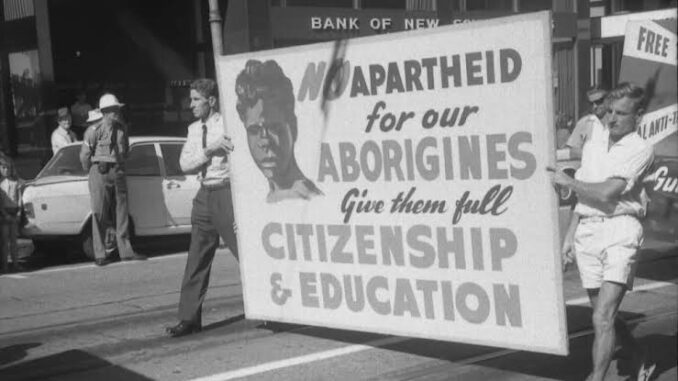
Chapter 13: Segregation in Australia – Jim Crow Without the Name
A System Without Its Own Name
In the United States, racial segregation was codified under the infamous Jim Crow laws. In South Africa, it was called apartheid. Australia rarely gave its segregation a single name – but the practices were just as real.
From the late 19th to mid-20th century, Aboriginal and Torres Strait Islander peoples lived under a web of laws, policies, and unwritten rules that separated them from the rest of society. It was segregation by another name, enforced not only through law but through daily humiliation and exclusion.
The “Colour Line” in Daily Life
Across Australia, Aboriginal and Torres Strait Islander peoples were barred – legally or informally – from spaces that white Australians took for granted.
Schools: In many towns, Aboriginal children were excluded from public schools, or placed in separate classrooms. Some were allowed only if parents agreed to stop speaking language at home.
Housing: Reserves and fringe camps were common, with families forced to live on the outskirts of towns, often in poor conditions without running water or sanitation.
Hospitals: In some hospitals, Aboriginal patients were segregated to separate wards or denied access altogether.
Cinemas and pubs: “Colour bars” meant Aboriginal people were refused entry or forced to sit apart from white patrons.
Swimming pools: In towns across Australia, Aboriginal children were barred from public pools, sometimes until the 1960s or 70s.
These practices were rarely written into national law, but they were enforced through local regulations, state acts, and community custom.
The “Protection” Laws as Segregation
State-based “Protection Acts” (Queensland 1897, WA 1905, NSW 1909, etc.) gave governments extraordinary powers over Aboriginal people.
Residence: People were confined to reserves and missions, often far from their traditional lands. Leaving required official permission.
Marriage: Officials could approve or deny marriages, particularly between Aboriginal and non-Aboriginal people.
Employment: Aboriginal people could only work with permits, and wages were controlled by Protectors.
Movement: Police could enforce curfews or forcibly remove people from towns.
These laws created a parallel system of citizenship – one for white Australians, another for Aboriginal and Torres Strait Islander peoples.
Everyday Racism and Policing
Beyond laws, segregation was reinforced by policing and social custom:
- Aboriginal people were often told to leave town before sunset – the so-called “sundown laws.”
- Police patrolled reserves and fringe camps, enforcing curfews and movement restrictions.
- Local businesses could (and often did) refuse service.
This policing was not about crime; it was about enforcing a racial order.
Segregation and Sport
Even in sport – often celebrated as the “great equaliser” in Australian culture – segregation was present.
Aboriginal athletes were barred from some competitions or forced to play in separate teams.
Exceptional talents, like Doug Nicholls (later Governor of South Australia), faced exclusion and humiliation before slowly breaking barriers.
For many, sport was both a site of exclusion and resistance, where Aboriginal excellence challenged racist assumptions.
How Australia Denied Its Own Jim Crow
Unlike the U.S., Australia rarely admitted it had segregation. This denial served two purposes:
- International image: Australia could present itself as a “fair” nation, avoiding the stigma that clung to apartheid South Africa or Jim Crow America.
- Internal myth: Australians could cling to the belief in the “fair go,” while ignoring the daily realities of racial separation.
The result was that Aboriginal and Torres Strait Islander segregation was less visible in law, but no less destructive in practice.
The Human Cost
Segregation meant:
- Children growing up humiliated and excluded.
- Families forced into poverty on the margins of towns.
- Generations denied equal access to education, healthcare, housing, and basic dignity.
- Communities constantly reminded that they were considered “less than.”
These were not small inconveniences. They were barriers deliberately designed to enforce inequality.
Resistance and Cracks in the System
As with every form of oppression, Aboriginal and Torres Strait Islander peoples resisted:
- Parents fought for their children’s right to attend schools.
- Families broke curfews and challenged bans.
- Activists in the 1930s and beyond (such as William Cooper, Jack Patten, and Pearl Gibbs) denounced segregation publicly.
These acts of defiance laid the groundwork for the civil rights struggles of the 1960s and the 1967 Referendum, which finally recognised Aboriginal people in the census and allowed the federal government to legislate on their behalf.
Why This Matters Today
Segregation may not be written into laws anymore, but its legacy remains:
- Health gaps rooted in decades of exclusion from hospitals.
- Educational inequality flowing from past exclusion from schools.
- Intergenerational poverty tied to enforced marginalisation.
When Australians talk about a “level playing field,” they must remember: for Aboriginal and Torres Strait Islander peoples, the game was rigged from the start.
Where This Leads
Australia’s system of segregation was home-grown, but it mirrored patterns seen elsewhere. To understand it fully, we need to place it alongside other global systems of racial control: Jim Crow in the United States, apartheid in South Africa, and assimilation policies in Canada and New Zealand.
That is where we turn next.
Continued tomorrow…
Link to Part 12:
From Ignorance to Understanding: Facing the Truth of Colonisation (Part 12)
Link to Part 14:
From Ignorance to Understanding: Facing the Truth of Colonisation (Part 14)
Dear reader, we need your support
Independent sites such as The AIMN provide a platform for public interest journalists. From its humble beginning in January 2013, The AIMN has grown into one of the most trusted and popular independent media organisations.
One of the reasons we have succeeded has been due to the support we receive from our readers through their financial contributions.
With increasing costs to maintain The AIMN, we need this continued support.
Your donation – large or small – to help with the running costs of this site will be greatly appreciated.
You can donate through PayPal or credit card via the button below, or donate via bank transfer: BSB: 062500; A/c no: 10495969


Lachlan; an excellent series – this one is well presented and should be mandatory reading for secondary school students who are at a formative stage of their perceptions of community. Too many have forgotten the travesty of the White Australia Policy. However, the irrational notion of white supremacy is universal and international. The recent riotous marches in Australia reveal the shameful side of human behaviour that prefers to create and accentuate difference as a justification for opposition. I am concerned that the anti-immigration elements of these protests will damage the harmonious relationship that most Anglo-Australians have with their successfully settled multi-ethnic neighbours. There – I have already suggested an unintended difference but I do so only to emphasize that the principle of “right relationships” when responsibly applied leads to harmonious co-existence and is independent of origins and ethnicities.
Thank you so much, Mediocrates. I’m learning more myself as I go -researching, gathering, and then arranging the information in a way that makes sense has helped me better understand things than I did before.
That’s really the whole purpose of this series: to provide meaningful, accessible insights for those who may not yet be aware of what has gone on (and what is still going on). Your comment tells me the message is landing, and I’m very grateful for that. Thanks for getting it! 😊
Lachlan, I asked my ‘brother’ if he gets upset/angry over all the racism he faces up north in South Australia.
“Not at all,” he replied.
That surprised me. “Why not?” I asked.
“I don’t feel any anger towards them. Instead, I feel pity. Pity for them for not knowing about our beautiful culture. It’s not their fault they’ve never been told. That’s where I come in: Instead of responding with anger, I respond with a kind word. A kind word about what they’re missing out on. Education is more powerful than a fist.”
This series is also an education.
Thanks Michael. Beautiful words 😊
Regarding segregation in hospitals, in the 1980s, my mother-in-law was in Canberra Hospital and was very upset because the other person in the two-bed ward was an Aboriginal woman. Mother-in-law took it as a personal insult, and was convinced she was being seen as of no account.
Meanwhile, I was quite excited by the brush with fame, because her room mate was the noted poet, Kath Walker.