The Racist Heritage of Colonial Australia
There has been much discussion in Australia about racism and the way it continues to manifest itself in our political and social landscape. Yet racism is hardly a recent phenomenon. It is an enduring thread that has woven its way through Australian society for more than two centuries.
To understand our contemporary racial attitudes, it is necessary to look back at their origins. I want, therefore, to examine our racist heritage – not simply to recount what our colonial forefathers did, but to explore what was in their minds that drove them to do it.
As an historian, I have little interest in what someone did on a particular day unless I can understand the thinking that lay behind the action. In this case, the question is particularly important:
Why did so many of Australia’s colonial forefathers come to believe that the First Australians had no legitimate place in the country they had inhabited for tens of thousands of years?
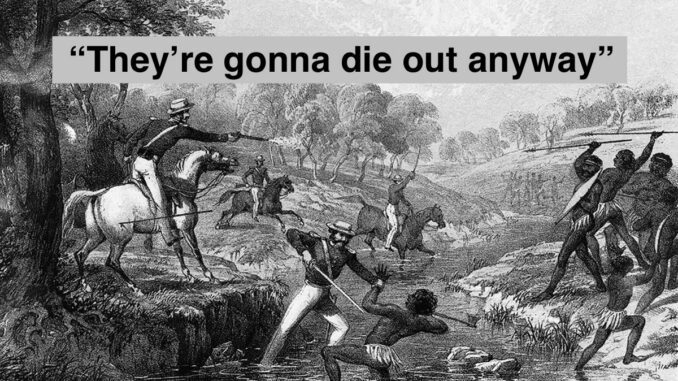
My research led me to a disturbing conclusion. In the minds of many colonial Australians, the demise of Aboriginal people was regarded as something ordained by a higher order. Nature, in their view, was already doing the work of removing the Aboriginal population – and the colonists were often quite prepared to help it along.
The prevailing attitude could be summed up in a brutally simple assumption: They are going to die out anyway.
This is not a short read. But for those with the time and patience to stay with it, I hope it will offer some insight into the ideas that shaped Australia’s racial history.
We begin…
The Construction of the Aboriginal “Other”
Australia was determined to maintain what many Europeans regarded as racial homogeneity. If Indigenous Australians continued along what Europeans perceived to be an inevitable path towards extinction, while other migrant races were excluded, restricted or expelled, the logical outcome, at least in the minds of some, was the creation of a supposedly “pure race.”
It is important that in Australia, as in other colonial contexts, Europeans imagined the indigenes as the “Other”, those fashioned or constructed which is outside and opposite, and a collective identity was forged through a discourse that set them apart from Europeans.
But the construction of the Aboriginal person as an inferior race did not begin with the arrival of the First Fleet. It had already begun in the European imagination.
Long before colonisation, Europeans had developed ideas about what Indigenous peoples were supposed to be: savage, primitive and untouched by civilisation. Aboriginal Australians were subsequently fitted into this existing European framework.
The English, in particular, believed themselves well qualified to make such judgments. William Dampier, the first Englishman known to have encountered Aboriginal Australians, helped establish an image that would influence subsequent European perceptions. He described them as “the miserablest people in the world.”
That description reinforced an existing European tendency to measure Indigenous peoples against European standards of civilisation – and to find them wanting.
When James Cook encountered Aboriginal Australians during his later voyages, he did not appear to challenge this established perception. His observations largely accepted the framework that Dampier had helped establish.
Yet Cook arrived with another intellectual influence as well: the contemporary European fascination with the idea of the “noble savage.” Philosophers such as Jean-Jacques Rousseau had portrayed Indigenous peoples as being, in some respects, uncorrupted by the vices and artificiality of European civilisation.
To European thinkers, the Indigenous person could therefore be imagined in two contradictory ways: either as the degraded savage, or as the innocent noble savage.
Neither image was a genuine understanding of Indigenous people.
Both were European constructions.
These idealised notions were subsequently modified as Europeans became more familiar with Aboriginal societies after 1788. Nevertheless, the early explorers generally failed to recognise – or at least failed to record – the complexity, sophistication and positive attributes of the societies they encountered.
Instead, they viewed Aboriginal people through the prism of European notions of civilisation and savagery, with Europeans naturally occupying the superior position.
The consequences of that worldview were profound.
The land was declared terra nullius – belonging to nobody – and the many Aboriginal nations who had occupied, managed and maintained the continent for millennia were effectively denied recognition as civilised societies.
Before the colonists had even begun to understand the people they had encountered, they had already decided what those people were.
From European Imagination to Colonial Policy
Earlier European constructions of Aboriginal people were no more flattering. Created by Europeans largely in their absence, these representations placed Aboriginal Australians low in the perceived hierarchy of humanity, based largely on assumptions about their supposed lack of intellect, industry and capacity for what Europeans regarded as civilisation.
These were not merely abstract ideas. They travelled with the colonists and became embedded in the emerging colonial society, helping to establish the intellectual foundations upon which the dispossession of Aboriginal people would ultimately rest.
By 26 January 1788, when the British flag was raised at Port Jackson and the history of sustained European colonisation began, these preconceptions were already well established. Governor Arthur Phillip and those who accompanied him did not arrive with an empty slate. They brought with them European assumptions about Aboriginal people and, importantly, assumptions about what their future in the new colony would be.
From the beginning, Aboriginal Australians were therefore being positioned not only geographically but historically. They were increasingly regarded as people belonging to Australia’s past rather than its future.
Some contemporary writers have presented the earliest encounters between Europeans and Aboriginal people as relatively amicable. They described pleasant interactions and expressed confidence that Aboriginal people would soon recognise that the colonists were not their enemies. Some even remarked that Aboriginal people appeared to regard the newcomers as equals.
There is some truth in the evidence of early interaction, but such accounts can obscure the fundamental imbalance between the two groups.
The British had arrived as an invading power. Aboriginal people had nothing the colonists particularly wanted – except the one thing the colonists wanted most: their land.
As the demands of the expanding settlement increased, the attempt to maintain diplomatic relations inevitably came under pressure. What might initially have been presented as mutual engagement increasingly became a relationship defined by possession, expansion and resistance.
There was also a curious legal ambiguity surrounding the status of Aboriginal people.
In the early years of the colony, Aboriginal people were sometimes to be treated as the equals of British subjects – without actually being recognised as British subjects. This distinction was useful to colonial authorities because it provided the Governor with at least some theoretical basis for exercising control over the conduct of Europeans towards Aboriginal people.
Official correspondence frequently distinguished between British subjects and Aboriginal people, and the two groups were consequently treated differently under colonial law. As interaction increased, however, Aboriginal people were sometimes treated as though they were British subjects, but only for particular purposes and without receiving the full rights associated with that status.
The contradiction was already apparent.
At the outset of European settlement, the British Crown claimed sovereignty over the Australian continent. London adopted an ethnocentric view that Aboriginal peoples who did not cultivate the land in the European manner, and who did not appear to live in permanent dwellings, had no recognised legal claim to it.
The assumption was extraordinarily consequential.
Aboriginal people were therefore brought under British dominion while simultaneously being denied the rights that might have challenged the Crown’s claim to their country. In theory, they were subject to the same laws as European settlers. In practice, the relationship was considerably more complicated.
Colonists were permitted to manage their own affairs, while Aboriginal people were largely left to manage theirs, provided they did not interfere with the interests of the colonists.
Even attempts to “benefit” Aboriginal people were framed through the colonial belief that Europeans possessed a superior civilisation to which Aboriginal people might, if they wished, voluntarily submit.
On paper, this could be presented as benevolent.
In reality, it rested upon an assumption of European superiority.
The situation changed considerably as the nineteenth century progressed. When the Australian colonies gradually acquired self-government during the latter half of the century, London’s influence diminished and colonial governments gained greater control over their own affairs.
For Aboriginal people, this shift was to have profound consequences.
They were increasingly displaced – not merely physically from their lands, but legally and politically as distinct peoples. The earlier ambiguities surrounding their status gradually gave way to more explicit systems of classification, control and exclusion.
By the latter half of the nineteenth century, the differences Europeans had constructed between themselves and Aboriginal people could be described, classified and, crucially, sanctioned by colonial law and policy.
The process had begun with ideas.
It was now becoming institutionalised.
Continued tomorrow: Darwin, Spencer and the “Survival of the Fittest”
Keep Independent Journalism Alive – Support The AIMN
Dear Reader,
Since 2013, The Australian Independent Media Network has been a fearless independent voice – holding power to account and delivering journalism that matters.
Running this site isn’t cheap. Rising costs mean we need your support now more than ever. Every donation, big or small, keeps our servers running, our writers working, and our stories free for everyone.
Donate here:
PayPal or credit card – just click on the Donate button below
Direct bank transfer: BSB: 062500; A/c no: 10495969

We’ve also set up a GoFundMe as a dedicated reserve fund for hosting and future improvements.

Thank you for standing with us. We couldn’t do this without you.
With gratitude,
The AIMN Team

And now we have Poorween who would be ecstatic if the indigenous population simply disappeared one night so the nice white people (well, her version of nice white people that is) could reign supreme.
Oh, yes, I had a run in with someome who took offence to me using the word “aboriginal”. Left them confused when I said the following: Aboriginal means native of, or native to a land and “indigenous” which also means native of, or native to a land. I realise that indigenous might not be totally correct but going by the Cambridge Dictionary quote: existing naturally or having always lived in a place; native: 60,000+ years puts them firmly in that category in my view.
Any one born here is a “native” Australian. The reality is all permanent Australians are migrants or the off spring of migrants, the date of ones arrival doesn’t make one migrant better or worse than another.
Tell a lie often enough and it becomes the truth (trust me would I lie?), Australian history carried by word of mouth and recorded by later day migrants needs to be taken with a grain of salt.
Jonangel,
what does a person born today in Australia being called a native of Australia, have to do with the racist, genocidal colonial settlement of Australia by Europeans?
Does it change any of that history, or are you denying that history, which was not just passed down by word of mouth, as you suggested, but plenty of it was documented in real time, and numerous instances through firsthand eye-witness accounts?
In answer: nothing, but the term”racist” is meaningless and this land was “colonised” (squatted on) by first migrants be they black or white thousand of years or months ago. As for “genocidal” it did not exist in the days of yore.
“As for “genocidal” it did not exist in the days of yore.”
Neither did the term “radio waves” but they still existed.
The word genocide might be recent development, I don’t know, nor do I care.
The fact is, the genocide occurred.
Jonangel,
perhaps you missed this bit: “Does it change any of that history, or are you denying that history, which was not just passed down by word of mouth, as you suggested, but plenty of it was documented in real time, and numerous instances through firsthand eye-witness accounts?”
You said: “Tell a lie often enough and it becomes the truth (trust me would I lie?)…”
What are you talking about? Are you suggesting that the history outlined in the article is a lie? If so, on what basis do you make that extraordinary claim?
@ Michael Taylor: Uhm ….. at the risk of being pedantic.
1) The foundation of indigenous racism is the Roman Church denigrated ”coloured races” as inferior to ”white Europeans” to justify the Spanish conquest of Central & South America from the 15th century. This thinking spread to other European countries as they began their imperialist exploits.
2) ”[T]he demise of Aboriginal people was regarded as something ordained by a higher order. Nature, in their view, was already doing the work of removing the Aboriginal population – and the colonists were often quite prepared to help it along.”
In Australia this was experienced based. In the historic absence of modern medical knowledge, the deaths of most of the Sydney Aborigines from European diseases was obviously nature ”ordained by a higher power”.
3) The secret orders given to Arthur Phillip instructed him to treat the Aborigines well, and establish trading relations with them. This lasted until the Toongabbie ”massacre” of two English shepherds (about 1790) by Aborigines seeking retribution for the rape of two of their women by the shepherds.
Then Phillip changed his attitude and turned a blind eye towards any European killings of Aborigines. Remember, it was only after the Myall Creek Massacre in 1838 (50 years after settlement) that any Europeans were found guilty of murdering Aborigines.
4) ”The land was declared terra nullius – belonging to nobody – and the many Aboriginal nations who had occupied,”
The earliest record of ”terra nullius” that I have found is about 1820 and may be associated with the westward spread of the wool industry over the Blue Mountains.
5) ”[A] curious legal ambiguity surrounding the status of Aboriginal people.”
As early as 1850, the basic features of colonial Australian law were firmly set. Aborigines had no recognised, inalienable legal rights to their tribal lands, based on the English definition of a ”settled land”.
Moreover, Aborigines were to be subject fully to criminal law, despite their inability to understand either the spoken English language or the English legal process. Customary Aboriginal law was ignored by the English. However, somewhat contrarily, Aborigines were entitled to all the rights & obligations of being British citizens.
This English legal domination extended to matters between Aborigines and settlers plus between Aborigines. The clash between Aboriginal customary law and imposed English law seldom favoured Aborigines.
There is a quite extensive literature describing the historical consequences of the English attitudes to Aborigines. The numerous excuses for massacres, even just for the fun of it, as happened in Armidale NSW, across the New England, even much later (until 1930s) on the Mid & Far North Coast of NSW makes shocking reading.
I look forward to the second instalment of this series.
NEC, you’re jumping ahead. Most of that is discussed in part 2.
This fascinating case from 1841 might interest you, NEC.
https://www8.austlii.edu.au/au/journals/ANZLawHisteJl/2011/5.pdf
Did It? Prove please.
I am not denying anything, but the documentation took place many years after the claimed events. People like yourself don’t believe what politicians say to day!! But, it seems accept, what it is claimed took place in years gone by!!!
I repeat, all the occupiers of this land are migrants or the decedents of migrants.
Do you dispute this?
The colonialists utilised the soul gathering talents of the Christian ministry to first pacify the aboriginals then force them onto reservations “for their own good”. The subjugation of aboriginal culture and beliefs by Christian missions remains one of the worst examples of European racist domination because no colonial authority would criticise the actions of the church; more so because the churches were willing to do the “dirty work” in order to capture souls for their version of salvation while the colonials continued to expand their occupation. Even today the churches do not see their mission complete.
I really don’t know what your point is? But the church and politics has never, anywhere been separated.
Dominate forces have over the centuries taken over weaker forces and we all, to a greater or lesser degree benefited.
Numerous empires, be they black, white, green or pink, subjected those seen to be lesser than themselves (nothing new here), to their influence
Those self flagating need to be asked;. Just what is your answer?
Oh, you expect us to believe that the newspaper reports of the trial of the perpetrators of the Myall Creek Massacre, that NEC referred to, took place “many years after”.
It took me less then a minute searching, with limited search engine capacity, to find: “This map shows documented massacres of the First Nations peoples across Australia, from the early years of the colony to within several decades of living memory.” (my emphasis)
https://australian.museum/learn/first-nations/unsettled/remembering-massacres/map-of-colonial-frontier-massacres/
That took less than a minute, but no doubt will be wasted on anyone who doesn’t want to know about documented massacres – not word of mouth as you claimed – documented.
It was you who inferred the telling of lies “Tell a lie often enough ….”, your words not mine.
You made the inference, don’t try to weazel out of it, you own it. Where is your evidence that it is a lie?
@ jonangel:
My answer is that whilst I can learn the history of European colonial domination of the aboriginals I personally cannot answer for the sins of our fathers. What I can do is support any community and political action that allows and supports aboriginal communities to have a determinate say in solving the problems that negatively affect many aboriginals today. Politicians must abandon their Canberra based patronising, “we know better” attitude and literally sit down in the “long grass” and meaningfully and respectfully seek a better way that recognises Australian Aboriginal citizens as equals. The recent debacle surrounding the “Voice” proposal was an exercise in media managed political chicanery that kicked all previous integration attempts back to the 19th century attitudes of racial domination. We can and must do better than that.
We quite often think in racial stereotypes but, if you saw the recent program with Tony Armstrong ABC presenter with Aboriginal roots, it makes you think.
Tony Armstrong and Shaun Micallef recently teamed up for an emotional and highly praised episode of the SBS documentary series Shaun Micallef’s Origin Odyssey (Season 2, Episode 6).
In the episode, host Shaun Micallef accompanies the television presenter and former AFL player to Tipperary, Ireland, to explore his lineage. The journey proved to be a deeply transformative experience for Armstrong, particularly when he meets the extended Irish Armstrong clan.
Well worth a look if you can pick it up: https://www.sbs.com.au/ondemand/tv-series/shaun-micallefs-origin-odyssey/season-2/shaun-micallefs-origin-odyssey-s2-ep6/2512789571864
I don’t “weazel” out of anything, but word of mouth history, backed up by documentation years after, is open to verification, which is not forthcoming.
But we are drifting off the point, proof of genocide? No.
Invasion!! how can you invade a land that is not owned by any one? Since when has squarting been ownership?
As for your last point, I’d suggest you answer my question first.
Terry, Am I to take it Tony Armstrong is Irish? Or can we all choose our nationality?
This is all so much bull shit.
Jonangel,
oh, yeah, you’re not trying to weazel out of what you said. Pull the other one, it plays a tune.
As soon as your position was questioned you resorted to obsfucation, semantic bullshit, distraction and selectively ignored inconvenient questioning of your argument.
The latest here, is changing ‘recorded by later day migrants’ to ‘backed up by documentation years after’ – there is a difference, do I really need to point it out?
You throw inferences of lying about, then back it up with nothing but hot air. You’ve got nothin’. Goodonya.
And next time spare us the bullshit semantics; different human ‘races’ might not exist, but the perception of ‘race’ does. We all know what ‘racist’ means, or if you’re the odd one out, try using a dictionary.
Don’t waffle, just try and answer the questions, if you can?
jonangel
Tony Armstrong, along with many people with Aboriginal heritage also has significant European roots so what they call themselves is entirely up to them.
Senator Jacinta Nampijinpa Price for instance has a white father and declares herself to be of Aboriginal (Warlpiri) and Anglo-Celtic (Irish/Scottish) descent.
Senator Lidia Thorpe claims ancestry with the Djab Wurrung, Gunnai, Gunditjmara clans, also has a white father and acknowledges English, and Irish heritage.
I guess the important thing is that they are first and foremost, Australian.
@ Michael Taylor: Apologies for jumping the gun on Part 2.
I was abstracting Alex C Castles (1982) An Australian Legal History, pb, 553pp The Law Book Company Ltd, Sydney; ISBN 0 455 19609 5.
The Bonjon article shows the legal confusion among the colonial fraternity. (An excellent read, thank you.)
Castle (p526) refers to the earlier R v Jack Congo Murrell (1836) matter where three Supreme Court judges agreed that Aborigines should be treated as being fully subjected to English law and its judicial processes. However, in 1826, then again in 1829 other Supreme Court judges rules that it would be unjust for an Aborigine to be tried under English law.
All this legal confusion stems from the recognition by English legal minds that England did not have sovereignty over Aborigines because of the manner that English invaders came into possession of Aboriginal lands.
@ Thommo: Thank you for the massacres reference. Local knowledge indicates that these continued until at least the 1930s, with Skeleton Creek giving up its bones that were buried after the event.
@ Mediocrates: A very sensible approach to a challenging historical problem.
@jonangel: You need to do considerable more research into these matters before forming your erroneous opinion.
Interesting response Terry, if “first and foremost (they are Australian), why the claim of Aboriginality?
Sorry NEC, but I have. Regarding an “erroneous opinion”, I suggest you look to yourself.
Michael, racism is a central tenet of colonisation. The ideology of racism is a necessary tool of colonisation as its needed to convince the coloniser general population that they are superior to the colonised, or how else would so many people be able to ignore their conscience and commit the unthinkable.
It is part of the social stratification that forms the class system in so many societies. Of course, the wealthy need racism directed towards the colonised people to enable depopulation (dispersal, massacres or genocide) to feed their greed for land and resources.
Racism creates a false superiority complex in the coloniser society.
I had a couple of years at Ethelton but never in the same age group as the St Joseph boys. I never knew that I had seen Aborigines till I came to darwin high school to teach.
The systemic racism was so obvious but its presence was invisible to most white Australians whose idea of racism is that of America. The Aboriginal people, in the 19th century, were considered by the education system as unable to progress past an 8 year old white, so a servant was the work. Sadly, the lowest acceptable level for a yr 12 certificate is grade 3 level english and maths. There is a proviso that Aboriginal students can negotiate a lower lrvel. Not much chance of closing the gap?
Another permanent racism is in the public service the least experienced is the person at the front desk? The first thing immigrants learn is our special racism towards Aboriginal people.
The clincher is the millions of hansons who use ‘they’ whenever there is a negative Aboriginal example but an exceptional he/she to a positive.
Making ‘they’ the worst 4 letter word in the english language.
@ Thommo: You must forgive jonangels wrong opinion of the Myall Creek Massacre subsequent legal proceedings; ”the documentation took place many years after the claimed events”.
The matter was dealt with very quickly and with considerable public concern that any white man” should be held accountable for killing any black fellow” regardless of the alleged legal status.
jonangel has obviously seen:
Mark Tedeschi QC (2016) Murder at Myall Creek (2016),pb, 319 pp, Simon & Schuster Ltd, Sydney; ISBN 978-19-254-5626-4.
but forgot to read any of the text before expressing his wrong opinion.
NEC, you really are confused, where have I ever mentioned the “Myall Creek Massacre”? This it seems is just another of your “erroneous” comments.
@ jonangel: Oh dear ….. You made a sweeping statement without any evidence that ”the documentation took place many years after the claimed events”. This is simply wrong, as shown by the Myall Creek proceedings, that feature the first successful prosecution of ”a white man” for killing ”a mere black fellow”.
Why is it that Black Armband LIARBRAL$ think that undocumented opinion is fact ….. like John Howard was ”a wonderful PM” ….. NOT!!!
When you have read enough early Australian history you will discover the legal sources that have documented all legal matters since about settlement in 1788.
I cannot be held responsible for your inability to discover historical sources. My only sensible role is to observe that your undocumented ”ramblings” continue to be egotistical excuses for academic research.
NEC, it must hurt to be caught with your pants down, just try answering the question. I’ll ask again, where have I ever mentioned the Myall Creek Massacre?
Don’t bother with a self declared wit if it is clearly dim. Dimwits seem to be breeding like maggots, threatening serious professional and academic standards so necessary for profitable discussion. So, unlike Hansonites, let us be polite, accurate, incisive, positive, sweet…
@ jonangel: Specifically you have not individually identified the Myall Creek Massacre, probably because you know nothing about either Myall Creek or Aboriginal massacres in Australia.
Indeed, Bloomfield, in ”Baal Balboa the End of the Dancing” collected massacre data from the station logs of properties, kept on a daily basis by graziers, just like a ship’s log. His book published these preferably hidden family secrets. So at law, a contemporaneous log is never considered ”many years after the claimed events”. Rather, it is usually considered prima facie evidence of what happened.
Your very broad sweeping statement, ””the documentation took place many years after the claimed events” must include this one singular event that clearly shows your sweeping statement is unfounded. Your sweeping statement is WRONG!! INCORRECT!! FALSE!! ILL-FOUNDED BULL MANURE!!
Thank you for demonstrating to all & sundry that you have no idea about either what you are talking about, or even how to conduct a sensible debate. This is my last word on this irrelevant author.
Embarrassed are you? Don’t worry, you’ll get over it, your type always does.
@ Michael Taylor: Uhm ….. It appears to me that this ”jonangel” entity is most likely a Coalition bot. Any way of checking??
NEC, need help do you? What are you going to post next, Truth or a Lie?
jonangel, you’d be surprised how accurate the traditional stories are, and how they align with the archeological record.
Michael, I have never for one minute discredited history be it verbal or written However, we all know word of mouth can become distorted and much can change in translation. The so called “good book” is a classic example.
jonangel:
“We’re all migrants or the offspring of migrants”
Well, yes, in a very broad sense, but migration is not always colonisation, and colonisation is the issue here. The usual use of the term “colonisation” in regard to Homo supposedlysapiens is when lands already occupied by humans are invaded and taken over by another group of humans. You know, like Europeans in Africa, various parts of Asia, the Americas, Australia and New Zealand. Australian Aboriginal people did not colonise this land in that sense, because they were the first humans here, and they were here for over 60,000 years when we oh-so-superior alabastards turned up and took over.
I just got home from a lovely little head-clearing break out bush and I already need to go back …
leefe, accepting (for discussi0n only) your view of colonisation, it would appear most, if not all of our world has been colonised.
Yes, a great deal of it has.
I was under the impression that this discussion was about the justification for, and ethical issues with, that process, particularly in Australia.
“Instead, they viewed Aboriginal people through the prism of European notions of civilisation and savagery, with Europeans naturally occupying the superior position.
The consequences of that worldview were profound.”
And what a profound oversight and ignorance on their own behalf that they fail to see that in this day and age, they are the savages!
Politically, environmentally, and socially.
Oh, how we love to hang onto our prejudices.
Thanks Michael for your Part 1 article. I missed it, and have come back to it after reading your very informative Part 2 article.
I have variously posted in AIMN much on the Oz history of the application of Terra Nullius (for political reasons by Burke et al) disguised in letters to the Crown, and to Settlers.
Also I have posted on the roots of Terra Nullius and the progression of (white) European conquest, land and resources theft. Starting with the Greco/Roman quest for lands owned/occupied by the Scythinas, onto the ‘Law of Nations’ (France 1758 – Swiss philosopher Emerich de Vattel), and English common law ‘Doctrine of Reception’ for the convenience of conquest – as enunicated in 1765 by Sir William Blackstone.
Of course, between the Greco/Romans 1stC BCE – 3rdC CE and (after the Crusades) Blackstone’s stuff 18thC CE, one ought not omit the pompous and divisive pronouncements of John (King of England etc) via the Magna Carta 1215 CE, and the Holy Roman Church, trying to cover their collective arses. And later the Holy Roman church covering its own arse for its conquests, and later, all others of Europe (incl Britain), especially after Columbus discovered that the Earth was indeed not flat.
The ‘Doctrine of Discovery’ was established through a series of papal bulls in the 15th century, notably including Dum Diversas in 1452, Romanus Pontifex in 1455, and Inter Caetera in 1493. All blessing now the global rush for conquest, land and resources theft, and subjugation, based solely on effete notions of (white civilized) supremacy.
IMO, a rolling dirty business plan, just like that of today’s American Trumpian regime.
At least Oz High Court overturned Terra Nullius in the 1992 Mabo case. But there remains a long way to go to remove ongoing entrenched (western) global prejudices as discussed in Part 2 of this article.
Thanks, Clakka. It sounds like you know your stuff (to quote an old saying).