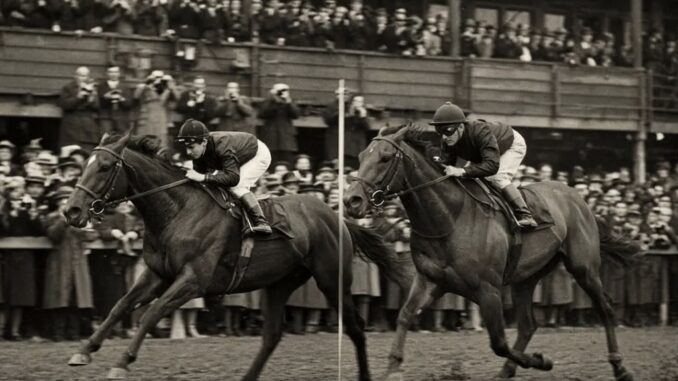
The Greens have a new leader. The press gallery has a new roughie. The field has been called to the post and the commentators are already in the box.
And they’re racing.
That is how we call politics.
With the race that stops a nation only a couple of pension cheques away, it is timely to reflect. Every contest is called from the stand: who led at the turn, who is weakening in the straight, who has drifted in the betting. A budget, a party-room ballot and an election campaign all come home in the same breathless monotone.
It is a strange old habit, Possums. We just will not give up our view of politics as a horse race.
We gave the world the secret ballot. We built preferential voting and two houses of parliament, one of them expressly designed not to behave like the other. We have independents, crossbenchers, preference flows and governments that occasionally discover a majority in one chamber is not ownership of the Parliament.
Yet the moment the little TV camera lights start winking, the whole thing becomes first past the post. The favourite is in front, the roughie is out the back, and the rest is colour commentary.
On Wednesday the Greens ran their own race. Larissa Waters stood down as leader because, in her words, her “health is getting worse”. We wish her well. The leadership, meanwhile, normally settled by consensus, went to a ballot. David Shoebridge polled six, Mehreen Faruqi three and Sarah Hanson-Young two. After preferences, Shoebridge won seven to four.
The whip, Nick McKim, then did something rare for the Greens, who normally just stick to announcing the new leader’s name. McKim read out the numbers. A result. A count. A photograph.
The Greens had printed their own photo finish and pinned it to the board.
Seventy-eight years ago, Flemington did the same.
The 1948 Melbourne Cup was the first decided by the photo-finish camera, newly installed at the course. The horse in front, by half a head, was Rimfire, and Rimfire was not supposed to be there.
He was six years old. His form was poor. He looked crook on the eve of race day. He started at 80 to 1.
Rimfire’s jockey, Ray Neville, was just a kid. Teenagers hadn’t been invented. A fifteen-year-old apprentice from Birchip, a day shy of sixteen, who had held his licence for eight weeks. He got the ride because he could make the weight. The trainer kept it from him until race day. No point keeping the lad awake all night.
Neville used to tell his children that as he came round the last bend “he just went for it”. Down the straight, Rimfire held off Dark Marne under Jack Thompson, one of the finest jockeys in the country. Thompson was certain he had won.
Then the camera spoke. What a boil-over.
Rimfire. The boy.
A perfect metaphor for Australian political journalism? The trouble is not that the gallery loves a horse race. The trouble is that it keeps calling the wrong one.
THE FORM GUIDE
Start with the weights. At the 2025 election the Greens lost three of their four lower-house seats, Adam Bandt’s Melbourne among them. Last Green standing, Elizabeth Watson-Brown in Ryan, said that it “might be a bit lonely”. One seat. Minor party. The handicapper has spoken.
Except the same election produced an inconvenient truth. The Greens’ national primary vote was 12.22 per cent, almost exactly the 12.25 per cent of 2022. The vote did not collapse. It was simply spread across the map in a way that returned almost no seats. One voter in eight. One seat in a hundred and fifty.
Then there is the Senate. The Greens came out of 2025 with eleven senators, enough for Labor and the Greens together to pass whatever they could agree on. Dorinda Cox crossed to Labor, and they are now ten.
Ten senators and one member. Call them minor if you like. Just don’t confuse minor with immaterial.
THE VACUUM
Shoebridge says the Greens are here to replace Labor. Longer odds than Rimfire, says the form guide, and the gallery reaches instinctively for the sports pages. Nobody read the next sentence.
“We’re here to fill the vacuum that has been left by the Labor Party rushing to the right.”
That was the sentence to lead with, because it is the only part of the claim that needs no odds at all. The vacuum is real: Labor has been hollowing out for forty years. It began with the Accord, when the party of the shop floor learned to speak fluent Business Council. It continued through privatisation, casualisation and a submarine pact that, in the words of Australian Foreign Affairs, “became bipartisan policy literally overnight”.
Every time Labor moved right, somebody was left standing in the paddock. Some of them now vote Green. Others, as Shoebridge also argued, have wandered off towards One Nation.
So why must the Greens replace Labor before we treat them as significant? That is not how the system works. A party does not need the Lodge to change what the Lodge can do. It needs votes, leverage, issues a government cannot ignore, and sometimes nothing more than the nerve to stand in the doorway.
THE RACE NOBODY CALLS
Consider the veterans. The Albanese Government proposed a $5,000 annual cap on allied health services for veterans, due to start in July 2027. Veterans called it a death sentence. Shoebridge and Jacqui Lambie got a bill through the Senate to stop any such cap being imposed. In September, Veterans’ Affairs Minister Matt Keogh took the cap “off the table”.
Lambie, the Coalition and the veterans’ groups can all claim a share of that. Politics is full of people arriving at the winning post carrying their own saddle.
Which is precisely the point. The government has 94 members in the House and the Greens have one. The government has 30 senators and the Greens have ten. And still the government cannot simply do as it likes.
The Greens matter without winning government. They matter precisely because they are not the government.
That is the race the form guide doesn’t print.
THE PRESS GALLERY’S FAVOURITE HORSE
Now to our corporate cartel of political horse callers.
The same horses. The same barriers. The same track. The same serene certainty that the most important thing in politics happened yesterday afternoon in a party room.
So a change of leader becomes a race. Who had the numbers? Who is disappointed? Who will Labor fear? Who will One Nation exploit?
The Nightly had the new leader “branching out” as the party “turns over new leaf”. The puns were in the mounting yard before the ink was dry.
And the Greens are scratched before the barriers, as they always are.
Lose a seat? Finished.
Lose a leader? Finished.
Too radical? Finished.
Help Labor? Finished.
Their internal disputes prove dysfunction. Their deals with Labor prove capture. Their refusal to deal proves they are unserious. Their Senate leverage is obstruction, their losses are extinction and their persistence is an annoyance. Whatever happens, the horse stays a roughie.
Meanwhile, down the back, almost unnoticed, are the questions that matter. Why does one voter in eight keep backing this party? Why do governments keep negotiating with it? Why do its policies, once dismissed as mung-bean sandal-wearing lunacy, keep turning up in Labor legislation?
Ask how a hard cap on the gross emissions of the country’s biggest polluters, 140 million tonnes a year and falling, ended up in Labor’s own Safeguard Mechanism in 2023. It was the price of Greens votes in the Senate.
Those questions make poor television. So the leadership race gets the camera, and the political class gathers around the tote board to discuss the tote board.
The gallery’s question is always: can they win?
The better question is: what happens because they are running?
THE .22
A rimfire cartridge is a .22. The rabbit gun. Small bore and unpretentious, the sort of firearm that lived behind the farmhouse door because the world occasionally required a rabbit to be dealt with and nobody needed a consultant’s strategic review to do it.
Shoebridge is one of the loudest critics of AUKUS. The Greens oppose the nuclear-submarine project outright. So here they are, a .22 in a contest with a fleet of submarines due some time in the 2030s.
Small things can still hit what they are aimed at. Farmers never kept the .22 to win a naval engagement. They kept it because it did one job well.
Parties have jobs too. Governments govern. Oppositions oppose. Senators scrutinise, bargain, obstruct and, now and then, force a government into retreat. A functioning democracy does not need every party in the chamber to be a government in waiting. It needs forces in the chamber that governments have to reckon with.
ASK THE CAMERA
In 1948 the camera was meant to settle an argument. Instead it became part of the legend. Thompson could not believe he had lost. The crowd could scarcely believe it either. The camera did not care. It showed what happened.
That is all the Greens are owed by political journalism. A camera.
Look at the vote. Look at the Senate. Look at the legislation, the amendments, the negotiations. Look at where they have used their leverage and where they have squandered it. Then decide what kind of animal it is.
There is a fair case that the Greens have problems. Internal divisions. Lost seats. A vote that is geographically inefficient. A leadership ballot that has just exposed an argument about the party’s own democracy, with Faruqi warning that “without a member vote, we cannot call ourselves a grassroots party”.
Replacing Labor may be a long shot. That is for the voters to settle, not a columnist, a bookie or a panel show.
But the opposite error is lazier. Assume a party cannot form government and therefore does not matter, and you have misunderstood the machinery entirely. The Greens may not even be entered in the Cup. They are running another race: over what governments can pass, what they can dodge, which arguments become respectable and which interests get challenged.
Less glamorous. Considerably more important.
THE SADDLE
Ray Neville collected £25 for winning the 1948 Melbourne Cup. Enough for a new suit and a saddle.
Then somebody stole the saddle.
Win the Melbourne Cup at 80 to 1 and somebody nicks the bloody saddle.
Neville rode until 1968 and spent years afterwards issuing barrier certificates. This year Birchip painted his story across its silos.
The Cup is run on Tuesday 3 November. The camera will be there. So will the gallery, and so will the bookies. And somewhere down the track will be a horse everyone has already written off.
They said 80 to 1.
Ask the camera.
This article was originally published on URBAN WRONSKI WRITES
Keep Independent Journalism Alive – Support The AIMN
Dear Reader,
Since 2013, The Australian Independent Media Network has been a fearless independent voice – holding power to account and delivering journalism that matters.
Running this site isn’t cheap. Rising costs mean we need your support now more than ever. Every donation, big or small, keeps our servers running, our writers working, and our stories free for everyone.
Donate here:
PayPal or credit card – just click on the Donate button below
Direct bank transfer: BSB: 062500; A/c no: 10495969

We’ve also set up a GoFundMe as a dedicated reserve fund for hosting and future improvements.

Thank you for standing with us. We couldn’t do this without you.
With gratitude,
The AIMN Team

It’s 6/4 on that Albanese has another thorn in his saddle, to add to all the others.The stewards should launch an inquiry into him running dead on so many traditional Labor values.
Disqualification is on the cards…the voting cards, that is.
Tweedle Dee and Tweedle Dum acting in collusion, have over the years nobbled the political scene.
They have taken it in turns defraud the punters, who still keep putting their money on the wrong horse.
Gambling really is an addiction.
Certainly the Greens are a more acceptable alternative to any of the other parties, especially the PHONeys (Profiteering Hanson Only No-one else you see), LIarbral$ and NOtional$.
The difficulty that the Greens face is that their following is too widely spread across the 174 electorates to make any direct election damage to the political duopoly destroying Australia for the benefit of foreign owned multinational corporations.
Wonderful read, thanks David.
Labor teamed up with their duopoly mate, the Coalition, to pervert the handicap system, the weights calculations, through their alterations to the electoral funding laws. It is now perversely, the smaller you are as a political entity the greater the weight you have to carry in the race.
The leverage the Greens have in the Senate can, of course, be subverted by a ruling duopoly party (presently Labor) by teaming up with the other duopoly party, as Labor did in order to rig future elections in its favour. Perhaps also akin to boxing a rival horse in on the rails.
Labor successfully used the leverage that tactic gives it to wedge the Greens over environmental protection and even carbon offsets, (aka, kill the NSW Koala Park, that was already a Labor election campaign promise, one they were apparently willing to break.)
Someone (sorry, can’t remember who) once said that the problem the progressives have is that they are forever attacking each other, whereas on the whole the conservatives just don’t want a progressive government and leave each other alone. That certainly isn’t true with the Coalition attacking One Nation at present, but that can be seen as a case where the Coalition were losing supporters due to their performance in government, who were going to One Nation. It could be argued that the Coalition has then broken with the pattern and selfishly attacked One Nation – selfishly, as they have no qualms about adopting One Nation stances.
Is it therefore hypocritical to criticise Labor? I don’t believe so, Labor has shown that it serves the corporates not the people, that’s not a progressive party. The Labor party now practises liberalism – it has shifted to the right, if you like that terminology – with a smattering of progressive actions, that are good in their own right, but that do not solve our society’s problems, thrown as bones to keep the faithful duped.
Nothing has made me sicker than the post 2022 ALP.
Thommo: enjoyed your thoughtful reply. Thanks very much. I think you’ve put your finger on an important extension of the argument: the race isn’t merely called unfairly, the weights themselves can be manipulated. And that makes the question of Greens leverage considerably more complicated than the usual “how many seats did they win?” analysis.
As for Labor, I don’t think criticising it requires pretending the Coalition or the Greens are beyond criticism. The interesting question is what each party actually does with the power it has. That’s where the form guide gets much more revealing than the odds.
Thanks, Cocky. Yes, I think that geographical distribution is one of the great paradoxes of the Greens: a substantial national vote that doesn’t translate neatly into lower-house seats. Which brings us back to the point of the piece: if we judge political significance solely by the number of seats won, we miss a good deal of what is actually happening in the race.
Today I spoke with a traveller who asserted that the Robodebt scandal was really a Labor Policy enacted by Scummo as Treasurer.
Can anybody provide any advice on this matter, because this is news to me.
@Paul Walter: Alb-Appeasie has been a classic failure; aspiring to a long reign as PM without doiong anything to justify the faith the voters put in the Labor Party to return to fundamental community values.
I think Thommo is correct; the Australian political duopoly has sold out the voters for the big bucks from corporations, both local and foreign owned.
Kos Samaras (P&I 021026) summarises the situation based on statistical data, and IMHO is not very far from correct.
NEC,
I believe, but stand to be corrected, that Labor was using an automated data matching scheme before Robodebt, but had human oversight to make sure that anomolies that were thrown up weren’t acted upon – Morespin and his band of thieves removed that human oversight.
The sick thing about this is that Labor nobbled the NACC, making sure no one was held to account for Robodebt on account of being referred to by the Royal Commission, then went and used automated assessment without human oversight in aged-care, and looks like doing so in the NDIS.
G’day New England Cocky,
Your traveller has been sold a pup, and it’s one Scott Morrison bred himself.
First, the dates. Morrison wasn’t Treasurer when Robodebt was cooked up. He was Minister for Social Services. In early 2015, in that job, he took the proposal to Cabinet. By the time he moved into the Treasurer’s office in September 2015, the savings were already pencilled in. In the December 2015 budget update, his own Treasury booked the money it was meant to claw back from the poor. The Human Services Minister, Alan Tudge, then launched the fully automated version in mid-2016. It was a Coalition scheme from start to finish.
Now, the grain of truth your traveller has dressed up as the whole loaf. Matching Centrelink records against tax office data does go back to the Hawke years. Under Rudd and Gillard, income averaging was sometimes used to flag that something might be wrong. That’s all it did, though. A human being then picked up the phone, chased the employer and got the actual pay figures. Averaging was where an investigation started. It never became the verdict.
Robodebt took the human out. It averaged a year’s tax-office income evenly across fortnights, sent out the debt notice automatically, and made the welfare recipient prove they didn’t owe the money, often years later, with payslips long gone. That reversal of the onus of proof is the heart of the scandal, and Labor never did it.
The “Labor did it first” line isn’t something blokes just say in pubs. It was Morrison’s defence. He ran it before the Royal Commission in 2022. Commissioner Catherine Holmes looked at it and didn’t buy it. Her 2023 report called the scheme “a crude and cruel mechanism, neither fair nor legal.” She found Morrison let Cabinet be misled into thinking no change to the law was needed. The department had legal advice dating from 2014 that cast doubt on income averaging, and it was buried. In 2019 the Federal Court declared the scheme unlawful. The government had to repay or wipe hundreds of thousands of false debts and settle a class action worth around $1.8 billion.
The cost wasn’t only in dollars. Families told the Commission about loved ones who took their own lives after the debt letters arrived.
So, short answer: Labor built the data-matching filing cabinet. Morrison’s Coalition turned it into a machine that sent out bills automatically and didn’t care whether they were right.
Your traveller might like to read the Royal Commission report. It’s free, it’s online, and it’s damning.
Cheers,
David
G’day Thommo,
You are right on the money. One correction first, though, because the record is grubbier than you’ve put it.
The NACC didn’t let Robodebt go. It tried to. In June 2024 it announced it would not investigate the six people the Royal Commission had referred, on the grounds that they’d already been examined. Then it came out that Commissioner Paul Brereton had a personal connection to one of them. He had stepped aside from the decision, but only partly. The NACC’s own Inspector found that was misconduct. The matter was reopened under an independent decision-maker, and in March 2026 the investigation, Operation Myrtleford, finally reported.
The result: two senior public servants were found to have engaged in corrupt conduct. One of them, Serena Wilson, misled the Ombudsman by keeping back the legal advice that income averaging was dodgy. Four people were cleared, Scott Morrison among them. Nobody was referred for prosecution. Robodebt survivor Felicity de Somerville called the outcome “grossly disappointing but not surprising.” Two bureaucrats copped it and the minister who took the scheme to Cabinet walked away clean. That’s not justice, it’s the sacking of the cook.
Labor built that watchdog. Public hearings are allowed only in “exceptional circumstances.” It doesn’t have to report on findings it doesn’t make. Labor didn’t need to nobble the NACC. It was built nobbled.
Now the bit that ought to make every pensioner choke on their Weet-Bix. On 1 November 2025, Labor’s new Aged Care Act started, along with an algorithm called the Integrated Assessment Tool that decides your Support at Home funding level. Assessors had been trained to believe they could override it. Then, three days before the start, an “URGENT” departmental brief told Minister Sam Rae that assessors would have “no legal discretion” to override. That’s from FOI documents. The department itself called it a “late change in messaging”. Requests for review shot up nearly fivefold in five months. The Commonwealth Ombudsman, the same office that had to deal with Robodebt, opened an investigation in April 2026.
The NDIS is next in line. Under its “new framework” plans, an assessor runs you through the I-CAN tool and the computer works out your budget. The agency’s own executive has said staff can’t change that figure. They can accept it or ask for a new assessment, and that’s all. Meanwhile the government’s goal of slowing NDIS growth to 5 to 6 per cent a year is no secret.
The Royal Commission’s main lesson was simple: never let a machine make decisions about vulnerable people with no human able to step in. Labor read the report, paid the compensation, and then built two new machines that do exactly that.
Holmes warned us. Nobody in Canberra was listening.
Cheers,
David
Fuck the Albanese government and all who sail in it.Vote for the Greens at every opportunity..starting yesterday.
That fuckhead Morrison should be in jail.
@ David Tyler: Thank you for the detailed Robodebt advice.
To a mug voter there appears to be sufficient evidence of maladministration to cost the involved COALition politicians at least some jail time.
How can the LIARBRAL$ justify pre-selecting Tudge, who remains crawling around under the Canberra bubble feasting upon the Parliamentary Allowances Scheme while growing his ”Retirement Payment”??
That is hardly justice for the 2,000+ suicide victims of the Robodebt Scheme he implemented.
@ Harry Lime: Agreed. Jail is too good for him, there are other colloquial alternatives.
As a person impacted by Robodebt and the subsequent Class Action, I have opted for Individual Assessment which will not be forthcoming until 2028.
It’s been quite obvious that yet again, the goal posts for claims have been moved to reduce its groaning liabilities as its limited to a five-year period where I was subjected to this crap from 2002 onwards and my heart aches for those who suicided thru no fault of their own and the families left grieving for them.
I hated being on that pittance of income support and worked at every opportunity that I could when my health would allow, and have subsequently uploaded documentary evidence as to the state of my health from 2008 up to 2019 as I was dealing with CFS which impacted heavily on my immune system. I was able to gain a modicum of decent work for four prior to retirement which were years that helped me dig my way out of accumulated debts.
Pleased to say that over 20 years I have reversed those impacts however I still have to be aware of stress factors and lay low for a day or two.
An interesting read with Kerry O’Brien’s perspective….
https://www.themonthly.com.au/october-2026/essays/tech-truth-and-decline-democracy?