By Chen Ziqi
Artificial intelligence is advancing at a breathtaking pace. Countries and companies are racing to build more powerful models and push the boundaries of what machines can do.
But for much of the Global South, the more immediate question is a different one: How can AI help solve problems that affect people’s lives today?
The answer may not always lie in the world’s most powerful AI systems. Countries across the region are at very different stages of technological development. Some have advanced research capabilities and large digital economies, while others are still building data centers, digital networks, and skilled workforce needed to make AI work at scale.
This is creating a new dimension of South-South cooperation. BRICS countries, with their diverse technological capabilities and development experiences, are increasingly developing and sharing AI technologies, expertise and applications with other emerging and developing economies.
Rather than simply transferring one-size-fits-all technologies, these efforts are being adapted to local infrastructure, economic conditions and development priorities.
The result is more about asking where AI can make the biggest difference.
Bringing medical expertise closer
Across much of the Global South, where medical resources are often concentrated in major cities, access to timely and quality healthcare can depend on where a person lives. For people in rural and remote areas, seeing a specialist may require traveling hundreds of kilometers, as local clinics may lack the equipment or expertise needed for an accurate diagnosis.
AI is beginning to offer a way to narrow this gap, helping extend medical expertise beyond the walls of well-equipped hospitals.
In China, Xunfei Healthcare has developed AI-powered tools that assist doctors with clinical decision-making, medical records and prescription reviews, and medical imaging.
The company is now taking some of these technologies abroad. In June, it signed a strategic cooperation agreement with Indonesia’s PT DSST Mas Gemilang to deploy AI healthcare solutions, including AI-assisted diagnosis and treatment, public-health monitoring and medical imaging. The cooperation combines China’s experience in large-scale AI applications with Indonesia’s local infrastructure and healthcare needs.
Another similar form of South-South technology diffusion can be seen in India’s Qure.ai. Its qXR system uses AI to analyze chest X-rays for signs of tuberculosis and other abnormalities. It has since been deployed in more than 60 countries across Africa, Asia and Latin America, helping healthcare workers identify patients who may require further testing in places where specialist radiologists are in short supply.
From satellites to early warnings
For communities on the front lines of climate change, a disaster often arrives faster than help can. Floods can sweep through farmland, storms can destroy homes and droughts can wipe out crops before communities have time to respond. But AI is helping turn that early warning into a reality.
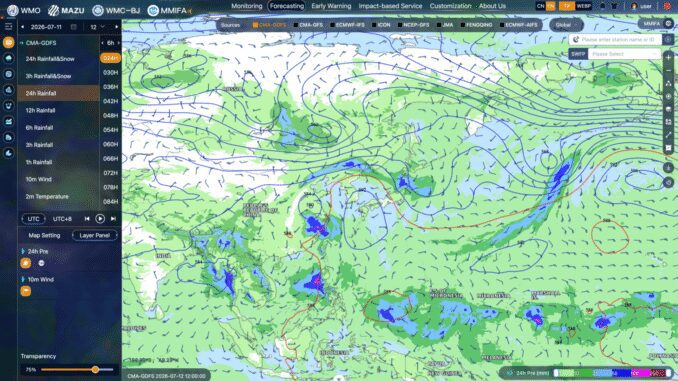
At this year’s World Artificial Intelligence Conference in Shanghai, the China Meteorological Administration unveiled the MAZU-Fengyun Satellite AI Toolbox.
By combining satellite-data reception, AI inference and multi-source data fusion, the meteorological toolbox can help improve monitoring and early warning for extreme weather and other meteorological hazards.
Customized MAZU systems have already been deployed in seven countries, including Pakistan, Ethiopia and Sri Lanka, helping countries vulnerable to floods, droughts and other extreme weather events strengthen their early-warning capabilities. More than 40 other countries are also accessing related MAZU services through cloud-based platforms.
Pakistani State Minister Bilal Bin Saqib said the MAZU Satellite AI Toolbox could provide smarter meteorological early-warning services for countries in the Global South, helping protect crops, strengthen food security and contribute to the UN Sustainable Development Goals.
Helping farmers make better decisions
For many countries in the Global South, agriculture accounts for a large share of economic activity. AI is offering farmers and agricultural researchers new ways to make better decisions, from how much fertilizer to apply to which seeds are most likely to survive a changing climate.
In Namibia, Chinese agricultural experts found that poor soil conditions and inappropriate fertilizer use were contributing to low agricultural productivity. To address the problem, they introduced a smart agricultural management system in 2025 that can generate tailored fertilization plans after farmers enter information about their soil. The system has been described as an “agricultural navigator,” offering farmers guidance based on the specific conditions of their land.
AI is also changing one of the most time-consuming stages of agriculture: cultivating better seeds.
Traditional seed selection can take eight to ten years of experimentation, followed by additional years of promotion before a new variety reaches farmers. AI can dramatically shorten this process by analyzing large amounts of data quickly and more accurately.
Chen Xin, president of the Society for the Advancement of Breeding Research in Asia and Oceania, said AI can improve the precision of selecting seeds that are more resistant to pests, diseases and more tolerant of high temperatures. It can also help researchers identify promising combinations for hybridization, accelerating the search for varieties suited to changing environmental conditions.
The technology is increasingly being adapted to local needs. In Thailand and Myanmar, for example, optimized bean varieties are being developed to better match local growing conditions and agricultural demands.
Financing AI-powered development
Technology alone cannot transform public services. AI systems need digital networks, computing infrastructure and other physical and institutional foundations, all of which require investment.
The New Development Bank (NDB), established by the BRICS countries in 2014 and beginning operations in 2015, provides financing for infrastructure and sustainable development projects in BRICS member countries and other emerging-market and developing economies. Its portfolio has increasingly included projects involving digital infrastructure and technology-driven public services.
In Brazil, the bank is supporting the development of a new generation of public healthcare infrastructure. Earlier this year, the NDB approved a $320 million loan for the first public smart hospital in São Paulo. The hospital is designed to combine advanced medical services with technologies including artificial intelligence, an AI-supported comprehensive diagnosis platform and online consultations.
For developing countries, the challenge is not only gaining access to AI technology, but also building the infrastructure and connected systems that allow that technology to be used at scale. By financing such projects, the NDB can help turn AI from an emerging technology into a tool embedded in essential public services.
During this year’s World Artificial Intelligence Conference in July, Chinese President Xi Jinping called for countries to:
“… carry out extensive international cooperation and help Global South countries with capacity building to bridge the AI and digital divides, promote sustainable development, and prevent creating new historical injustice in AI.”
He has also called for a consensus-based global governance framework “to make this frontier technology better benefit humanity.”
For countries across the Global South, this means more than gaining access to the latest AI models. Cooperation can help them share technologies, expertise and development experience while adapting AI solutions to local conditions.
For more than six billion people across the region, its success may be judged by a more immediate measure: whether AI can help deliver better healthcare, protect livelihoods, strengthen food security and give communities a better chance to prepare for the challenges ahead.
Chen Ziqi is a reporter for CGTN Radio, China
Keep Independent Journalism Alive – Support The AIMN
Dear Reader,
Since 2013, The Australian Independent Media Network has been a fearless independent voice – holding power to account and delivering journalism that matters.
Running this site isn’t cheap. Rising costs mean we need your support now more than ever. Every donation, big or small, keeps our servers running, our writers working, and our stories free for everyone.
Donate here:
PayPal or credit card – just click on the Donate button below
Direct bank transfer: BSB: 062500; A/c no: 10495969

We’ve also set up a GoFundMe as a dedicated reserve fund for hosting and future improvements.

Thank you for standing with us. We couldn’t do this without you.
With gratitude,
The AIMN Team
The Chinese have stated that despite their growing economic, military, and industrial strength, they have no wish to supplant the US as the global hegemon.
And when we think about it, why would they?
As Caitlin Johnstone has pointed out, it would be absolutely crazy of the Chinese to look at the US going broke trying to maintain 800 military bases throughout the world, neglecting their own domestic development, engaging in wars, skirmishes and government overthrow here there and everywhere, making enemies left right and centre, and the Chinese saying, that looks good, we’ll have a bit of that.
The proposition is ludicrous.
But ironically, by not going down the US path, the Chinese will in all likelihood achieve hegemon status without trying.
But this will be a hegemony unlike anything we’ve seen before.
Not a hegemony based on fear.
Not a hegemony based on lies.
A hegemony based on trust.
It’s widely known that Confucian thinking is influential in China today, but Lao Tzu is still held in high regard.
If China assumes global leadership, it will be in part due to the Taoist view of the world.
Hegemony flowing from The Way.
Tao, the Way, is a kind of natural law behind all of creation.
Natural law from which Lao Tzu gave the world thoughts such as this:
When you are content to be simply yourself and don’t compare or compete, everybody will respect you.
Nature does not hurry, yet everything is accomplished.
The Way is ever without action, yet nothing is left undone.
The value of teaching without words and accomplishing without action is understood by few in the world.
Let’s hope that China can teach without words, how civilised development can occur.
Because that’s a lesson that the world really needs.
Steve,
that’s a great comment. Well said.
OK …. the source is PRC China but the content make a very pleasant change from TACO Trumpery rants ….. is Trump being used as a ”look at me” fool so that Putin make continue beating up Ukraine while making huge profits for US NE Military Industrial Complex?? But I digress ….
The BRICS bloc is doing a lot of quiet public infrastructure building with assistance from PRC China, a better feeling than national genocide of Indigenous Palestinian landholders by the amoral IDF directed by Butcher Bibi & the corrupt Israeli Knesset.
It would be nice to have some Australian news of public infrastructure construction, other than the NIR scam initiated by Beetrooter for the benefit of the SANTOS Pilliga Scrub CSG fields to export through Port Gladestone.
Why even a press release returning to completing the last about 25km in NW NSW to give Moree Plains (NSW) produce to be moved directly ON RAIL to Port Newcastle for export.
Financial and technological colonisation. Slower than the military version, but more effective in the long run.
In the blink of an eye we’ve witnessed:
China, the sleeping giant, stirring into life.
Of the two, number 1 concerns me the most.
My current level of trust, support, interest, in USA actions is subzero nowadays, while, having observed China over the last half century, attitudes have risen, stabilised, developed. The old ways attracted interest from student times long ago. Comment by Steve underlines views. Expect “westernisms” to crumble, and steady harmony to come from old ways as applied to the worsening world, facing rapid threatening change for most of us. Greed, domineering, supremacist drives must be stopped from ruinous harmful careering, Trumpery as mistaken as was Hitlerism. May the world harness tech. improvements better, for us all.
We are hearing on a daily basis about the rush to construct AI data centres evidently representing a new, massive artificial intelligence boom, to benefit humankind. In the next year or two major tech companies are projected to spend between $US650 billion and $US800 billion globally on AI infrastructure.
Inevitably the major tech companies are going to demand a significant return on their investments, and they are already baulking at creating additional electricity and water infrastructure insisting that we will all benefit from their AI innovations.
If, as we are told, one of the major benefits we humans will reap will be in healthcare and diagnostic enhancement and longer and healthier lives, may I ask who will pay for all this when it starts entering our healthcare systems? Could it be the mug that you see in the mirror each day ?
I have a suspicion that the tech billionaires will not be handing out their munificence for free but I may be wrong.
Anybody ?
Roswell:
Indeed. At least China is using their power relatively gently in most places.
@ Terry Mills: Uhm ….. the unstated facts within those huge proposed expenditure are that 90+& of that expenditure returns to the USA to purchase computer hardware and the driving software. The main advantage is that these AI Data Centres can be located in poor economic regions where the demand by AI for electric power and water for cooling will parasitise the local Australian community. This is the way international investment is done.
Then there is the advantage gifted to foreign investors in Australia that US$1 buys about A$150 of Australian value, thus making any real estate purchases almost zero cost.
A great interview from just a few days ago at the link below — American businessman living in China, explains and describes the difference in competence between Chinese and US politicians.
Also covers how China is overcoming corruption while in the US corruption is built into the political system.
Note at the end the lingering belief in US exceptionalism, despite all that was said previously. Or is he just making sure that he is not barred from travel to the US?
https://www.youtube.com/watch?v=eLBV1NAEtXk
And whilst we are riding that ‘Dragon’s Tail’ here something to help with tracking all those annoying tech glitches, and today’s is like a Christmas tree (16th Sept)….
https://www.thousandeyes.com/outages/