By James Moore
“Climb the mountains and get their good tidings. Nature’s peace will flow into you as sunshine flows into trees. The winds will blow their freshness into you, and the storms their energy, while cares will drop off like autumn leaves.” (John Muir, naturalist).
When I was young, I loved my country with a fever.
The first time I left Michigan for a road trip to Mississippi in my father’s old Studebaker, I stared at the endless cornrows of Illinois as if they had been conjured by some magic incantation. Nothing seemed to truly exist in such grand proportions; I was watching a movie of an unbelievable reality passing through the glass into a seven-year-old’s eyes. The great bridge across the Ohio River in Cairo convinced me fine things existed in abundance and I might grow up to enjoy their offerings. The big muddy river we followed southward to the cotton fields I eventually came to think of as the aorta of America’s thumping heart of hopefulness, pulling big dreams and prosperity out into the wider world. I was so struck by the Mississippi that even during my university years I almost convinced an editor at National Geographic to fund me floating its full distance to write a piece celebrating some anniversary of Mark Twain, or one of his books, I can’t recall.
Up in Michigan, we did not have much at our house and I never saw those sea-sized lakes that surround the state until I was eighteen and hitchhiked up to the Straits of Mackinac, the narrowest passage of water between lakes Michigan and Huron. In elementary school we had been shown a movie of bridge construction across that gap, the longest suspension road in the world, according to the baritone narrator, and men had died falling into the concrete piers, left there as their flesh and bones turned to stone that held up the massive span. I did not traverse the Mackinac Bridge until many years later and have still not been on the island of that name, which is home to a famed hotel and bans automobiles for transport.
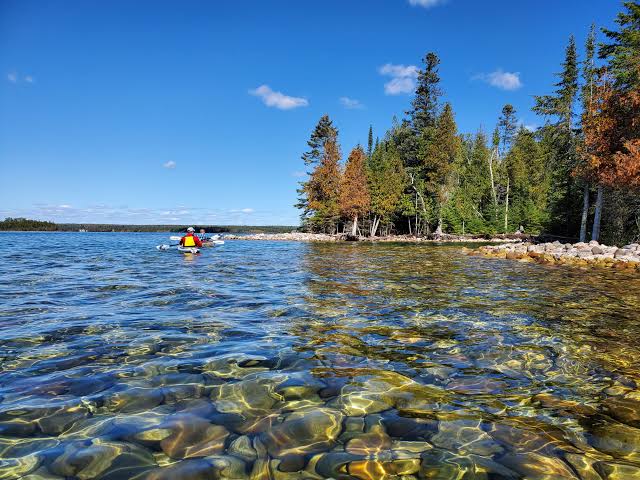
I did make it to a place called Drummond Island and camped on an interior lake without a single human structure in sight while we all hunted hours for morel mushrooms to fry over a camp fire. Fifty years ago there were only two gravel roads that intersected in the island’s center, which was the location of an Esso gas pump and a general store known to never have bread in stock. There is a resort there now with a golf course. The Great Lakes were imaginary things to me, even growing up only an hour distant from Port Huron’s Bluewater Bridge and the Canadian border. In college, I never tired of hearing Gordon Lightfoot’s songs, and hoped to one day sail the Georgian Bay and seek anchorage “in the lee of Christian Island,” which is in Ontario and far to the Southeast of Drummond. The closest I ever came was to spot the island on a digital map illuminated on the bulkhead of a 747 jetliner as we flew northeastward on an overseas vacation. Lightfoot was probably on a beam reach somewhere 35,000 feet below me.
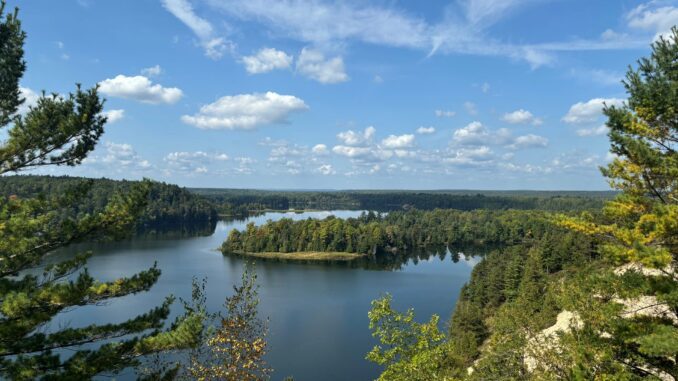
One night when the slate gray suicide sky of January was hovering over the university’s campus, I found a poetry anthology entitled, “The Sand River Almanac,” and spent my evening constantly rereading its sparse pages. The poems were a collection of student meter that worked wonderfully and awkwardly, but the river they were using for inspiration was the Au Sable, not the Sand, which flowed from west to east across Michigan and emptied into Lake Huron. French fur traders had used the name Rivière au Sable, which translates to “sand river” because of deep glacial deposits of sand on the river’s bed. Billions of board feet of virgin white pine were cut and floated down the Au Sable to mills next to the big lake, lumber that helped build much of the Midwest but also destroyed the river’s ecology with log jams scraping bank-to-bank and disrupting fish habitats.
Before the loggers, there was an ancient fish that swam the Au Sable, the Arctic Grayling, which moved with a tall dorsal fin and ate voraciously. The river was world-famous because of the Grayling but it went extinct before the lumbermen were finished with the woods. Trainloads of anglers came north to catch the Grayling in the 1870s and their proficiency put an end to its existence. They routinely caught 100 a day and the overfishing, deforestation, and warming waters caused extinction of the Grayling. Brook, Brown, and Rainbow trout were later introduced to the Au Sable and proliferated to the point where fly fisherman from around the world seek out an 8-mile stretch east of the interstate highway that is referred to as the “holy waters.” In fact, the modern conservation movement was founded along that water course in 1959 with the creation of the national river advocacy group “Trout Unlimited” at a place called the “The Barbless Hook” cabin near the town of Grayling.
During my collegiate years I canoed and camped the Au Sable a few times and as we floated along on the gentle gurgle of the crystalline water I wished that I had come of age nearer the river. My childhood was spent in an industrial suburb much farther south and I wondered had I grown up fishing and floating the north woods if I would have ever left. I suppose I was bound to wander a bit; the natural beauty of Michigan was not enough to keep anchored to the land four of the finest writers of English letters. Jim Harrison, author of Legends of the Fall, was born and raised in the state’s north country, hunting and fishing, hiking and drinking, but eventually left for Montana and Arizona.
Harrison met Thomas McGuane on the campus of my alma mater, Michigan State University, where they were both enrolled, and grew a friendship on a foundation of fly fishing and hunting. McGuane, raised in Detroit, had literary and financial success with his first novel The Sporting Club, and bought a ranch in Montana, the spot where he still labors as the last of the outdoorsman authors. Harrison, too, ended up with land in the big sky state and became obsessed with fishing the mountain rivers. Richard Ford, who was raised in Jackson, Mississippi across the street from Eudora Welty’s house, came north to attend Michigan State and began a literary career that was highlighted when he became the only writer to ever win the Pulitzer Prize for fiction and the Pen/Faulkner award for the same book, Independence Day. Ernest Hemingway, too, spent the summers of his youth at his parent’s cabin on Walloon Lake in Northern Michigan and set many of his early Nick Adams stories in way up north, the most famous of which was The Big Two-Hearted River, a narrative of a soldier home from World War I recovering his humanity by fishing the remote reaches of an Upper Peninsula river.
Michigan was always too cold for me and I had fallen in love with the West by watching black and white westerns on our faltering Zenith TV. I had also discovered the works of Wallace Stegner and his sentences brought detailed landscapes to my imagination that far transcended old cowboy movies, almost perpetually set in Monument Valley, Utah. As graduation approached, I sent off for a nylon and aluminum backpack for $18.95, another consequence of literature. A lyrical book by two brothers exploring the West, On the Loose, was filled with color photos and poetic writing about their adventures and seemed to have been written to address my unnamed urges to wander and sleep under the sky instead of a roof. Unfortunately, though, I needed a job.
There was nothing romantic about my early travels. I had filled much of the backpack with five-inch reel-to-reel audio recordings of my regular two-hour show playing records and doing the news on the campus radio station in the dead of night. The plan I had made for my future was to hitchhike down any road west and when a broadcast tower rose up from a corn field or a mountainside, I’d ask to be dropped off, walk to the studio and leave a tape and resume. There was little reason for optimism. A new radio station operating out of a trailer up north of the Au Sable River had an owner who told me quickly, after hearing my tape, that I was not polished enough to “talk to his audience.” His damnation meant I was not sufficiently articulate for the farmers and fishermen and fry cooks and mechanics and truck drivers that might pick up his station’s signal in its 100 mile broadcast radius.
I was hopeful, nonetheless, and willing to go anywhere for a chance, which was what I was doing when I was given additional rejections in North Platte and McCook, Nebraska. Did I spend four years getting a degree to practice a craft that no one thought I was capable of? The notion did not give me peace as I stood by the roadside with my thumb out, listening for a cadence in the passing wheels of big tractor-trailers and families driving their Chevies and Fords toward sunsets and summer vacations. Lightfoot’s music and lyrics of the road kept my anxiety at a simmer and I hummed his tune, “Right now I’m on a highway just east of Omaha, ridin’ shotgun on the biggest rig you ever saw… and that long thin dawn is comin’ on again.” I grew increasingly uncertain I even wanted to work in broadcast journalism and feared I had made a horrible mistake with my career choice.
My optimism did not completely wane, though; the Paris Peace Talks had gotten underway a few months earlier and the draft had come to an end. I had avoided Vietnam and after a corrupt president had been rooted out of office, the country felt as if it had turned toward the sun. I ran out of audition tapes and resumes and kept getting rides westward, up over the Great Divide and then down along the Colorado past Glenwood Springs, heading toward the mesas and fruit orchards of Grand Junction out on the Utah line. I remember running out of daylight near the town of Rifle and walked toward a grassy berm on the north bank of the river where a copse of cottonwood trees leaned out over a the water and the tumble of a short, quick rapids. I did not bother with my tent, unrolled my bag and fell asleep on the cool, soft long grass with the conviction I would never get off the road, or perhaps it would never get off of me.
And I’m still hoping it goes on forever.
This article was originally published on Texas to the world.

James Moore is the New York Times bestselling author of “Bush’s Brain: How Karl Rove Made George W. Bush Presidential,” three other books on Bush and former Texas Governor Rick Perry, as well as two novels, and a biography entitled, “Give Back the Light,” on a famed eye surgeon and inventor. Mr. Moore has been honored with an Emmy from the National Academy of Television Arts and Sciences for his documentary work and is a former TV news correspondent who has traveled extensively on every presidential campaign since 1976.
He has been a retained on-air political analyst for MSNBC and has appeared on Morning Edition on National Public Radio, NBC Nightly News, Last Word with Lawrence O’Donnell, CBS Evening News, CNN, Real Time with Bill Maher, and Hardball with Chris Matthews, among numerous other programs. Mr. Moore’s written political and media analyses have been published at CNN, Boston Globe, L.A. Times, Guardian of London, Sunday Independent of London, Salon, Financial Times of London, Huffington Post, and numerous other outlets. He also appeared as an expert on presidential politics in the highest-grossing documentary film of all time, Fahrenheit 911, (not related to the film’s producer Michael Moore).
His other honors include the Dartmouth College National Media Award for Economic Understanding, the Edward R. Murrow Award from the Radio Television News Directors’ Association, the Individual Broadcast Achievement Award from the Texas Headliners Foundation, and a Gold Medal for Script Writing from the Houston International Film Festival. He was frequently named best reporter in Texas by the AP, UPI, and the Houston Press Club. The film produced from his book “Bush’s Brain” premiered at The Cannes Film Festival prior to a successful 30-city theater run in the U.S.
Mr. Moore has reported on the major stories and historical events of our time, which have ranged from Iran-Contra to the Waco standoff, the Oklahoma City bombing, the border immigration crisis, and other headlining events. His journalism has put him in Cuba, Central America, Mexico, Australia, Canada, the UK, and most of Europe, interviewing figures as diverse as Fidel Castro and Willie Nelson. He has been writing about Texas politics, culture, and history since 1975, and continues with political opinion pieces for CNN and regularly at his Substack newsletter: “Texas to the World.”
Keep Independent Journalism Alive – Support The AIMN
Dear Reader,
Since 2013, The Australian Independent Media Network has been a fearless independent voice – holding power to account and delivering journalism that matters.
Running this site isn’t cheap. Rising costs mean we need your support now more than ever. Every donation, big or small, keeps our servers running, our writers working, and our stories free for everyone.
Donate here:
PayPal or credit card – just click on the Donate button below
Direct bank transfer: BSB: 062500; A/c no: 10495969

We’ve also set up a GoFundMe as a dedicated reserve fund for hosting and future improvements.

Thank you for standing with us. We couldn’t do this without you.
With gratitude,
The AIMN Team
Thank you James, The passion of language still brings salve to weary souls.