By Nick Chugg
Why Albanese’s ‘Deadliest Ever’ Bondi Claim Does Not Survive Australia’s Frontier History
When Prime Minister Anthony Albanese spoke about the Bondi Beach terrorist attack, he made an unequivocal historical claim.
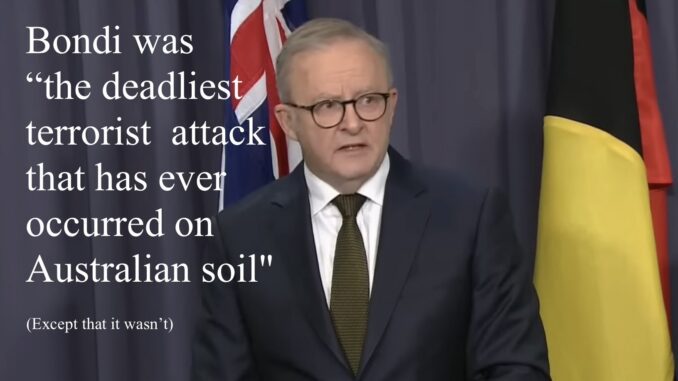
It was, he said, “the deadliest terrorist attack that has ever occurred on Australian soil” (Albanese 2026).
Fifteen people were murdered at Bondi on 14 December 2025. There is no argument about the horror of what occurred, nor any reason to diminish the suffering of the victims, their families or the Jewish community that was targeted.
But Albanese’s wording contains two sweeping propositions that deserve scrutiny: that Bondi was the deadliest terrorist attack on Australian soil, and that this remained true across the whole span of Australian history – ever.
Those propositions can only be tested by asking what counts as terrorism. If politically or ideologically motivated violence is deliberately used to intimidate a population, then Australia’s frontier record cannot simply be excluded because the perpetrators were colonial authorities, police, soldiers or settler forces, or because the events have traditionally been labelled massacres rather than terrorism.
Some of those massacres killed more than 15 people. In some cases, the historical evidence records an explicit purpose of terrorising Aboriginal communities, punishing resistance and forcing submission.
That directly challenges the word deadliest. And because Albanese said ever, the comparison cannot sensibly begin only with Australia’s modern counter-terrorism era.
To test the claim honestly, we need to ask what terrorism means now, what the term originally meant, and whether documented frontier massacres meet those substantive characteristics.
That is where truth-telling enters the argument.
What makes violence ‘terrorism’?
Australia’s current legal definition is useful because it tells us what supposedly separates terrorism from other terrible acts of violence.
Under the Criminal Code, a terrorist act must involve violence or threatened violence intended to advance a political, religious or ideological cause, together with an intention to intimidate the public or a section of the public, or to coerce or influence a government through intimidation. It must also cause or threaten consequences such as death, serious physical harm, serious property damage or serious danger to public safety (Attorney-General’s Department n.d.; Commonwealth of Australia 2026).
In other words, it isn’t simply the body count that makes an atrocity terrorism.
It is the purpose.
Violence is being used not only to kill the immediate victims, but to send a message to others.
Fear itself becomes a weapon.
Indeed, in a 2025 speech discussing Australia’s terrorism laws, Attorney-General Michelle Rowland described terrorism as violence motivated by a cause and intended to influence or intimidate a wider community. She noted that Australia’s statutory definition of a terrorist act was first introduced into the Criminal Code in 2002 (Rowland 2025).
So let us take that principle seriously.
And let us take it back through Australian history.
Massacre and terrorism are not mutually exclusive categories. A massacre describes the nature and scale of a killing; terrorism describes the use of violence as a means of political, ideological or religious intimidation. An event can be both.
Applied historically – not as retrospective criminal liability, but as an analytical test – the question is straightforward: was serious violence used for a political or ideological purpose with the intention of intimidating a wider population? Where the documentary evidence says yes, the fact that history has conventionally called the event a frontier massacre does not make its terroristic purpose disappear.
Mount McMinn: when ‘terror’ was the stated objective
In 1875, on the Roper River frontier in what is now the Northern Territory, a punitive expedition followed the deaths of two white men, Charles Johnston and Abram Daer.
At Mount McMinn, an estimated 40 Mangarayi Aboriginal people were killed.
The University of Newcastle’s Colonial Frontier Massacres project classifies the attack as a reprisal and records contemporary evidence from the Northern Territory Times and Gazette (Ryan et al. 2024a).
What makes this particular episode so important to the terrorism comparison is the language used at the time.
Discussing the punitive operations and the indiscriminate hunting of Aboriginal people, the newspaper nevertheless declared it desirable to “strike terror into the hearts of the natives” so that they understood that white lives could not be taken without punishment (Ryan et al. 2024a).
Forty people dead.
Violence as reprisal.
And an explicitly stated desire to terrorise the wider Aboriginal population into changing its behaviour.
If the deliberate use of lethal violence to advance a political or social objective by instilling fear in a population is one of the defining characteristics of terrorism, what exactly are we supposed to call that?
Certainly, nobody could now be charged retrospectively under a Commonwealth terrorism law enacted more than a century later.
But that is a question of legal jurisdiction and historical chronology.
The historical evidence does, however, answer the question Albanese raised when he used the words “deadliest” and “ever”: at Mount McMinn, lethal violence was deliberately used to terrorise a wider Aboriginal population, and the estimated death toll was 40 – well above Bondi’s 15.
Pinjarra: ‘appall them as a people’
Then there is Pinjarra.
On 28 October 1834, Governor James Stirling led soldiers, police and settlers against the Pinjarup Noongar people in Western Australia.
The University of Newcastle database gives an estimated death toll ranging from 15 to 80 people (Ryan et al. 2024b).
Here, both questions matter: how many people were killed, and whether the violence was inflicted for a terroristic purpose.
According to the historical material assembled by the Newcastle research team, Stirling reported that his purpose was to punish the group, weaken them, instil fear and break their resistance. His language spoke of inflicting severity sufficient to “appall them as people” (Ryan et al. 2024b).
Survivors were reportedly warned that renewed resistance could bring a force four times larger that would destroy every man, woman and child (Ryan et al. 2024b).
Consider those elements.
Political authority.
Organised lethal violence.
A population being punished collectively.
An intention to break resistance.
An intention to instil fear beyond the immediate victims.
A threat of still greater violence should resistance continue.
If those characteristics appeared in a contemporary prosecution brief involving some modern extremist organisation, would we have much difficulty identifying the terroristic purpose?
Yet place the same behaviour in a red coat or colonial uniform and two centuries suddenly seem to change our vocabulary.
It becomes a ‘punitive expedition’.
A ‘dispersal’.
A ‘frontier encounter’.
Perhaps, eventually, a ‘massacre’.
But rarely terrorism.
Why?
Before terrorism meant what we think it means
There is an historical irony here that is too important to ignore.
The word terrorism did not begin as a description of clandestine groups attacking governments. Its political lineage runs in the opposite direction.
The words terrorism and terrorist entered English from French usage associated with the Reign of Terror of 1793-1794, when the revolutionary government used organised, official violence – including executions – against those regarded as enemies of the Revolution. Early English usage referred to this state-sponsored system of intimidation; Merriam-Webster notes that the original political sense was violence perpetrated by government (Merriam-Webster n.d.).
That history matters. The original terrorist was not necessarily a masked outsider plotting against the state. The word emerged from a political system in which the state itself used terror as an instrument of rule.
The timing is historically eerie. The First Fleet arrived in January 1788, marking the beginning of British colonisation in Australia. The French Revolution began the following year, in 1789. The Reign of Terror followed in 1793-1794, and the new vocabulary of terrorism was circulating in English by the middle of that decade (National Museum of Australia n.d.; Merriam-Webster n.d.).
There is no evidence that the French Terror caused Australian frontier violence, and none is needed for the comparison. The point is conceptual, not causal: the political language of terrorism was being born at almost the same historical moment that the colonial project in Australia was beginning.
And in its original political meaning, terrorism was not something the state merely fought. It was something the state could do.
That makes the question of frontier massacres more, not less, relevant to any claim about the deadliest terrorist violence ever committed on Australian soil.
It also leads to another term that is useful when discussing state killing: democide.
Political scientist R.J. Rummel coined democide as an umbrella concept for intentional killing by government, including genocide, politicide and mass murder. In his formulation, democide includes massacre and can include the direct targeting of non-combatants in violent conflict where the purpose is to terrorise or force a population into submission (Rummel 1994).
Democide is not a criminal offence in Australian law, and Rummel’s framework is not universally accepted as the only or definitive way to classify state killing. But the concept is useful because it exposes a blind spot in everyday political language: a government can kill for ideological or political purposes, can target a population, and can use fear to compel obedience even when contemporary officials refuse to describe that conduct as terrorism.
Indeed, modern Australian law itself no longer assumes that terrorism can only be committed by non-state actors. The Criminal Code Amendment (State Sponsors of Terrorism) Act 2025 created a contemporary framework for state sponsors of terrorism and state terrorist acts (Commonwealth of Australia 2025; Attorney-General’s Department n.d.).
The vocabulary has, in one sense, come full circle.
Terrorism apparently depends on who is doing the terrorising
This is where the word ever becomes more than a historical technicality.
It raises the uncomfortable question of whether Australia applies the word terrorism consistently.
When ideological violence is committed against civilians by people outside the state, we readily examine whether the attackers intended to frighten a broader community.
When state authorities or settler forces used mass killing explicitly to frighten Aboriginal communities into abandoning resistance, the same concept is usually filed somewhere else in the historical cabinet.
That distinction makes sense in a criminal courtroom.
It is much harder to defend as a description of history.
Nobody is suggesting Governor Stirling could somehow be retrospectively prosecuted under legislation created in 2002.
Nor should historians simply transplant twenty-first-century criminal offences wholesale into 1834.
But we can still examine conduct according to its purpose.
Historians routinely use concepts that did not exist in statutory form at the time of the events they describe.
And the question here isn’t whether a colonial official committed the modern Commonwealth offence of terrorism.
The question is whether organised violence was deliberately used as terror to achieve political or ideological ends.
In some frontier massacres, the documentary evidence says that it was.
That is also where the older meaning of terrorism and the later concept of democide intersect. The first reminds us that terror was historically understood as a method available to governments. The second gives us a vocabulary for intentional government killing that modern terrorism discourse can otherwise obscure.
Seen through that lens, the neat division between ‘terrorism’ and ‘frontier massacre’ begins to look less like a moral distinction and more like a classification choice.
This wasn’t an isolated episode
The scale of Australian frontier violence also makes it impossible to dismiss these examples as obscure footnotes.
The University of Newcastle’s completed Colonial Frontier Massacres database records 438 frontier massacres and 10,657 victims. Of those, 10,374 Aboriginal and Torres Strait Islander people are recorded as victims of massacres by colonists. The researchers stress that their figures are conservative minimum estimates based only on events for which sufficient evidence survives (Ryan et al. 2024c).
The database identifies 23 groups of massacres in which expeditions moved through areas carrying out repeated killings; the project states that such groups were intended to eradicate an entire group of people from an area. It also records state agents as participants in 225 massacres, or 51 per cent of the total, involving an estimated 5,300 victims (Ryan et al. 2024c).
That does not mean every frontier massacre should automatically be labelled terrorism.
Motives differed.
Evidence differs.
Some killings were opportunistic. Some were revenge. Some accompanied dispossession. Others occurred amid genuine frontier warfare.
History deserves more care than simply attaching the same label to every atrocity.
But precisely the same caution should apply in the other direction.
We should not automatically exclude colonial massacres from consideration merely because official Australia has traditionally placed them in a different historical category.
Where there is evidence of mass killing carried out specifically to intimidate a population, crush resistance or frighten survivors into submission, the resemblance to the principle underlying our modern definition of terrorism is difficult to avoid.
The problem is ‘deadliest’ – and ‘ever’
By this point, the problem with Albanese’s wording is concrete: both deadliest and ever depend on excluding documented frontier violence that bears the substantive characteristics of terrorism.
The word deadliest is a numerical claim. If a frontier massacre involved terroristic purpose and killed more than 15 people, then Bondi cannot be the deadliest terrorist attack in the historical sense asserted by the Prime Minister.
Mount McMinn, with an estimated 40 Aboriginal people killed and contemporary language explicitly advocating that terror be struck into Aboriginal hearts, exceeds Bondi’s death toll. Pinjarra, with estimates ranging from 15 to 80 and documented intent to minstil fear and break resistance, may do so as well (Ryan et al. 2024a; Ryan et al. 2024b).
That challenges deadliest.
The word ever makes the problem broader still.
Ever sets no temporal boundary. It makes a claim about the whole history of violence on Australian soil, not merely incidents prosecuted or officially classified under contemporary counter-terrorism laws.
It therefore reaches beyond the modern security lexicon and into the colonial period, when organised lethal violence was sometimes used explicitly to intimidate populations, crush resistance and impose political authority.
Once a Prime Minister reaches for the word ever, Australia’s whole history enters the room.
That includes the history before Federation.
It even reaches back to a period before the name Australia had entered official colonial usage. Governor Lachlan Macquarie first used the name officially in 1817 – yet the land and its peoples did not suddenly acquire a history when the colonial administration settled on a name.
It includes Aboriginal history.
It includes frontier violence.
And it includes documented instances in which Aboriginal Australians were killed in numbers greater than fifteen for the expressly articulated purpose of frightening their communities into submission.
Perhaps the problem is not history, but memory
There is another reason this distinction matters.
Australia is currently engaged in an often bitter argument about truth-telling.
We hear constant demands that history be accurate, evidence-based and stripped of political exaggeration.
Fair enough.
But that standard has to operate in both directions.
If contemporary Australia defines terrorism partly by the deliberate use of violence to frighten a wider population for political or ideological purposes, then truth-telling cannot simply start the historical clock when modern governments began using the terrorism label.
Our own history contains episodes in which fear was consciously used as an instrument of policy, reprisal and dispossession.
The people carrying it out did not necessarily call themselves terrorists.
Of course they didn’t.
People exercising power rarely describe their own violence that way.
The important question is what they did, what they intended, and what message the killing was designed to send to those left alive.
At Mount McMinn, forty people were killed and contemporary commentary expressly spoke of the desirability of striking terror into Aboriginal hearts (Ryan et al. 2024a).
At Pinjarra, the historical record describes a colonial governor seeking to instil fear, weaken a people and break their resistance, with estimates of the dead reaching far beyond fifteen (Ryan et al. 2024b).
Nothing in that historical reckoning lessens the horror of Bondi by a single life.
Those episodes do, however, directly challenge both elements of the Prime Minister’s historical superlative.
They challenge deadliest because documented frontier massacres with a terroristic purpose killed more than 15 people. They challenge ever because the Prime Minister’s wording purports to encompass the whole history of violence on Australian soil while excluding a colonial history in which terror was deliberately used as an instrument of political authority, reprisal and dispossession.
A narrower claim confined to Australia’s modern counter-terrorism framework would have a defined historical boundary. Deadliest ever does not.
It asks history, not merely contemporary national-security vocabulary, to supply the answer.
And if a Prime Minister says ever, then truth-telling requires Aboriginal history, frontier massacres, the original state-centred meaning of terrorism and democide to be part of the historical reckoning.
If we are going to use the word ever, Aboriginal Australians are not an optional footnote to that reckoning. They are part of the history the word itself claims to encompass.
References
Albanese, A. 2026, ‘Press conference – Sydney‘, Prime Minister of Australia, 30 April, viewed 11 August 2026.
Attorney-General’s Department n.d., ‘Australia’s counter-terrorism laws‘, Australian Government, viewed 11 August 2026.
Commonwealth of Australia 2025, Criminal Code Amendment (State Sponsors of Terrorism) Act 2025 (Cth), Act No. 60 of 2025, Federal Register of Legislation, viewed 11 August 2026.
Commonwealth of Australia 2026, Criminal Code Act 1995 (Cth), compilation 30 June 2026, Federal Register of Legislation, viewed 11 August 2026.
Merriam-Webster n.d., ‘The history of the word terrorism‘, Merriam-Webster, viewed 11 August 2026.
National Museum of Australia n.d., ‘The First Fleet arrives at Sydney Cove‘, Digital Classroom, viewed 11 August 2026.
Rowland, M. 2025, ”Defining Terrorism’ – INSLM Review,” speech, Attorney-General’s portfolio, Australian Government, 11 August, viewed 11 August 2026.
Rummel, R.J. 1994, Death by Government, Transaction Publishers, New Brunswick, NJ; chapter 2, ‘Definition of Democide’, University of Hawaii, viewed 11 August 2026.
Ryan, L., Debenham, J., Pascoe, B., Smith, R., Owen, C., Richards, J., Craig, H., Gilbert, S., Anders, R.J., Usher, K., Price, D., Newley, J. & Brown, M. 2024a, ‘Mount McMinn‘, Colonial Frontier Massacres in Australia, 1788-1930, Stage 5.0, Centre for 21st Century Humanities, University of Newcastle, viewed 11 August 2026.
Ryan, L., Debenham, J., Pascoe, B., Smith, R., Owen, C., Richards, J., Craig, H., Gilbert, S., Anders, R.J., Usher, K., Price, D., Newley, J. & Brown, M. 2024b, ‘Pinjarra‘, Colonial Frontier Massacres in Australia, 1788-1930, Stage 5.0, Centre for 21st Century Humanities, University of Newcastle, viewed 11 August 2026.
Ryan, L., Debenham, J., Pascoe, B., Smith, R., Owen, C., Richards, J., Craig, H., Gilbert, S., Anders, R.J., Usher, K., Price, D., Newley, J. & Brown, M. 2024c, ‘Statistics‘, Colonial Frontier Massacres in Australia, 1788-1930, Stage 5.0, Centre for 21st Century Humanities, University of Newcastle, viewed 11 August 2026.
Keep Independent Journalism Alive – Support The AIMN
Dear Reader,
Since 2013, The Australian Independent Media Network has been a fearless indepen dent voice – holding power to account and delivering journalism that matters.
Running this site isn’t cheap. Rising costs mean we need your support now more than ever. Every donation, big or small, keeps our servers running, our writers working, and our stories free for everyone.
Donate here:
PayPal or credit card – just click on the Donate button below
Direct bank transfer: BSB: 062500; A/c no: 10495969

We’ve also set up a GoFundMe as a dedicated reserve fund for hosting and future improvements.

Thank you for standing with us. We couldn’t do this without you.
With gratitude,
The AIMN Team
Thank you Nick
Kennaook (Cape Grim), where Aboriginal people were shot and their bodies thrown off the cliffs. There’s no official count, but estimates and eye-witness testimony say around 30 people.