How Sport demonstrates our need for Rules Based Order, so we don’t fail the fairness Test.
I was delighted when former Socceroo, broadcaster, film producer, author, and refugee advocate Craig Foster agreed to be interviewed on my new Love, Laughter and Kindness podcast. With such a wide listening and viewing audience as he attracts, his willingness to join my small endeavour was a tribute to his generosity.
Foster, the former Socceroos captain turned human rights advocate, traced his own path from the Soccer pitch to public advocacy and back to the culture of team sport itself. Being part of a high-functioning team, he explains, means caring for teammates and for the rules that let everyone compete on equal footing. That instinct to protect the players with the least leverage – the youngest, the most vulnerable – was, he believes, the same instinct that later pulled him toward advocacy for refugees and other marginalised groups. As he puts it, a fellow Australian is a teammate in a broader sense – and so, eventually, is a refugee on the other side of the world.
Sport as a mirror for fairness
The current debacle with the FIFA World Cup where powerful actors who don’t need to be named, demanded and were given special attention resulted in the game and FIFA being devalued. So good to note Belgium defeating the USA despite the Trump administration’s interference in fair play.
Craig spoke of how changing the rules to favour a powerful country undermined the very idea of a level playing field. For athletes who have spent their careers competing under clear, consistent rules, he said, this kind of inconsistency feels like a personal affront.
He extended that same logic to global politics: powerful nations, he argued, are rarely held accountable in the way smaller or weaker nations are. He notes a pointed contrast between the international prosecution of a leader like the Philippines’ Duterte, and the near-total lack of accountability faced by more powerful governments accused of similar conduct.
Referencing Canadian Prime Minister Mark Carney’s recent remarks on the so-called “rules-based order,” Foster argued that the underlying legal frameworks – human rights law, international law – are sound, but their application is wildly uneven depending on who is accused.
Refugees, conflict, and the dots we don’t connect

I raised with Craig the issue of refugees and questioned our responses to them and world situations that caused people to flee for safety. Craig spoke candidly about his 2024 documentary work in the Cox’s Bazar refugee camp in Bangladesh, home to over a million Rohingya refugees. His central argument: media and public discourse rarely connect the dots between the conflicts wealthy nations participate in or support. In Australia when people argue against refugees arriving here, we are not reminded of the fact that our involvement in wars and conflicts that created the situation have produced the need for sanctuary for the people who then seek our help.
Craig spoke of how countries treat refugee crises as a border-control problem. An example being Australia’s involvement in the Iraq War and refugees from that. He extended the same critique to climate change, framing both as failures of nations to honour commitments – like the Paris Agreement – that they’ve already signed onto.
Call for a Kindness Summit
I asked Craig about my belief that we should have something like a Kindness Summit to examine how we perform as a nation in regards to government, sport, education and business.
This idea is part of the podcast’s broader vision for a kindness movement led by children. Why Kindness? Well my belief is that close to home and far afield the lunacy of the Fascist wrong, (right doesn’t seem quite right there) is doing too much damage. Kindness is one thing that they don’t demonstrate with their hatred of any group that serves their purpose venting their spleens, but Kindness can drain their swamps.
Craig spoke of kindness needing a framework, and the clearest one being the human rights framework: the right to housing, education, enough food to eat, freedom from discrimination and racism. Kindness, in his view, isn’t just warmth – it’s also about holding people and countries accountable, because peace itself depends on rules being upheld rather than power being imposed.
He was careful to note that no religion, ideology or nation has a monopoly on either kindness or extremism – citing the atrocities committed against the Rohingya, perpetrated by people of what most people recognise as the peace loving Buddhist faith, stands as a reminder that extremism can emerge from any tradition.
Proximity as the antidote to hatred
One of the episode’s most resonant ideas was Foster’s belief that proximity is the most powerful disinfectant to hatred and racism. Drawing on his own experience in football dressing rooms – sitting alongside teammates of every faith, background and political view – he argued that dehumanisation thrives on distance, and collapses once people actually get to know one another. He cited the Biloela community in Queensland, who rallied around a Sri Lankan refugee family, as a real-world example of a community that chose proximity and connection over fear.
Peter Norman: a quiet act of courage
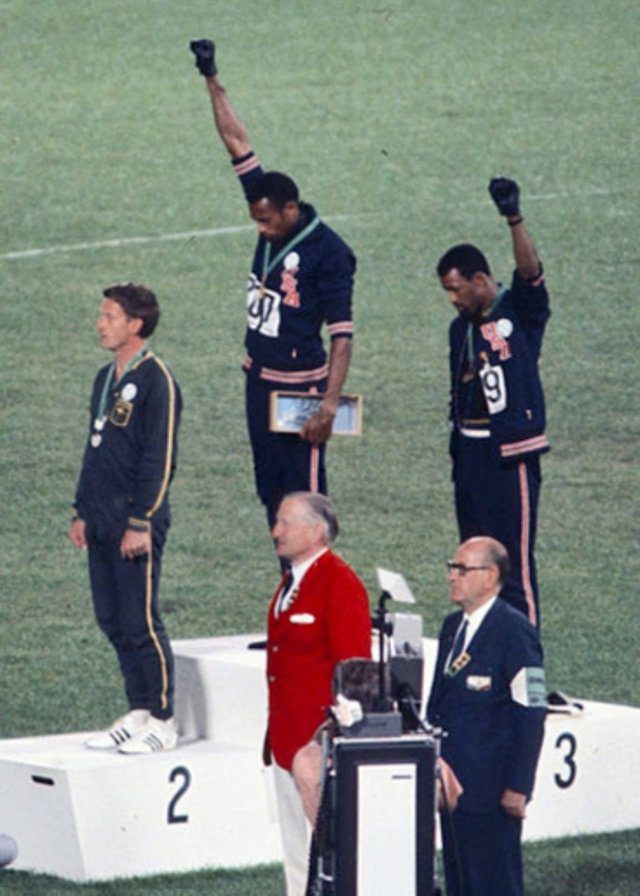
I put Craig on the spot by asking him to name an act of kindness in sport that stayed with him. He chose Peter Norman – the Australian sprinter who stood on the podium at the 1968 Mexico Olympics alongside Tommie Smith and John Carlos during their Black Power salute. Norman wore a human rights badge in solidarity, and paid for it: there were mixed feelings when he arrived back in Australia and he was not celebrated as the hero that many felt he was.
The podcast finishes with a tribute to Peter Norman and references his funeral in Melbourne where Tommie Smith and John Carlos carried his coffin and spoke eloquently of their friend.
The takeaway
Across the conversation, Foster’s throughline was consistent: kindness isn’t simply a feeling — it’s a discipline, built on fair rules, consistently applied, and a challenge to get close enough to people different from us to recognise our shared humanity.
This episode follows on from the first with another great Australian, Hugh Mackay, author of 25 books including “The Kindness Revolution” – researcher turned advocate. Hugh was magnificent as I would expect. The second features Guy Dauncey, Canadian resident, Futurist, Environmentalist and author. His new book “The Economy of Kindness” is being published soon. His views on community, global failures, the environment and hope for the future are really worth examining.
Faced with such bad news and views in the world around us, Guy has a belief that speaks to it perfectly:
“The Power of our Vision must be so much stronger than the power of our Fear.”
Next week I’ll publish an interview with Ros Ben-Moshe and Sally Pymer about laughter, kindness and the power of a smile to change our world.
Ros is a Keynote Speaker, Author, and Coach in Laughter, Resilience and Wellbeing. She is also an adjunct lecturer at La Trobe University. Her international best selling book “The Laughter Effect“ has been published in 8 different languages – which only goes to prove people of all cultures, creeds and ethnicities love to laugh.
Sally lives on a farm in rural Victoria. She writes a fortnightly column “Smiles with Sally” for her local paper in Horsham. She has a background in Psychology, Alcohol and Other Drug Counselling, Motivational Interviewing, Narrative Therapy, Fitness, health promotion and community development she works to rebuild trust and belonging and connection one smile at a time!
Sally and Ros share their belief in Love, Laughter and Kindness and tell their stories of turning life around after serious illness and other challenges of life.
If you like the podcast or just this article please leave a comment. I’m trying to build a movement that will help change our world and maybe even introduce that Kindness Summit too. Mischievously I think as a nation we sometimes need a good regular checkup – that would naturally include blood or other pressure, temperature, heart rate and from time to time even a colonoscopy… especially when you hear the nonsense from some people who claim to be politicians.
Oops. Sorry, I should be more kind.
The YouTube Podcast is available on my website Podcast – Love, Laughter & Kindness – Zorzle and the audio version on Spotify, Apple Podcasts, Amazon Music, Listen Notes, and the RSS.com community
Also by David
The Party That Killed Democracy
What if Chicago or Brisbane was Gaza?
Keep Independent Journalism Alive – Support The AIMN
Dear Reader,
Since 2013, The Australian Independent Media Network has been a fearless independent voice – holding power to account and delivering journalism that matters.
Running this site isn’t cheap. Rising costs mean we need your support now more than ever. Every donation, big or small, keeps our servers running, our writers working, and our stories free for everyone.
Donate here:
PayPal or credit card – just click on the Donate button below
Direct bank transfer: BSB: 062500; A/c no: 10495969

We’ve also set up a GoFundMe as a dedicated reserve fund for hosting and future improvements.

Thank you for standing with us. We couldn’t do this without you.
With gratitude,
The AIMN Team

A great article.
While reading, the thought occurred to me that Craig Foster would make a great Australian of the Year.
Then I was somewhat ashamed that I had not recognised this years ago.
Onya, Fozz.
Thanks David, for sharing your insights into your interview.
Craig is outspoken in his opposition to genocide and pro-Palestine stance. After being a part of SBS’s broadcast of 6 male and 4 female World Cups for some reason, best known to them and anyone who may have heavied them, SBS chose to leave Craig out of this years World Cup broadcast – perhaps they thought it was time to share kindness in someone else’s direction.
Norman’s feat was matched by Raeline Boyle, which perhaps gives a benchmark for how much of a personal sacrifice Norman made by showing solidarity when you compare the treatment of each back in Australia.
The day of Norman’s funeral, 9 March, is remembered as Peter Norman Day by USA track and field.