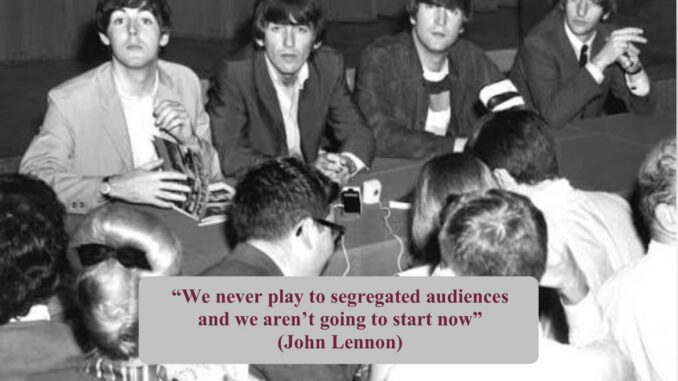
In September 1964, Beatlemania was sweeping the United States. Everywhere they went, John Lennon, Paul McCartney, George Harrison and Ringo Starr were greeted by screaming fans, packed stadiums and unprecedented media attention. The Beatles could seemingly do no wrong.
Yet one of the most important things they did during their first American tour had nothing to do with music.
It happened in Jacksonville, Florida, where the Beatles were scheduled to perform at the Gator Bowl on September 11, 1964. At the time, racial segregation remained a reality across much of the American South. Despite the gains made by the Civil Rights Movement, many public venues still separated Black and White patrons.
When the Beatles learned that audience members at their concert might be segregated according to race, they drew a line in the sand.
They refused to perform.
John Lennon made the band’s position crystal clear: they would not play before a segregated audience. If segregation remained in place, they were prepared to walk away from the concert altogether.
“We never play to segregated audiences and we aren’t going to start now. I’d sooner lose our appearance money.”
For the promoters, this was a nightmare scenario. The Beatles were the biggest act in the world. Thousands of tickets had been sold. The event was expected to generate enormous publicity and revenue. Cancelling the concert would have been both financially and publicly disastrous.
Faced with that choice, the organisers backed down.
The audience was integrated, and the concert went ahead.
Looking back more than sixty years later, it is easy to underestimate the significance of what happened. The Beatles were not politicians. They were not civil rights leaders. They were not Americans. They were four young musicians from Liverpool whose extraordinary success had given them a platform unlike any other.
Yet when confronted with racial discrimination, they chose not to remain silent.
Their stance was particularly noteworthy because they were performing in a region where opposition to integration remained strong. It would have been far easier – and far more profitable – to say nothing. Instead, they risked alienating some fans and promoters by insisting that Black and White concertgoers be treated equally.
The decision reflected more than simple common sense. The Beatles had built their musical careers on foundations laid by African American artists. Rock and roll itself owed an enormous debt to Black musicians such as Little Richard, Chuck Berry and countless others whose influence shaped modern popular music. To the Beatles, segregation was not only morally wrong; it was fundamentally at odds with the music they loved.
Their stand in Jacksonville was not a one-off gesture. The band later ensured that contracts for their American appearances included provisions preventing them from performing before segregated audiences.
The story serves as a reminder that history is not made only by presidents, judges and activists. Sometimes it is shaped by people who simply decide that something is wrong and refuse to go along with it.
The Beatles did not end racism in America. They did not dismantle segregation across the South. But on one September day in 1964, they used their immense popularity to challenge discrimination and win.
At a time when many people chose silence, the Beatles chose principle.
And that is why the story remains worth telling.
For all the songs, records and accolades that made them famous, one of the Beatles’ finest performances may have been the concert they almost never played.
Also by Michael Taylor
Independent Media: Democracy’s Last Line of Defense
Keep Independent Journalism Alive – Support The AIMN
Dear Reader,
Since 2013, The Australian Independent Media Network has been a fearless voice for truth, giving public interest journalists a platform to hold power to account. From expert analysis on national and global events to uncovering issues that matter to you, we’re here because of your support.
Running an independent site isn’t cheap, and rising costs mean we need you now more than ever. Your donation – big or small – keeps our servers humming, our writers digging, and our stories free for all.
Join our community of truth-seekers. Please consider donating now via:
PayPal or credit card – just click on the Donate button below
Direct bank transfer: BSB: 062500; A/c no: 10495969

We’ve also set up a GoFundMe as a dedicated reserve fund to help secure the future of our site.
Your support will go directly toward covering essential costs like web hosting renewals and helping us bring new features to life. Every contribution, no matter the size, helps us keep improving and growing.

Thank you for standing with us – we truly couldn’t do this without you.
With gratitude, The AIMN Team

Much of the success against racial discrimination in the USA (Undemocratic Sewer of Apartheid) was made by the actions of many performing artists.
Frank Sinatra refused to perform when Rat Pack member Sammy Davis Junior was told by the desk clerk at the hotel performance venue to ”go around to the back door through the kitchen”, until that same desk clerk gave Davis the same courtesy as Frank received.
What colour is love, achievement, commitment, care, responsibility, awareness, decency? Racism must end eventually, for humanity’s sake.
Nina Simone’s life was defined by her opposition to racism in America. A child prodigy, her music teacher had arranged for her to perform for an audience of local townspeople in her hometown of Tryon, North Carolina. Arriving at the hall, she found that her parents, who’d been sitting in the front row, had been forced to move to the back of the hall to make way for white people.
She refused to perform until her parents were allowed to return to the seats at the front.
I don’t know if she ever met the Beatles, but I’m certain she would have been sympathetic with their position.