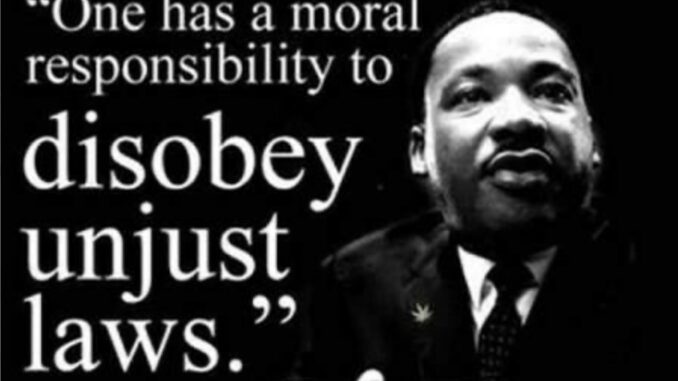
At the heart of any healthy society lies a fundamental moral question: When does adherence to the law conflict with the demands of justice? This tension strikes at the core of our ethical obligations as citizens. While the rule of law provides the foundation for stable democratic governance, there are moments when blind obedience to flawed or oppressive statutes becomes not only questionable but morally untenable. In such cases, civil disobedience emerges not merely as a permissible option, but often as a necessary ethical duty.
The principle is straightforward yet profound: citizens have a responsibility to challenge laws that institutionalise or sustain injustice, even if doing so disrupts legal norms. This does not reject the value of lawful order outright – democracies rely on it for predictability and fairness – but it insists that law must ultimately serve justice, not supplant it. When statutes entrench harm or inequality, passive compliance can erode the moral fabric of society.
This perspective draws from a rich tradition in political philosophy. In his influential 1849 essay “Civil Disobedience,” Henry David Thoreau contended that individuals must not surrender their conscience to the state. If a government enacts policies or laws that violate deeply held moral principles, citizens have a duty to resist rather than become instruments of injustice. Thoreau’s stance, born from opposition to slavery and the Mexican-American War, emphasised personal integrity over unthinking loyalty to authority.
Philosopher John Rawls advanced a more systematic framework in A Theory of Justice. He argued that, within a broadly democratic and “nearly just” society, civil disobedience can be a legitimate response to serious violations of core principles – such as equal liberty or fair equality of opportunity. For Rawls, such acts must be public, non-violent, and aimed at appealing to the community’s shared sense of justice, rather than mere personal rebellion. They function as a corrective mechanism when standard political channels prove insufficient.
These ideas resonate with Australian discussions of law, power, and social change. Jim Cairns, in works like The Quiet Revolution, explored how ordinary people and movements can drive ethical shifts against entrenched systems, often through forms of protest that test legal boundaries. Similarly, in 2017, ACTU Secretary Sally McManus sparked intense national debate when she stated that she had “no problem” with workers breaking laws they viewed as unjust, particularly in contexts like workplace safety or fair pay where existing rules tilted heavily against employees. She framed this by affirming belief in the rule of law – when it is fair and right – but rejecting it when it perpetuates harm.
McManus’s comments, made shortly after assuming her role, ignited swift backlash from conservative commentators and politicians. Critics warned that endorsing selective law-breaking by union leaders could undermine democratic stability, erode respect for institutions, and invite chaos. Media coverage amplified the divide, with some outlets highlighting fears that such rhetoric threatened the legitimacy of legal authority and social order. The episode brought underlying tensions into sharp relief: the clash between prioritising security and institutional continuity on one hand, and pursuing substantive justice on the other.
This public flare-up underscored a deeper dilemma. Loyalty to unjust laws does not always preserve democracy – it can corrode it from within by normalising inequity and alienating those harmed by the system. Political responses at the time, including heightened scrutiny of union activities (such as Bill Shorten’s appearance before the Royal Commission into Trade Union Governance and Corruption in July 2015), reflected broader anxieties about where the boundaries of protest and resistance should lie.
Ultimately, debates over civil disobedience force us to weigh competing values – order, security, legitimacy, and justice – within a democratic framework. Theorists across traditions acknowledge the inherent ethical friction: breaking the law is, by definition, illegal, yet its moral justification hinges on the severity of the injustice, the exhaustion of lawful remedies, and the commitment to non-violence and public accountability. The McManus controversy illustrates this vividly: calls for resistance to perceived unjust laws do not merely provoke disagreement; they compel society to confront the ethical responsibilities of both citizens and leaders when law and morality diverge.
To grasp the full stakes of this debate, it is essential to consider it from multiple angles. A multifaceted approach reveals the intricate trade-offs involved in civil disobedience and its potential to reshape societies for the better – or, in some cases, to destabilise them.
At its core, the dilemma is stark: Can a democratic society justly demand unwavering obedience to laws that embed or perpetuate injustice? Or do citizens have a higher obligation to scrutinise, challenge, and, when necessary, defy such laws – even when surface-level compliance seems orderly and reasonable?
History offers compelling answers through the lives of transformative figures who chose resistance over conformity. Imagine a world without Mahatma Gandhi’s campaign of non-violent defiance against British colonial rule in India, Nelson Mandela’s long struggle against apartheid in South Africa, Martin Luther King Jr.’s leadership in the American civil rights movement, or Rosa Parks’s quiet yet seismic refusal to yield her bus seat. Each of these individuals deliberately broke laws they regarded as profoundly unjust, and their actions helped dismantle systems of oppression that had long seemed immovable. Their legacies demonstrate how targeted civil disobedience can catalyse profound social and political change when moral conviction confronts entrenched power.
This raises a more difficult question: Does mere personal moral disagreement with a law provide sufficient justification for breaking it? Laws and the order they sustain represent one of civilisation’s greatest achievements, providing predictability, security, and a framework for coexistence. Yet we must also acknowledge a basic truth: laws are made by fallible human beings, operating within imperfect institutions. Even in well-functioning democracies, errors occur—not merely through malice, but through ignorance, bias, or the inevitable limitations of human judgment. Some laws are enacted with good intentions but produce harmful outcomes; others are crafted to protect powerful interests at the expense of the vulnerable.
Whistleblowers offer particularly vivid illustrations of this tension. Figures such as Daniel Ellsberg, who leaked the Pentagon Papers in 1971, Mark Felt (known as “Deep Throat”) in the Watergate scandal, Chelsea Manning, and Edward Snowden each chose to violate the law in order to expose what they saw as grave government misconduct hidden from public view.
Ellsberg’s actions revealed critical truths about the Vietnam War and the extent of official deception, compelling both the public and policymakers to reassess the morality of state secrecy during wartime. Felt’s leaks helped unravel the Watergate cover-up, contributing directly to President Nixon’s resignation and sparking broader conversations about presidential accountability and institutional integrity. Manning’s and Snowden’s disclosures, meanwhile, ignited global debates about the delicate balance between national security imperatives and the rights to privacy and governmental transparency.
These cases highlight the double-edged nature of civil disobedience. On one hand, such acts can serve as vital correctives, forcing societies to confront hidden injustices and prompting meaningful reforms in areas like oversight, accountability, and civil liberties. On the other, they inevitably raise serious concerns about national security, the protection of classified information, and the potential for unintended consequences that could undermine public trust or endanger lives. By stepping outside legal boundaries, whistleblowers do more than reveal misconduct – they compel citizens and institutions alike to weigh the costs and benefits of pursuing justice through extralegal means.
Critics of whistleblowing and civil disobedience raise compelling counterarguments. They contend that even well-intentioned lawbreaking can erode social cohesion, undermine public institutions, and compromise national security. When individuals place their personal moral judgment above the law, they risk endangering innocent lives, straining international relations, or inadvertently aiding adversaries. Moreover, established legal channels – such as elections, judicial review, parliamentary debate, and regulated protests – already provide structured avenues for dissent. Bypassing these mechanisms, critics warn, weakens trust in the system and creates dangerous precedents that could encourage selective obedience based on subjective beliefs.
This perspective finds strong philosophical grounding in thinkers like Thomas Hobbes. In his seminal work Leviathan, Hobbes argued that absolute obedience to sovereign authority is essential to prevent society from descending into a chaotic “state of nature,” where life becomes “solitary, poor, nasty, brutish, and short.” According to this view, the social contract demands that citizens collectively uphold the law, even when particular statutes seem imperfect or mildly unjust, because the alternative – widespread defiance – threatens the very stability that makes civilised life possible.
From a legal standpoint, the principle of the rule of law insists that no individual or group stands above the law. Allowing exceptions based on personal conscience, critics argue, risks a slippery slope: what begins as principled resistance could devolve into widespread lawlessness justified by ever-shifting moral claims. Democracies, they point out, are designed with built-in mechanisms for reform, including courts that can strike down unjust legislation, legislatures open to public pressure, and protected rights to peaceful protest.
Yet proponents of civil disobedience counter that these formal channels sometimes prove inadequate when confronting deeply entrenched injustices or institutional failures that legal processes are slow – or unwilling – to address. As noted in the Stanford Encyclopedia of Philosophy, far from necessarily undermining legal authority or democratic stability, carefully conducted civil disobedience can actually strengthen the social and legal order. By publicly highlighting moral failings and prompting collective reflection, such acts can drive meaningful improvements and reinforce the legitimacy of democratic institutions over time.
The tension between these positions highlights the profound ethical balancing act required in evaluating civil disobedience. Each case demands weighing the duty to expose and resist injustice against the duty to respect legal order. The line between heroic resistance and reckless criminality often remains blurred, shaped by context, intent, consequences, and the severity of the underlying wrong.
Complicating matters further is the reality that some laws are deliberately crafted by political leaders to obscure truth or protect powerful interests. Given that all laws emerge from imperfect human processes, the distinction between just and unjust statutes is rarely straightforward. This challenge transcends national borders. For example, Australia’s participation – alongside key allies – in the 2003 invasion of Iraq without explicit United Nations Security Council approval drew sharp accusations of illegality under international law. Such cases illustrate how governments themselves can face acute moral dilemmas when balancing security concerns, strategic interests, and ethical obligations.
Some observers suggest that robust laws are needed primarily for those lacking a strong sense of citizenship or personal ethics. In my view, however, the more fundamental question is whether laws consistently serve the broader public good or, in certain instances, actively perpetuate injustice. Only by confronting this question honestly can societies navigate the delicate balance between order and moral progress.
Jane Caro, writing for Fairfax at the time, argued that:
“Even in a democracy, laws tend to be made by the powerful and the privileged. It is therefore inevitable that those with less power and privilege, including women, may have to break some of those laws to find justice.”
The dismissive responses from political figures such as Malcolm Turnbull, Peter Dutton, and Christopher Pyne – downplaying the moral complexities surrounding civil disobedience – only highlight how central this tension remains in contemporary Australian politics. Their opposition underscores that debates over when, if ever, citizens or leaders should defy the law are not abstract philosophical exercises but live issues with real consequences for governance and public trust.
History reminds us, however, that civil disobedience has played an indispensable role in moral progress. It was through sustained, principled resistance – including acts that defied existing laws – that slavery was ultimately abolished in many societies. Such examples demonstrate that challenging unjust legal frameworks has often been essential to expanding human freedom and dignity.
These reflections compel us to confront an enduring truth: the relationship between legality and morality is rarely simple or static. Societies advance not through unthinking obedience alone, but through the courage of individuals willing to question flawed laws and accept personal risk in pursuit of justice. In the end, meaningful progress depends on citizens and leaders who can discern when the demands of justice outweigh strict adherence to the law.
The fundamental challenge persists: when confronted with unjust laws, will we possess the moral clarity and courage to respond?
“In terms of social activism. The word wait should never mean never.”
After weighing the philosophical, historical, and practical dimensions of law, morality, and civil disobedience, it is worth reflecting on the broader implications for social progress. Meaningful societal advancement often requires individuals and communities to confront laws that entrench injustice, even when doing so tests legal boundaries.
History repeatedly shows that deliberate challenges to unjust laws have served as powerful catalysts for reform. From the civil rights movements in the United States to campaigns by trade unions, environmental activists, and Indigenous rights advocates in Australia and beyond, civil disobedience has sometimes been the only effective way to expose systemic wrongs and compel legislative or institutional change.
Building on these examples, the central thesis of this essay can be restated clearly: societies bear an ethical responsibility to resist laws that perpetuate injustice, even when such resistance involves stepping outside established legal norms. At the same time, this duty must be exercised with care. The decision to break the law demands a thoughtful balance between the moral imperative to pursue justice and the very real risks of undermining social stability and institutional trust. Determining precisely where to draw this line remains one of the most difficult yet essential tasks in democratic life.
To guide such judgments, several key criteria can help assess whether civil disobedience is morally justified in a particular case:
- Availability of lawful alternatives: Have all reasonable legal and democratic avenues – such as petitions, litigation, parliamentary advocacy, or regulated protest – been genuinely exhausted or shown to be ineffective
- Proportionality: Is the scale and nature of the disobedience commensurate with the harm inflicted by the unjust law, and are non-violent methods clearly prioritised?
- Openness and acceptance of consequences: Are participants acting transparently, publicly acknowledging their actions, and willingly accepting legal accountability? Such willingness signals respect for the broader framework of the rule of law even while challenging a specific statute.
- Likelihood of positive impact: Is there a reasonable prospect that the act will generate meaningful public debate, awareness, or pressure for genuine reform, rather than mere disruption or backlash?
These criteria do not provide mechanical answers, but they offer a framework for responsible ethical reasoning in situations where law and justice diverge.
By applying these criteria, individuals and societies can make more reasoned judgments about whether resistance to a particular law is ethically warranted. Not every grievance justifies breaking the law; context, severity, and potential outcomes matter greatly. Nevertheless, when statutes actively sustain serious injustice, I maintain that targeted civil disobedience can become not only defensible but necessary for driving meaningful social progress. This careful balancing of moral duty and practical restraint lies at the heart of the essay’s argument.
History offers powerful illustrations of this principle in action. The American founders’ deliberate defiance of British colonial laws helped birth the United States and established enduring ideals of liberty and self-governance. In Australia, the Eureka Rebellion of 1854 stands as a defining moment in the development of democratic rights. Miners who took up arms against what they saw as oppressive licensing laws and lack of representation ultimately advanced the causes of fair governance, voting rights, and egalitarian principles that continue to shape national identity.
Determining when lawbreaking is genuinely justified – and who bears responsibility for that judgment – remains a profoundly complex question at the intersection of ethics, law, and public trust. Courts have traditionally played a key role, evaluating individual cases on their legal merits while sometimes weighing broader moral considerations. Judicial rulings can set important precedents, either by recognising the legitimacy of civil disobedience in the face of egregious injustice or by reaffirming the overriding importance of the rule of law.
Broader societal assessment often extends beyond the judiciary. Movements for change typically require sustained public support to translate protest into institutional reform, and acts once condemned may later be celebrated as heroic – or vice versa, depending on shifting cultural and historical perspectives. In some instances, independent oversight bodies, such as human rights commissions or ethics advisory panels, can provide valuable expert analysis of controversial actions and their wider implications.
Ultimately, the legitimacy of civil disobedience is best viewed as a shared responsibility. Legal institutions, the general public, and specialised independent bodies each bring distinct perspectives and standards to the evaluation. Together, they help society navigate the difficult terrain between preserving stability and advancing justice.
In the end, the willingness to confront unjust laws with courage, clarity, and restraint will continue to define how societies evolve. Progress rarely comes without tension, but it depends on our collective ability to discern when fidelity to law must yield to the higher demands of morality.
Legal scholar Margaret H. Lemos highlights how questions of accountability and independence recur in debates about democratic governance, particularly regarding lawmakers’ decisions and omissions. This concern extends beyond individual statutes to the broader challenge of ensuring that those entrusted with creating laws – especially those aimed at preventing mass violence or protecting public safety – remain answerable for both their actions and their failures to act.
Strengthening such accountability is vital for sustaining public confidence in democratic institutions. Practical measures can help achieve this. Oversight committees, independent inquiries, and robust whistleblower protections enable the exposure and correction of governmental inaction or negligence. Greater transparency in legislative processes – through mandatory public reporting, regular reviews, or open scrutiny of how laws are developed – can encourage lawmakers to consistently prioritise the public interest over narrower political concerns.
Statutory reforms could impose clearer consequences on officials who ignore credible evidence or warnings about life-threatening risks. At the same time, active engagement from civil society organisations and the media plays a crucial role in bringing leadership failures into public view and maintaining pressure for reform.
Final Reflection
Throughout this essay, I have argued that confronting unjust laws demands a willingness to question established norms and to critically examine long-accepted legal and political assumptions. In the same spirit, readers and citizens alike should approach societal debates with openness to new evidence, perspectives, and arguments. Such intellectual and moral receptiveness is indispensable if societies are to move meaningfully toward greater justice and lasting progress.
The challenge remains as urgent today as ever: when laws conflict with justice, will we have the courage and wisdom to respond?
My thought for the day
Having the ability to admit that you are wrong is an absolute prerequisite to discernment and knowledge.
Keep Independent Journalism Alive – Support The AIMN
Dear Reader,
Since 2013, The Australian Independent Media Network has been a fearless voice for truth, giving public interest journalists a platform to hold power to account. From expert analysis on national and global events to uncovering issues that matter to you, we’re here because of your support.
Running an independent site isn’t cheap, and rising costs mean we need you now more than ever. Your donation – big or small – keeps our servers humming, our writers digging, and our stories free for all.
Join our community of truth-seekers. Please consider donating now via:
PayPal or credit card – just click on the Donate button below
Direct bank transfer: BSB: 062500; A/c no: 10495969

We’ve also set up a GoFundMe as a dedicated reserve fund to help secure the future of our site.
Your support will go directly toward covering essential costs like web hosting renewals and helping us bring new features to life. Every contribution, no matter the size, helps us keep improving and growing.

Thank you for standing with us – we truly couldn’t do this without you.
With gratitude, The AIMN Team

Bad laws are the worst form of tyranny.
When you get silly LNP governments, influenced by extremist religious groups, banning slogans such a from the river to the sea it’s time for civil disobedience……..
I see that a young woman was arested for wearing a T shirt with that slogan and she will be hauled before the Queensland judiciary for a suitable penalty – the Zionists want her to be stoned. Quite likely the Magistrate hearing this offence will throw it out.
A cricket fan was booted out of the Sheffield Shield final for wearing a “Free Imran Khan” t-shirt, police have so far not decided if this is offensive or antisemetic and thus warrants a caning.
If you wear a T shirt saying ;Arrest Benjamin Netanyahu would you be apprehended in Queensland for being antisemetic? If so would your defence of merely supporting an order of the ‘International Criminal Court’ be reasonable justification?
I’m off to get a T shirt reading : Stop Israel bombing Gaza, The West Bank, Lebanon, Iran and Iran and Qatari energy hubs
Terry. T shirt manufactures must be making a fortune. Ban the T shirt might be the go.
Who does the law ” protect and serve”? In most cases it is maintaining the rights and needs of private property and wealth. A homeless person cannot even sleep on the doorstep of a bank without being in trouble.
And it is applied in a biased fashion, so in the above example a person expressing their opinion on a teeshirt is arrested and brought before the court but the lying Murdoch media is allowed to continually express its views and promulgate them everywhere.
The rule of law does not deal with ethics as per se and full of moral hazards, philosophy or intention and as usual is left to a broad range of interpretations.
https://en.wikipedia.org/wiki/Black-letter_law#Synonymous_phrases
“When individuals place their personal moral judgment above the law, they risk endangering innocent lives, straining international relations, or inadvertently aiding adversaries. Moreover, established legal channels – such as elections, judicial review, parliamentary debate, and regulated protests – already provide structured avenues for dissent. Bypassing these mechanisms, critics warn, weakens trust in the system and creates dangerous precedents that could encourage selective obedience based on subjective beliefs.”
Completely highlights the moral failure of NACC and Scott Morrisons, Campbell’s and Brereton’s escape from justice regarding Robodebt.
Such matters of jurisprudence stinks to high heaven.