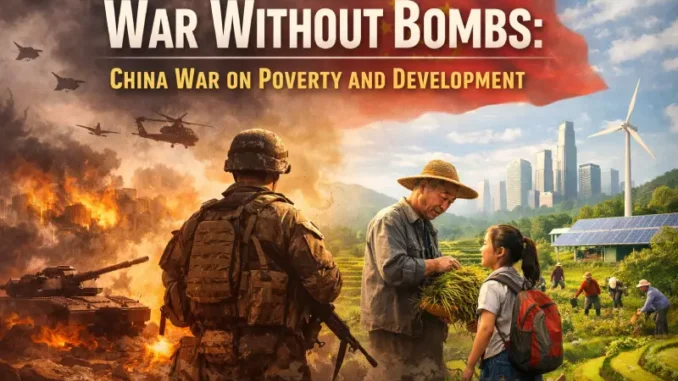
By Denis Hay
Description
How China war on poverty and development contrasts with US militarised wars, revealing different uses of power and human outcomes.
This article was inspired by Jerry Grey from “Jerry’s Take on China”, which prompted a broader analysis. The views and conclusions presented here are my own.
Introduction: When War Is Not About Weapons
When Australians hear the word war, we think of troops, bombs, invasions, and long lists of casualties. In modern Western politics, however, war has also become a metaphor. The United States has declared wars on terror, drugs, crime, homelessness, and more. Yet these wars are often still violent, punitive, and externally focused.
By contrast, when China declares war, it is usually against a social condition. Poverty. Corruption. Pollution. Drugs. These campaigns are internal, policy-driven, and aimed at changing everyday life rather than conquering territory.
This article examines what China war on poverty and development means in practice, how it appeared from China’s history, and what its outcomes reveal when compared with US militarised foreign policy.
The Problem: Two Very Different Meanings of War
1. War as Destruction Versus War as Transformation
In the Western tradition, war is commonly used to defeat an enemy. It relies on force, punishment, and deterrence. Even metaphorical wars often adopt this logic, criminalising social problems rather than restructuring their causes.
China’s modern approach reflects a different assumption. Social breakdown is treated as a political failure, not an individual one. Poverty, addiction, and environmental collapse are seen as conditions produced by systems, not moral weakness.
This distinction matters because it decides whether policy responses rely on coercion or reconstruction.
2. China Historical Experience with War
China’s modern state was shaped by war, but not by choice. From the mid-19th century onward, China was invaded, partitioned, and economically exploited by foreign powers. By the time of the First World War, it was politically fragmented and partially occupied.
China entered that war late and without sending combat troops. Hundreds of thousands of Chinese labourers supported the Allied war effort, digging trenches and building infrastructure. Despite this contribution, China did not recover its lost territories at the war’s end. That failure contributed directly to mass protests and the rise of revolutionary movements.
By 1949, the lesson was clear. Military conflict had weakened China. Internal collapse had made it vulnerable. Survival required rebuilding society from the inside out.
The Impact: China Social Policy Outcomes Since 1949
3. The War for Human Dignity
One of the first campaigns launched by the new government after 1949 targeted practices that denied basic human dignity.
The 1950 Marriage Law abolished forced marriage, concubinage, child betrothal, and bride prices. Women gained equal legal status and the right to initiate divorce. Foot binding was eliminated nationwide through administrative enforcement. Prostitution was shut down through the closure of brothels and the retraining of workers rather than mass imprisonment.
Within a few years, practices that had defined feudal hierarchy for centuries were removed from everyday life. This was not symbolic reform. It was comprehensive, rapid, and enforced.
4. The War on Drugs Without Mass Incarceration
China’s anti-opium campaign between 1950 and 1952 ended widespread addiction that had persisted since the colonial era. Cultivation, sale, and use were banned. Addicts were rehabilitated. Traffickers were punished.
By the early 1950s, opium addiction had disappeared. This outcome contrasts sharply with the US War on Drugs, which has lasted decades, incarcerated millions, and has not removed either supply or demand.
The difference was not moral superiority. It was policy design. One treated addiction as a social disease. The other treated it primarily as a crime.
5. China War on Poverty and Development
From its founding, the Chinese state treated poverty as a political condition created by land ownership patterns, imperial exploitation, and social hierarchy.
Land reform redistributed land to peasants. Urban work units guaranteed employment, housing, healthcare, and education. While later reforms changed these systems, the underlying principle stayed. No mass homelessness or slum formation. Basic housing for everyone.
Unlike many developing countries, China did not urbanise through the creation of shantytowns. Even in poor rural areas, people had a place to live. This is still one of the most overlooked outcomes of Chinese social policy.
By 2021, China declared extreme poverty eliminated under World Bank measurement standards. While inequality and rural revitalisation remain ongoing challenges, the scale of improvement is historically unprecedented.
6. The War on Corruption as Governance Reform
Corruption existed in China, as it does everywhere. What changed in recent decades was how it was treated.
Large-scale anti-corruption campaigns targeted senior officials and local groups alike. Hundreds of thousands were disciplined, and thousands prosecuted. Asset recovery programs recovered funds and brought fugitives back from overseas.
This stands in contrast to systems where political influence is openly bought through lobbying, campaign finance, and revolving doors between government and industry.
The Environment: From Growth at All Costs to Ecological Repair
7. The War on Pollution
Rapid industrialisation created severe environmental damage by the early 2000s. Air pollution, water contamination, and soil degradation were undeniable.
Under Hu Jintao, policy priorities shifted from pure GDP growth to human wellbeing and ecological sustainability. Agricultural taxes were abolished. Rural healthcare and education were expanded. Investment was redirected toward renewable energy, reforestation, and environmental rehabilitation.
China is now the world’s largest producer of renewable energy infrastructure. Air and water quality have improved significantly in many regions. While environmental challenges remain, pollution was treated as a systemic failure requiring state coordination rather than market correction alone.
Comparison: US Militarised Foreign Policy
8. What Western Wars Have Delivered
The US War on Terror has killed and displaced millions, destabilised entire regions, and generated cycles of conflict. The War on Drugs has criminalised addiction while entrenching black markets. Environmental policy has often prioritised corporate interests over ecological repair.
In each case, the underlying structure of society remained unchanged. Violence addressed symptoms, not causes.
China’s campaigns, by contrast, focused on restructuring land use, labour relations, healthcare, education, and environmental management. They aimed to prevent breakdown rather than punish its aftermath.
9. Why Australia Defaults to the US Example
Australia’s tendency to follow the United States is not primarily ideological. It is structural. Since the Second World War, Australia has relied on US security guarantees, shaping both defence policy and broader strategic thinking. Over time, this alignment has extended beyond military matters into economic and social policy frameworks.
Australian governments frequently adopt US policy language and assumptions, even when domestic conditions differ significantly. This has contributed to a preference for managing social problems rather than pursuing large-scale structural solutions.
Media narratives and political incentives further reinforce this pattern. Debate is often constrained within familiar US-centric frames, limiting consideration of alternative models that prioritise prevention, reconstruction, and long-term social investment.
The result is a capable country that rarely asks whether better outcomes are possible, even when international examples suggest they are.
Call to Action
We want to hear from you
- Please share your thoughts through our Reader Feedback
- Visit our Testimonials page to see how others are engaging.
- Leave a comment below; every voice helps shape future content.
Explore more
Find more writing on political reform and Australia’s dollar sovereignty at Social Justice Australia.
Share this article
Articles like this only create change when they are shared. If it stays with one reader, the message stops.
Support independent journalism
Running this site costs around $2000 a year, and reader donations have helped cover $807 so far.
Every contribution helps keep this work online, accessible, and independent.
Donate now, one time or monthly.
Already donated? A quick Google review helps others discover the site.
Sources
World Bank: China Poverty Reduction Overview
The People’s Republic of China: State Council Information Office White Papers
World Health Organisation: Primary Healthcare and Social Determinants of Health
United Nations Environmental Program: China Environmental Governance and Restoration
This article was originally published on Social Justice Australia
Keep Independent Journalism Alive – Support The AIMN
Dear Reader,
Since 2013, The Australian Independent Media Network has been a fearless voice for truth, giving public interest journalists a platform to hold power to account. From expert analysis on national and global events to uncovering issues that matter to you, we’re here because of your support.
Running an independent site isn’t cheap, and rising costs mean we need you now more than ever. Your donation – big or small – keeps our servers humming, our writers digging, and our stories free for all.
Join our community of truth-seekers. Donate via PayPal or credit card via the button below, or bank transfer [BSB: 062500; A/c no: 10495969] and help us keep shining a light.
With gratitude, The AIMN Team

Thank you an excellent article showing that Australia was on the correct course in the 1930s when we had the highest standard of living in the world ….. until the American banks collapsed the system in 1929 by profit mongering without accountability. Then again in 1987. Now again in 2026 under TACO Trumpery & Project 2025 policies??
Look after the workers and the economy will look after itself. There is no corporate desk jockey worth 5-100 times the lowest paid labourer in their corporation.
Then internationally we see PRC CHINA pouring development funding into African countries for public infrastructure, the Belt & Road Project that links PRC CHINA to Europe overland in about 10 days by integrated rail networks, to name just two.
Meanwhile across the Pacific, the USA has been involved in 80+ foreign ”adventures” into controlling the national resources and economies of other ”sovereign” nations. They even interfered in the Dismissal of the democratically elected Whitlam LABOR government with Royal Consent from Buck Palace in 1975.
So the ALBANESE LABOR GOVERNMENT wants to believe that paying BILLIONS in vassalage for USUKA subs that may never float is sensible policy rather than surrendering national sovereignty??
WE have a lot to learn from PRC CHINA and a lot to fear from the USA (United States of Apartheid).
I have to agree Cocky, the USA has done more harm to this country than good. The believe that MacArthur saved us from the yellow hoard is not only wrong, it has curb our development ever since.
Australia is not beholden to the USA and never has been, what the USA did, it did in it’s own interest.
Thanks for the comment, New England Cocky. You raise several important historical and structural points that often get overlooked.
Australia achieved high living standards when its policy focused on full employment, strong public institutions, and the protection of workers. Once financialisation took hold and accountability weakened, those gains were steadily eroded. That pattern has repeated internationally.
Your point about wages is also central. When labour is treated as a cost to be minimised rather than the foundation of the economy, inequality widens, and social cohesion breaks down.
On the international front, the contrast between development-led engagement and intervention-led foreign policy is stark. Infrastructure investment tends to create long-term capacity, while military “adventures” have rarely delivered stability or prosperity.
Where this article ultimately lands is not about choosing sides, but about outcomes. Australia has choices. We can align security policy with external interests while neglecting domestic needs, or we can focus on rebuilding economic security at home.
That decision is political, not inevitable.
jonangel,
Thanks for adding to the discussion.
There’s no doubt that the idea of Australia being “saved” by the United States has become deeply embedded in our national story, often without much critical examination. Like all major powers, the US has always acted primarily in its own strategic interests, not out of altruism.
The more important question for Australia now is not re-litigating the past, but deciding how much that inherited narrative continues to shape our present choices. When strategic alignment becomes automatic rather than considered, it can limit policy imagination, especially in areas well beyond defence.
Australia’s interests are not identical to those of any other country. A mature, confident nation should be able to cooperate with allies while still setting its own priorities, particularly in economic security, social cohesion, and long-term prosperity.
That balance is something we still need to work much harder to achieve.
Having been to China again last year (4th time over 40 years) China is so far a head for Australia Technologically (even militarial) but above all socially. The people are happy caring, helpfull, there is hardly any homeless.. Compare that to the appalling shit show here…