By Denis Hay
Description
Environmental chemicals and health risks affect Australians through work, food, and water. Learn impacts, causes and solutions.
Introduction
Environmental chemicals and health are inseparable issues in modern Australia. For decades, Australians were exposed to industrial chemicals at work and at home with little warning or protection. Many health effects only appear years or decades later, long after exposure has ended. This article explains how environmental chemicals affect health, why risks were ignored, who benefited from that silence, and how Australia can respond today.
Problem
Systemic causes
Environmental chemicals entered Australian workplaces and communities long before modern safety standards existed. Trades such as mechanics, manufacturing, mining, and construction relied on petroleum solvents, degreasers, and fuels as routine tools. Chemicals were considered harmless because they were effective and inexpensive.
Regulatory systems focused on acute injury rather than long-term exposure. Chronic harm to bone marrow, immune systems or cardiovascular health was poorly understood or ignored. Chemicals were approved first and restricted later, often decades later.
This failure is acknowledged today in cases such as PFAS contamination. The Australian Centre for Disease Control confirms ongoing risks from historical PFAS use in firefighting foams and industrial settings.
Who benefits
Chemical manufacturers, industrial employers, and governments benefited from weak regulation. Productivity increased while health costs were delayed and transferred to workers and the public health system.
This pattern reflects broader economic structures in which risk is externalised, and responsibility avoided, a theme examined in Social Justice Australia’s analysis of systemic failure and privatisation.
This transfer of risk from corporations to the public is not new. It follows a long historical pattern of corporate behaviour in which profits were prioritised over human and environmental harm, as documented in detail in Corporate Atrocities Over a Century.
Impact
Environmental Chemicals and Health Risks in Australia
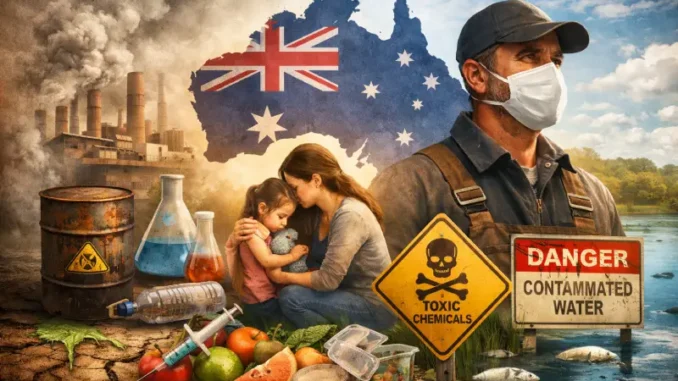
Environmental chemicals and health risks in Australia are closely linked because exposure is widespread and often unavoidable. Australians are exposed to chemical risks through food production, drinking water, air pollution, workplaces, and consumer products. These exposures rarely occur in isolation and can accumulate over time, increasing the likelihood of long-term health effects.
Real-world effects on Australians
The health impacts of environmental chemicals are now well documented. The World Health Organisation confirms that some chemicals disrupt hormone systems, damage organs and increase cancer risk, even at low doses.
Exposure pathways include food residues, contaminated water, air pollution, and workplace contact. Effects are often delayed, making links harder to recognise.
Lived experience from Australian trades
Many older Australians worked for years using solvents such as carbon tetrachloride, kerosene, diesel and petrol with no warnings, gloves, or ventilation. These substances were commonly used to clean engine parts and equipment.
Decades later, some of those workers now live with serious health conditions. While individual causation cannot be proven retrospectively, occupational medicine recognises that long-term exposure to petroleum solvents and aromatic hydrocarbons, such as benzene, can damage bone marrow, disrupt immune function, and increase cardiovascular risk.
This lived experience illustrates a critical point. The absence of warnings did not mean there was no harm. It meant the harm was delayed, hidden, and borne by workers long after exposure ended.
Cumulative health burden
Environmental chemicals and health risks accumulate across a lifetime. Children are vulnerable during development. Adults accumulate exposure through work and daily life. Older Australians face compounded effects as detoxification systems weaken. These burdens add to the cost of living and health pressures discussed in Why Australia’s Cost of Living Crisis is Worsening.
Why personal choice is not enough
Australians are often told to manage risk individually. Avoid plastics. Choose organic food. These steps help, but they do not address systemic exposure. No individual can opt out of contaminated water, air, or legacy pollution.
Environmental chemicals and health protection must be treated as collective responsibilities.
Solution
Policy options
- Apply the precautionary principle to chemical approvals
- Phase out persistent and bioaccumulative chemicals
- Fund long-term occupational health monitoring
- Strengthen workplace exposure standards
- Ensure polluters fund remediation
The Australian Academy of Science has identified weaknesses in chemical regulation and called for reform. International evidence shows that prevention is cheaper than cleanup, as documented by the European Environment Agency.
Australia’s monetary sovereignty as the enabling tool
Australia is a dollar sovereign nation. It can fund prevention, monitoring, and remediation without relying on private insurance or litigation. Public health protection is a policy choice, not a financial constraint.
FAQs
What are environmental chemicals?
Environmental chemicals are substances found in air, water, food, soil, or workplaces that can affect human health. Some occur naturally at harmful levels due to pollution, while many are man-made chemicals used in industry, agriculture, and consumer products.
Can health effects appear decades after exposure?
Yes. Many health conditions linked to chemical exposure develop slowly. Damage to the immune system, bone marrow, hormones, or organs may not become apparent until years or even decades after repeated or long-term exposure has ended.
Is definitive proof needed before preventive action is taken?
No. In public health and environmental policy, action is often justified when there is credible evidence of risk, especially where harm may be serious or irreversible. Waiting for absolute proof has historically delayed protection from hazards such as asbestos, lead, and some industrial solvents.
Final Thoughts
Environmental chemicals and health are not abstract concerns. They are lived realities for many Australians whose exposure was normalised and unexamined. Australia now has the knowledge and capacity to prevent future harm. What remains is the willingness to act.
Engaging Question
Should Australia do more to recognise and prevent long-term occupational chemical exposure?
Call to Action
If this article helped you better understand how Australia really works, do not leave it here. Please share it with others who are asking the same questions.
Your voice matters. Your experience matters. And your participation matters.
➡ Share this article with family, friends, and your community
➡ Leave a comment below and join the discussion
➡ Visit the Reader Feedback page and share your view
➡ Share a testimonial if our content has helped you think differently
➡ Connect with us on TikTok, LinkedIn and X
Discuss this article in our Facebook group, where Australians share perspectives and ask questions in a calm, respectful space.
A more informed Australia starts with people willing to talk about the issues that shape our future. You can help lead that change.
Support independent journalism
Running this site costs around $2000 a year, and reader donations have helped cover $807 so far. Every contribution helps keep this work online, accessible, and independent.
If you find value in these articles, please consider supporting the site. Even a few dollars help keep this work going.
Donate now, one time or monthly.
Already donated? A quick Google review helps others discover the site.
This article was originally published on Social Justice Australia
Keep Independent Journalism Alive – Support The AIMN
Dear Reader,
Since 2013, The Australian Independent Media Network has been a fearless voice for truth, giving public interest journalists a platform to hold power to account. From expert analysis on national and global events to uncovering issues that matter to you, we’re here because of your support.
Running an independent site isn’t cheap, and rising costs mean we need you now more than ever. Your donation – big or small – keeps our servers humming, our writers digging, and our stories free for all.
Join our community of truth-seekers. Donate via PayPal or credit card via the button below, or bank transfer [BSB: 062500; A/c no: 10495969] and help us keep shining a light.
With gratitude, The AIMN Team

Be the first to comment