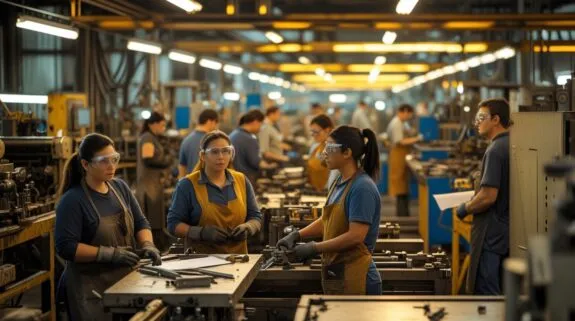
Despite world-leading reforms, half of Australian workers remain trapped in insecure employment while the young bear the brunt.
The numbers don’t lie, even when the politicians do. Australia’s precariat; that swelling army of the insecurely employed, the casually contracted, the perpetually anxious, continues its inexorable growth despite Labor’s much-vaunted industrial relations “reforms.” When only half your workforce can rely on permanent full-time employment with leave entitlements, you don’t have an economy. You have a crisis in your social contract and your duty of care; a national emergency dressed up as “flexibility.”
Let’s cut through the cant. By 2021, a bare 50.5% of Australian jobs qualified as permanent full-time positions with leave entitlements, meaning half of all employed Australians now face one or more dimensions of insecurity in their work. This isn’t some unfortunate accident of market forces. It’s the deliberate result of a business model, embraced across both private and public sectors, that systematically shifts the risks of employment from employer to employee while minimising labour costs at the expense of job quality.
The Grim Statistics of Insecurity
The Australian Bureau of Statistics paints a portrait of desperation that should shame any government claiming to represent working people. We now have a record 867,900 people juggling two or even three jobs, with 209,100 unfortunates working three or more positions simultaneously, the highest proportion in the entire history of ABS statistics. These aren’t ambitious go-getters embracing the gig economy’s supposed freedoms. They’re workers scrambling to cobble together a living wage from the scraps of casualised employment.
The Precariat By Numbers
- 50.5% of jobs are permanent full-time with leave entitlements
- 867,900 Australians working two or more jobs (record high)
- 209,100 working three or more jobs
- 9% youth unemployment—double the national rate
- 6.7% of casual workers wanting permanent work secured it in 2024
- $12.50/hour average earnings for food delivery workers after expenses
And it’s our young who cop it worst. Youth unemployment sits at roughly 9%, more than double the national rate, with growing numbers classified as NEET: not in employment, education, or training. After protracted education processes accompanied by massive debt accumulation, young people discover that entry points into the jobs they’ve trained for are scarce or non-existent, leading to a trajectory of casual and short-term positions with tenuous links to their education and limited potential as stepping stones to anything better.
This is the social contract, shredded. Study hard, accumulate debt, develop skills; and then discover the ladder’s been pulled up behind you.
Labor’s Inadequate Tinkering
Now, to be fair, a courtesy Labor now rarely extends to workers, the Albanese government has attempted some repairs to our tattered industrial relations framework. Since taking office in 2022, Labor has introduced the Secure Jobs Better Pay reforms and two rounds of Closing Loopholes amendments passed in 2023 and 2024. In February 2024, Parliament passed what some hailed as world-leading minimum standards for platform workers.
Sounds impressive, doesn’t it? World-leading! Minimum standards! But scratch beneath the progressive veneer and you’ll find reforms carefully calibrated not to seriously inconvenience capital.
From August 2024, gig economy and road transport delivery workers gained classification as “employee-like” workers, theoretically giving the Fair Work Commission power to order digital platforms to pay fair wages and provide safe working conditions. Yet here’s the rub: these laws may actually serve to defend corporations’ right to implement ever-harsher exploitation by establishing a lower tier of “employee-like” workers without most basic rights.
Employee-like. Ponder that weasel phrase. You’re sort of like an employee, mate, just without the actual entitlements, security, regular hours, respect, or protections that real employees enjoyed back when Australia had a labour movement worth the name.
The Brutal Reality for Workers
The human cost of this grand neoliberal experiment reveals itself in stark research findings. A Transport Workers Union survey from mid-2024 discovered food delivery workers earning approximately $12.50 per hour after expenses, well below minimum wage, with no insurance, personal leave, or workers’ compensation. Since the Australian transport gig economy began in 2017, eighteen food delivery riders and one rideshare driver have been killed. Their dependents received nothing, no workers’ compensation, no recognition, nothing, because these workers weren’t employees. They were “independent contractors.”
And here’s a detail that should enrage anyone with a functioning sense of justice: up to one-third of casual workers report receiving no casual loading whatsoever. They endure all the insecurity of casual employment without even the pittance of extra pay that’s supposed to compensate for that insecurity. Meanwhile, of casual workers who wanted permanent employment in 2024, only 6.7%, about one in fifteen, actually secured it.
The precariat isn’t a bug in the system. It’s a feature.
The Mental Health Catastrophe
The psychological toll of all this insecurity compounds the economic devastation. When households become insecurely employed, they face five times greater odds of also experiencing housing affordability stress, a phenomenon researchers call “double precarity”, with devastating effects on mental health. People exposed to this double precarity report 2.4 times higher odds of mental health deterioration.
Currently, 67% of Australians experience housing stress, 75% of renters face rental stress, and 66% worry about the housing crisis’s impact on their mental health and general wellbeing. This isn’t coincidence. Home ownership pathways for recent generations have faltered, producing “generation rent” with its greater reliance on family wealth and increased precarity in Millennials’ life trajectories.
You can’t separate precarious work from the housing crisis. They’re conjoined twins of neoliberal policy, each feeding the other in a death spiral of insecurity.
Who Benefits? Follow the Money
So if half the workforce suffers while juggling multiple jobs and battling anxiety about next week’s rent, who’s thriving in this brave new world of “flexible” employment?
Neoliberal policies have favoured large corporations, particularly mining, finance, and real estate, with removal of regulatory constraints allowing these sectors to operate with minimal oversight and generate significant profit margins. Governments and industry lobby groups present these changes as essential for national economic prosperity, a claim that might carry more weight if prosperity weren’t quite so unevenly distributed.
Business advocacy groups fight tooth and nail against meaningful reform. Organisations like the Centre for Independent Studies, the Institute of Public Affairs, and the H.R. Nicholls Society have consistently pushed for labour market deregulation that goes further than even Labor ministers are willing to countenance. The Australian Chamber of Commerce and Industry complains that recent amendments “further centralise” regulations and reduce flexibility, by which they mean the flexibility for employers to treat workers as disposable.
Digital labour platforms like Uber have reshaped how hundreds of thousands work, with worker exploitation rife as people face pressure to meet unreasonable schedules and performance metrics, always risking account termination if they don’t keep up. These platforms built empires worth billions by treating human beings as algorithmic inputs, all while claiming they’re just neutral technology companies connecting willing buyers and sellers.
The Bipartisan Betrayal
Here’s the inconvenient truth Labor would rather you didn’t dwell upon: the architecture of precarity was built by both major parties, with Labor laying much of the foundation during the Hawke-Keating years.
Since the Hawke-Keating government in the 1980s, neoliberal reforms included privatisation, extensive tax cuts, and creation of more flexible labour markets through restriction of trade union power. From the 1980s under Hawke Labor, through the 1990s under Keating Labor and Howard’s Liberal-National coalition, economic rationalism placed the market before state and society.
Labor’s recent reforms, modest as they are, represent less a repudiation of this history than a minor course correction. The party that once spoke for the organised working class now tinkers at the margins while the fundamental business model of casualisation and risk-shifting remains untouched.
The Implications for Society
What happens to a society where half the workforce lives in permanent insecurity?
Precarious work arrangements erode the ability to envision the future, make commitments, buy property, and develop a lasting sense of occupational identity and community. Workers suffer inferior rights, entitlements, and job security alongside lower wages growth, making it nearly impossible for families to plan when they cannot rely on regular incomes but face rising costs and mounting debt.
The waste of young people’s talents and skills comes precisely when Australia’s productivity and growth potential face serious questions, with the existence of a precariat serving as a hallmark of social inequality. Since 2013, nominal wages have barely kept pace with consumer price rises, meaning real wages, adjusted for inflation, have stagnated for more than a decade.
And perhaps most concerning for the long-term health of democratic participation: the precariat tends toward values and interests less oriented to class identification and union involvement, people are less inclined to strike when their employment could be terminated at any moment. The erosion of non-wage income leaves workers alienated from labour solidarity and vulnerable to opportunism.
This is how you break a working class: fracture it into atomised individuals competing desperately for the next shift, the next gig, the next contract. Make them too exhausted and anxious to organise. Then tell them it’s all about flexibility and choice.
What Needs to Happen
Labor’s reforms have made some small improvements, better than nothing, worse than necessary. The real question is whether any Australian government has the political courage to confront the fundamental business model driving casualisation.
What’s needed is restoration of a “decent work” agenda, with some proposing visions of citizen participation linked to provision of basic, unconditional economic security. That means not just tinkering with definitions of employment but fundamentally rebalancing power between capital and labour.
It means recognising that the proliferation of insecure work hasn’t occurred by accident, conscious business and policy decisions based on cost and risk allocation have been the key drivers. If policy created this mess, policy can fix it. What’s lacking isn’t technical solutions but political will.
The precariat grows not because it must, but because powerful interests want it to. Until Labor, or any government, is willing to name that truth and act on it, expect more soothing rhetoric, more inadequate reforms, and more young Australians discovering that the Australian dream died before they were born.
The ladder’s been pulled up. The only question now is whether we’ll watch a generation fall, or whether we’ll rebuild the social contract that once made Australia a place where working people could build secure, dignified lives.
The ladder’s been pulled up, yes. But ladders can be rebuilt; and this time, we know exactly who pulled it up and why. Every statistic in this piece, every documented exploitation, every researcher confirming what workers already knew: these aren’t just facts. They’re ammunition. Knowledge transforms individual grievance into collective understanding. Understanding enables organization. And organization is what power fears most.
Neither major party will lead this fight, they’re too invested in the neoliberal project that created the precariat. But that’s liberating, in its way. It means the solution won’t come from above. It’ll come from below, from the horizontal networks of workers sharing information, building solidarity, and refusing to accept that their insecurity is inevitable or natural. The precariat is learning that their individual precarity is a collective political problem requiring a collective political solution.
So to those juggling three jobs, those delivery riders earning below minimum wage, those young workers told there’s no alternative: you’re not lazy, you’re not entitled, and you’re not alone. You’re the majority now. And once the majority understands both the problem and their own power, that’s when the real reforms begin, not the kind that create “employee-like” workers, but the kind that restore dignity, security, and power to working people.
The question isn’t whether change will come. It’s whether we’ll organize to shape it, or whether we’ll let another generation fall first. Choose organizing. Choose solidarity. Choose to be ungovernable by those who profit from your precarity. That’s how social contracts get rebuilt, not through begging politicians for crumbs, but through workers collectively demanding the security that was stolen from them.
Knowledge. Solidarity. Organization. The precariat has all three within reach. That’s what should keep the architects of insecurity awake at night.
This article was originally published on URBAN WRONSKI WRITES
Keep Independent Journalism Alive – Support The AIMN
Dear Reader,
Since 2013, The Australian Independent Media Network has been a fearless voice for truth, giving public interest journalists a platform to hold power to account. From expert analysis on national and global events to uncovering issues that matter to you, we’re here because of your support.
Running an independent site isn’t cheap, and rising costs mean we need you now more than ever. Your donation – big or small – keeps our servers humming, our writers digging, and our stories free for all.
Join our community of truth-seekers. Donate via PayPal or credit card via the button below, or bank transfer [BSB: 062500; A/c no: 10495969] and help us keep shining a light.
With gratitude, The AIMN Team


This article nails the reality facing millions of Australians, but we need to say the quiet part out loud. The casualisation crisis is not an accident, a glitch, or a market “adjustment.” It is the logical outcome of neoliberalism, a cancer on society that has turned every citizen, every job, every house, every service, even our natural environment into a commodity to be traded for profit, no matter the human or ecological cost.
When exploitation becomes a business model, insecurity becomes a feature, not a flaw. That is why half the workforce lives without secure employment, why young people carry massive debts for jobs that no longer exist, and why millions are forced to juggle multiple gigs to survive. This is not flexibility. It is organised precarity.
And here’s the bitter truth: both major parties helped build this system and both continue to support it. Hawke and Keating laid the foundations, Howard deepened them, and modern Labor tinkers around the edges while refusing to challenge the ideology itself. You cannot fix neoliberalism with “world-leading reforms” designed to protect corporate power. Casualisation is profitable, that is why it expands.
If we want dignity, security, and fair wages, we cannot keep pretending the market will save us or that Labor will “shift left” out of moral awakening. Change will only come when working people reject the neoliberal lie that insecurity is normal and start demanding an economy built for people, not shareholders.
Neoliberalism treats workers as expendable inputs. A fair society treats workers as human beings. The more Australians recognise that capitalism has been redesigned to extract, not support, the easier it becomes to build the solidarity needed to tear this system down and rebuild one where work provides dignity, not desperation.
Has there been any improvement since 2021
Everyone, politicians and businesses seem to have forgotten that the standard of living in Australia and by extension the profitability of businesses, large and small, was built during the period after the Second World War on the basis that workers, also being consumers, had secure jobs and secure income which allowed them to purchase a home, a car, feed and clothe their families and provide a good education for their children, to take holidays and to become consumers of goods that they may not have necessarily needed, but wanted.
Insecure work, which results in insecure income, takes away the ability of consumers to purchase goods and services other than those that are deemed necessary. It does not provide for what is called discretionary spending, that spending that is not absolutely necessary.
The longer term results of making more and more of the workforce insecure is that business also suffers in that their customer base is reduced and therefore their sales and income reduces.
But in an environment where management remuneration is based on short term profits there is no forward planning for when their workforce is unable to buy the products that they produce or sell.
Long term business needs to have a customer base that is earning enough to feed, clothe, house and provide transport for themselves and their families as well as to indulge in discretionary spending, which are holidays, entertainment, etc. By suppressing workers income businesses are ensuring that their business income will be suppressed.
Business does not live in a vacuum, it needs customers to survive, if those customers cannot afford a businesses product that business will go out of business.
Free Market,barely regulated,Neoliberal economic religion.It’s got us to this point folks,profit is the dominant ideology..see:Musk,Etc.
Won’t be long before the entire planet can put it’s head between it’s legs, and kiss it’s arse goodbye.But hey, the Ashes is back to bore us shitless.
Yet another long-term bilious manipulation by John Howard, in addition to the other despicable sores that he has fractured the country with.
If you haven’t read it yet, read ‘Not Happy John’ by Margot Kingston and you will find the real narcissistic manipulative man; I have three others to read ‘Howard’s War, ‘Sexing it Up’ and God under Howard.
Didn’t like the man when he was PM, even less now.
Such a charming fellow, not!
Dennis Hay. I agree, but I would add another layer to the laws:
1) Make wage theft a jail-able offence. A fine simply becomes a cost of doing business.
2) Make it compulsory to fully pay the 25% loading on casual staff.
3) Outlaw franchise systems that cannot deliver proper after-cost returns to the operators.
These 3 simple rules will correct a lot of the problems. Admittedly, it won’t solve everything, but it will go a long way.
The issue of casualisation is multifaceted and complicated.
A decade ago over 50% of casual employees worked with organisations with less than 10 people, and I note there is no analysis of the current percentage split of casual employment between small, medium and large businesses.
Which is a hugely relevant issue.
Employment law, awards, workers compensation, are unrelentingly fraught and complicated, and (in my opinion) are pretty well impossible for typical carpenter, electrician, cafe owner, retail store owner, pool pump installer, cleaner… to navigate in taking on an employee.
Their employment policy generally amounts to “hope for the best”
If we are serious about reducing casualisation, more needs to be done to simplify full time employment, particularly during the probationary period.