Working in the Lithium Mine (We’re Already There)
If we don’t confront the forces atomising and destroying working-class power, we’ll wake up one morning to discover we’re already working in a lithium mine owned by one of seventeen billionaires who control all the world’s resources.
Actually, scratch that. We won’t wake up to discover it. We’re already there. We’re just still calling it the gig economy and pretending it’s a choice.
This is the final piece of the story: not just how Labor betrayed workers, not just how the legal system caged unions, but how the material conditions of modern work make collective resistance nearly impossible. Even if workers wanted to organise, even if the legal framework permitted it, the precarity, atomisation, housing crisis, and attention economy have created a workforce too fragmented, too exhausted, and too anxious to build the solidarity that once defined working-class power.
Welcome to the Precariat
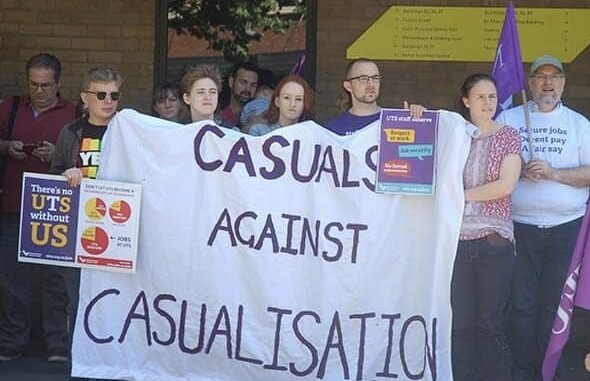
Thirty-five per cent of Australian workers are casual or contract employees not paid for sick leave or annual leave. Among workers aged 15 to 19, casualisation rates hit 76 per cent; for those 20 to 24, it’s 41 per cent, far above the 25 per cent national average.
These aren’t holiday jobs or temporary positions before “real” careers begin. This is the labour market young Australians face: permanent impermanence, casualisation as life sentence, insecurity as default condition.
The gig economy represents the sharp end of this transformation: an extension of the casualisation and fragmentation that has restructured Australian labour markets. You’re not a worker anymore; you’re an independent contractor with an app that tells you what to do and an algorithm that decides whether you eat this week. You have all the responsibilities of running a business with none of the security or support.
Even well-paid gig positions create significant stress, increasing tension at home, slowing family formation, and making friendships less common. How do you maintain relationships when your schedule changes daily? How do you plan anything when you don’t know your income next month? How do you start a family when you can’t guarantee rent in six months?
Such arrangements erode the ability to envision the future, make commitments, buy property, or develop a lasting sense of occupational identity and community. For growing numbers of Australians, insecurity isn’t a temporary condition; it’s a way of life.
Camus wrote about the absurd: a society that celebrates entrepreneurship whilst creating an underclass of atomised hustlers with no safety net and no future. We’re living in that absurdity. We just haven’t admitted it yet.
The Psychological Toll
The psychological consequences of precarious work extend beyond individual suffering. Precarity creates a particular kind of anxiety: not the sharp fear of immediate threat, but the grinding, exhausting uncertainty of never knowing whether you’re secure.
Will my contract be renewed? Will I get enough shifts next week? Can I afford to take a sick day? What happens if I need to see a doctor? Can I plan a holiday? Should I buy that textbook my kid needs for school, or will I need that money for rent?
This isn’t the normal stress of work. This is existential insecurity as permanent condition. And it has effects beyond the individual: precarious workers are less likely to have children, less likely to maintain long-term relationships, more likely to experience mental health problems, and more likely to report feeling socially isolated.
When your life is defined by uncertainty, you can’t build the deep connections and long-term commitments that create community. You’re always in survival mode, always managing immediate crises, never able to lift your head long enough to think about collective solutions to collective problems.
How do you organise when you can’t predict your hours next week? How do you build solidarity with coworkers you’ve never met? How do you strike when you have no guaranteed income? It’s hard to man the barricades when you’re busy refreshing the app to see if you’ve got a shift tomorrow.
The Rental Crisis: Pricing Workers Out of Existence
The 2024 Rental Affordability Index shows rental affordability has hit record lows in nearly every major capital city and region. Rental markets are now “critically unaffordable” for those on JobSeeker, parenting payments, or pensions. Perth’s affordability dropped 13 per cent in one year, Adelaide 8 per cent, Melbourne 6 per cent.
Over the past decade, average house rents across capitals increased 59.8 per cent whilst wages rose just 28.9 per cent. Up to 70 per cent of renting households now experience rental stress, spending more than 30 per cent of income on housing.
Australian renters now need an annual income of $130,000 to afford an average rental without housing stress. Even six-figure earners face housing costs exceeding 30 per cent of their income in capital cities and many regional areas.
Think about what this means. A hospital nurse earning $80,000 a year, an experienced tradie earning $90,000, a schoolteacher earning $85,000: all experiencing housing stress. These aren’t entry-level positions. These are skilled professionals with years of experience, and they can’t afford housing without financial strain.
The myth that struggling city dwellers should simply move to cheaper regional areas has been exposed as fantasy. Essential workers find negligible affordable rentals even in supposedly cheaper regions. There is no escape hatch. There is no plan B.
For the apprentice setting out to learn a trade, those young workers we should be celebrating and supporting, home ownership has become unimaginable. How do you save a deposit when you’re paying $600 a week in rent on an apprentice wage? How do you build a life when shelter itself is unaffordable? How do you start a family when you’re paying three-quarters of your income to a landlord?
Housing insecurity doesn’t just affect where you live. It affects everything: your ability to maintain employment (hard to keep a job when you’re couch-surfing), your children’s education (hard to succeed at school when you move every six months), your health (housing stress is a significant predictor of poor health outcomes), and your capacity to think about anything beyond immediate survival.
You can’t organise for a better future when you’re desperately trying to secure basic shelter.
The Attention Economy: Colonising Consciousness
Neoliberalism has created a society where isolation, privatisation, and instrumental rationality make it difficult to form communal bonds and long-term commitments. Atomisation isolates individuals and fosters helplessness by suggesting the existing order cannot be changed.
Since the 1980s, corporate deregulation and loss of labour power allowed the wealthy to monetise larger portions of our lives, forcing us to think of time and attention in terms of monetary value. Always connected, always on, we have less time to nurture actual connections.
The average Australian employee loses 600 hours annually to lost focus: 75 work days, placing us second in the world for hours lost to workplace distractions. The annual cost is estimated at $27,585 per employee, with repercussions including anxiety, depression, burnout, and turnover.
But calling it “distraction” misses the point. This isn’t workers being lazy or undisciplined. This is the systematic colonisation of attention by technologies designed to capture and monetise every moment of consciousness.
Your phone buzzes. Your email pings. Your Slack channel updates. Your social media feeds refresh. Your news alerts chime. Your productivity apps remind you of tasks. Your fitness tracker nags about steps. Your meditation app ironically interrupts your thoughts to remind you to be mindful.
We’re not distracted. We’re under siege.
Succeeding in the attention economy requires constantly marketing ourselves, leading us to see each other as potential customers rather than friends and community members. Your LinkedIn profile isn’t you; it’s your personal brand. Your Instagram isn’t your life; it’s your curated content. Your network isn’t your community; it’s your professional contacts.
We’ve turned human relationships into transactions, community into networking, and solidarity into personal brand management.
The Extinction of Community
During the twentieth century, a proletarian public sphere thrived: working-class parties, unions, bookshops, newspapers, publishers, reading groups, debating societies. Workers had spaces where they developed consciousness and solidarity, where they learned to think collectively about collective problems, where they built the social bonds that made industrial action possible.
That world has disintegrated. Expensive, monetised diversions have replaced working men’s clubs, union halls, and community gatherings. Now we scroll alone, each in our separate cell, convinced we’re connected because we can see what everyone had for breakfast.
The privatisation of public space has been comprehensive: libraries closing, community centres defunded, parks turned into revenue generators, squares filled with expensive cafes accessible only to those who can afford a $7 coffee. Even third spaces that remain are often hostile to anyone not consuming: try sitting in a shopping centre without buying anything and see how long before security moves you on.
Young people particularly have lost access to unmediated, non-monetised space. Where do teenagers hang out? Not in parks (anti-loitering laws). Not in shopping centres (unless buying). Not in streets (moved on by police). They retreat to online spaces that are equally monitored, monetised, and hostile to genuine connection.
How do you build solidarity when you have no space to gather? How do you develop working-class consciousness when every interaction is mediated by algorithms designed to keep you scrolling, consuming, isolated?
We’re too distracted to notice we’re being robbed. Which is rather the point.
The Death of Making Things
Australia’s manufacturing has fallen to just 5 per cent of the economy, down from 14 per cent in the late 1970s: the lowest manufacturing share in the OECD. This isn’t natural economic evolution. This is the result of specific policy choices.
Over recent decades, privatisations destroyed apprentice training facilities and programmes. Government-run railway workshops that once trained thousands of apprentices were sold off or closed. Public utilities that maintained comprehensive training programmes were privatised, and the new owners slashed training budgets.
Major corporations abandoned comprehensive apprenticeships or adopted limited industry-specific training. Why invest in training when you can poach skilled workers from competitors or import them on 457 visas? Why develop Australian workers when you can offshore production to countries with lower wages and weaker labour protections?
The number in training as a share of total employment has fallen 47 per cent since 2012, whilst course completions have more than halved over the past decade. In the past four years, student withdrawals exceeded completions, previously uncommon. We’re not even replacing the skilled workers we’re losing.
TAFE, once the pride of Australia’s vocational education system, has been systematically gutted. Funding slashed, campuses closed, courses cut, teachers made redundant. Private training providers sprang up to fill the gap, many delivering appalling quality training focused on extracting government subsidies rather than developing genuine skills.
Some trades like engineering patternmaking face extinction, with only four apprentices currently training at TAFE Queensland, yet employers remain desperate for these skilled workers. This isn’t market forces or automation; the demand exists. It was a political choice to ignore these skills, to let them die, to pretend they didn’t matter.
The Loss of Identity and Dignity
The loss isn’t just economic; it’s cultural and psychological. Former automotive workers, after the 2017 industry closure, experienced profound shock at the new world of precarious work after long protection in unionised industry. They lost not just jobs, but entire ways of working, communities of practice, and the dignity that came with skilled labour passed down through generations.
One former auto worker interviewed for research described it: “I was a tradesperson. I had skills. I trained apprentices. I built things that lasted. Now I stack shelves on a casual contract, and they can let me go any week without reason. I’m not a skilled worker anymore. I’m just casual labour.”
That sense of lost identity, lost dignity, lost purpose: it’s replicated across thousands of workers who once had secure skilled employment and now face precarious casual work with no prospects for advancement, no job security, and no recognition of their skills and experience.
Pity the poor apprentice, indeed, setting out to learn a trade in an economy that has systematically destroyed the pathways, institutions, and dignity that once made the trades a foundation of working-class prosperity. We’ve turned the skilled tradesperson into a memory, replaced them with someone on an app who got a weekend certificate and a toolbelt.
The Migration Weapon
What’s often missing from discussions of Australian labour markets is the role of temporary migration as a union-busting tool. Australia runs one of the world’s largest temporary migration programmes: 457 visa holders, working holiday visa holders, international students with work rights, seasonal workers.
These workers face visa conditions that make them extraordinarily vulnerable to exploitation. International students can work limited hours, making them desperate for any employment. 457 visa holders are tied to specific employers, making it nearly impossible to challenge poor conditions without risking deportation. Working holiday visa makers need to complete regional work to extend their visas, creating a captive workforce for rural employers.
This creates a multi-tiered labour market where temporary migrants work for less, accept worse conditions, and cannot organise without risking their visa status. Employers use this to undercut wages and conditions for all workers, threatening permanent workers with replacement by cheaper temporary labour.
The “skills shortage” narrative is often cover for refusal to train Australians or pay market wages. Why train apprentices when you can import skilled workers? Why pay proper wages when international students will work for less? Why improve conditions when you have a pool of vulnerable workers desperate for any employment?
Labor, in government, has continued and in some cases expanded temporary migration programmes, despite unions identifying them as major threats to wages and conditions. The party of the worker chooses capital’s need for cheap labour over workers’ need for job security and decent wages.
The COVID Moment That Was Squandered
The COVID-19 pandemic briefly made essential workers visible. Suddenly we noticed the cleaners, the warehouse workers, the delivery drivers, the supermarket staff, the aged care workers. We called them heroes. We applauded them.
Then we systematically screwed them over.
JobKeeper excluded casual workers (unless they’d been with the same employer for 12 months, which many casuals haven’t by definition), excluded temporary migrants (including international students who’d been here for years), and excluded workers whose employers’ turnover hadn’t dropped enough to qualify.
The most precarious workers, the ones who lost jobs first and faced the most severe hardship, were explicitly excluded from the major support programme. Meanwhile, JobKeeper flowed to profitable companies that didn’t need it, with some using the money to pay increased dividends to shareholders.
Essential workers who kept working through lockdowns faced extraordinary health risks whilst often earning poverty wages. Aged care workers, predominantly women, predominantly migrants, predominantly casual, risked their lives caring for vulnerable people for $23 an hour. Supermarket workers copped abuse from customers whilst stocking shelves for barely above minimum wage.
When the pandemic receded, did we thank these essential workers by improving their wages and conditions? Did we end casualisation in sectors that had proven their workers were essential? Did we increase funding for aged care to properly pay the workers we’d called heroes?
We did not. We returned to “normal,” which meant returning to precarity, low wages, and job insecurity. The essential workers went back to being invisible. The applause stopped. The heroism rhetoric evaporated. Nothing changed.
Labor, elected in the middle of this, could have seized the moment to fundamentally restructure work in sectors proven essential. They could have ended casualisation in aged care, raised wages for essential workers, strengthened job security in healthcare and education.
They did some things. Small things. Inadequate things. The bulk of essential workers remain underpaid, overworked, and insecure.
Zombie Jobs and the Hours Arms Race
Underemployment is now a bigger problem than unemployment. Hundreds of thousands of workers want more hours but can’t get them. They’re technically employed but earning poverty wages because they’re only getting 10 or 15 hours a week.
This creates an hours arms race: everyone working part-time wants full-time. Everyone on casual contracts wants permanent positions. Everyone wants more hours, more security, more stability. Employers maintain this deliberately, keeping workers on part-time and casual contracts to maintain “flexibility” (which means flexibility for the employer to cut costs, not flexibility for workers to control their schedules).
The result is a workforce that’s technically employed but functionally underemployed, economically insecure, and unable to plan beyond the next roster. You can’t get a mortgage on 15 hours a week casual work, even if you’ve been doing those 15 hours every week for three years. Banks see casual as insecure, which it is. You can’t rent an apartment on uncertain income. You can’t start a family on 20 hours a week.
These aren’t edge cases. This is a substantial and growing portion of the Australian workforce: technically employed, functionally impoverished, trapped in permanent precarity.
What This Means for Organising
Every one of these conditions makes collective organising harder:
Precarious employment means workers can’t risk being identified as troublemakers. One word to your gig platform about union activity and you’re deactivated. One complaint to your labour hire company and you’re not rostered next week.
Housing insecurity means workers are focused on immediate survival, not long-term collective action. Hard to think about industrial campaigns when you’re desperately trying to avoid eviction.
The attention economy fragments consciousness, making it difficult to maintain the sustained focus required for organising. Hard to build a campaign when everyone’s too exhausted and distracted to attend meetings.
Loss of community spaces means nowhere to gather, nowhere to build solidarity, nowhere to develop collective consciousness outside work.
The death of manufacturing means loss of the concentrated workplaces where unions traditionally built power. Hard to organise gig workers scattered across a city compared to factory workers all in one location.
Migration as weapon means a workforce stratified by visa status, where the most vulnerable can’t organise without risking deportation.
Underemployment means workers are desperate for more hours, making them vulnerable to employer threats about reduced shifts.
Each factor alone makes organising harder. Together, they create conditions where collective action seems not just difficult but impossible. Which is exactly what they’re designed to do.
We’re Already in the Lithium Mine
The dystopian future we fear isn’t coming. It’s here. We’re living it. We just haven’t admitted it yet because we’ve dressed it up in the language of choice, flexibility, and entrepreneurship.
You’re not a worker; you’re a “contractor” or “partner” or “independent service provider.” You’re not exploited; you’re “empowered” to “be your own boss.” You’re not insecure; you’re “flexible.” You’re not underpaid; you’re “building your portfolio” or “gaining experience.”
The lithium mine doesn’t need barbed wire fences and guard towers. It has algorithms that determine your access to work, apps that monitor your every movement, rating systems that discipline you through customer feedback, and gig platforms that can terminate you without warning or recourse.
You’re already there. We’re all already there. The question isn’t how to avoid the dystopia. The question is how we escape the one we’re in.
What Now?
Despite everything, workers are organising. Gig workers across the world are finding each other, developing transnational networks of resistance. Starbucks workers in the US are unionising store by store against extraordinary opposition. Amazon workers are building solidarity despite the company’s union-busting. Deliveroo and Uber Eats workers are taking collective action despite the atomisation designed to prevent it.
In Australia, young workers are beginning to rediscover collective action. Retail and hospitality workers are organising through new formations like the Retail and Fast Food Workers Union. Gig workers are connecting through online platforms that employer can’t monitor. Students are linking precarious work to housing unaffordability to climate crisis, building a broader understanding of systemic problems requiring systemic solutions.
The work of rebuilding secure employment, affordable housing, strong unions, and the social fabric that allows people to think beyond atomised existence is the great task before us. It won’t be easy. The forces arrayed against working-class power are immense: legal frameworks designed to prevent organising, economic conditions that make solidarity difficult, and political parties that have abandoned workers.
But understanding these forces isn’t fatalism. It’s the first step towards confronting them. You can’t fight what you can’t see. You can’t organise effectively against forces you don’t understand.
The precariat isn’t permanent. Atomisation isn’t inevitable. Housing can be affordable. Manufacturing can return. Apprenticeships can be rebuilt. Community can be recreated. Unions can be strong again.
But only if we recognise what’s been done to us, name the forces arrayed against us, and build collective power despite the extraordinary obstacles placed in our way.
The lithium mine has no walls because it doesn’t need them. It has our atomisation, our precarity, our exhaustion, our distraction. Breaking out requires breaking through all of these at once: building solidarity despite atomisation, finding security despite precarity, maintaining focus despite distraction, creating community despite isolation.
It’s the work of a generation. It starts now. It starts with recognising where we are, understanding how we got here, and refusing to accept that this is how things have to be.
The betrayal runs deep. The system is rigged. But the fight isn’t over. It’s just beginning.
Link to Part 2:
Building the Cage: How Labor Built Neoliberalism and Called it Partnership (Part 2)
Keep Independent Journalism Alive – Support The AIMN
Dear Reader,
Since 2013, The Australian Independent Media Network has been a fearless voice for truth, giving public interest journalists a platform to hold power to account. From expert analysis on national and global events to uncovering issues that matter to you, we’re here because of your support.
Running an independent site isn’t cheap, and rising costs mean we need you now more than ever. Your donation – big or small – keeps our servers humming, our writers digging, and our stories free for all.
Join our community of truth-seekers. Donate via PayPal or credit card via the button below, or bank transfer [BSB: 062500; A/c no: 10495969] and help us keep shining a light.
With gratitude, The AIMN Team


Hawke weakened the protections for the workers. Howard completed the destruction of the Unions.
Yes David, were already there!
“These aren’t holiday jobs or temporary positions before “real” careers begin. This is the labour market young Australians face: permanent impermanence, casualisation as life sentence, insecurity as default condition.”
I found myself in that position in 2002, yes 2002 post the passing of my late Mother and an employer who attempted to sack me during her hospitalisation, I had a letter from a Dr. on her medical team and I was sacked less than 3 weeks post returning from bereavement leave.
Not to mention that absolute meanness that I experienced during transition and change from most supposed high-end recruiters, despite the support from a mentor from Talent2 at the time, not to mention the Outplacement that I banged into and not paid for like most executives exiting their well-paid sinecures for the next one, along with the cognitive biases of discrimination and ageism.
I could not get paid work, let alone a basic job as I had been self-employed within the Financial Services Industry, held a Class 2 Securities Licence, had read law with a HD outcome and was shunted into those horrible places called call centre’s by a job provider called IPA (now known as synergy) who saw me as an easy target and unwilling to work? I spent the entire week job hunting and dealing with a flock of egos more than anything else.
From there it was a backwards trajectory to get whatever work I could to sustain and maintain me till I reached retirement age at 65 which was Market Research based and that allowed me to dig myself out of a very big hole.
So, it’s not just the young who are dealing with this, it’s everybody.
Well said Heather, casualisation is the great destroyer, it is hard to plan or even dream when you don’t know when (if ever) your next shift or dollar is forthcoming. Try getting a home loan when you are only a casual employee.
Sadly, we are getting ever closer to the American system, our casual employees will soon be working for the basic wage and tips and if some one comes along who is prepared to work for less than the basic wage, watch you job (back).
Thank you so much for sharing your experience, Heather. It’s a powerful and sobering reminder that the casualisation and insecurity in the labour market is not just an issue for young people starting out;; it’s a harsh reality that spans generations. Your story highlights the personal costs behind these systemic problems; the loss, the unfair treatment, ageism, and the sheer difficulty of finding dignity in work when the system is stacked against you.
The way you describe being shuffled into call centres despite your qualifications and years of experience really drives home how pervasive and cruel these patterns can be. It’s an important reminder that “permanent impermanence” and “insecurity as default” touch all of us, regardless of background or career achievements. Your resilience in navigating those challenges and eventually finding a way forward is inspiring.
I agree entirely; this casualisation of work is a societal issue that needs much more attention and urgent action. Thank you again for amplifying this crucial perspective. It adds depth and urgency to the conversation. Kind regards, David Tyler
I just want to offer a few words of empathy towards Heather and many like her who have found themselves in a continual struggle in this Concrete Jungle with Apex predadors in board rooms , job interviews ,social security appointments , rent collectors , electricity providers ,food stores , petrol servers ,,Oh Heck ..the price of everything is controlled by the predators ,their a hungry pack and their Hunger cant be quenched or stopped , they hunt in packs or small units or large contigenies..
The Concrete Jungle is over run from top to bottem , its a well connected eco-system vying for blood and vying for more victims and the casualities are mounting, especially in the casulisation of the work force …
Davd and Denis have touched upon in great detail how Clandestine ( the Neo liberalism monster is ) and effects on ordinary Australian workers and its fragmentating of society , its stalking and stalking , a silent Assasin amongst the Pigeons , the pigeons are hungry and they work hard to find their feed ,but the stalkers are diligent, they are almost the Crypto agents , they scatter ,they fragment , the agents of malice and deception , for they are the ones at the top of the Food chain ,their greedy little hands- are always at the Top end of Town ,
IN short, The Architechs , – NEO LIBRALISM ( The Masters and Slaves , System )…Its well designed and well hidden in The Concrete Jungles around Australian Cities and urban sprawls , Where every Law of the Land – Is the Law of the Jungle !!!!!!! …….
I commend Denis and David for the extensive work on the topic and i stand in SOLIDARITY- and i am humbled by their expertise on the topic and i look forward in engaging and humbling my self to learn new things about the topic and i appreciated the effort they put in to give readers some Insightful knowledge and i pay tribute to all the Aim writers and contributers on this 100 percent credible independent News site , cheers .
Kind regards and solidarity from Jano ..
A major consideration is assessing what degree of social disobedience would be necessary to convince enough politicians to re-establish a fair society in Australia.
Looking at what happened within the ALP in the Hawke/Keating era it is easy to overlook the fundamental shift in their approach to gaining power and sustaining the personal futures of the parliamentary members, both while in government and after. They came to believe that it was easier and more personally rewarding to form alliances with business and financial institutions than to respond responsibly to the electorate. They learnt from media powerbrokers to rely upon misleading the electorate rather than representing them. Your article comprehensively details many of the deceptions.
The ALP parliamentary members and their party machine feel safe in their current position and are confident that their networking will also provide a secure post-parliament future. Their ‘arrangements’ have been working for thirty years, and they are members of the “Establishment” so why would they respond to a community that wants to break up that “Establishment”?
They are so cynically confidant that they can appoint Murray Watt to rubber stamp developments that do not consider climate change because its “good for business and the economy”.
I wish I knew the easy answer, but what will sway enough people to stand against the destruction of our community? Ever since Bob Hawke cried about ending poverty, a check of the Bureau of Statistics will show that nothing has been done in the intervening years to reduce the percentage of Australians living in poverty to any significant degree. It is never seriously raised as an issue and the plight of 13.8% of the population in 1990 [2,355,660 people] continues for 14.2% of our current population, that is 3,905,000 people.
It is not just the politicians who are ignoring these issues, it is the electorate.
Motivation is the key but where do we look for it?
There are many of us who want a fair society but how do we co-ordinate it?
David, thank you for a powerfully put case; I agree with almost all of it.
To me, the most important piece in what you have written is this: we need to stop imagining that the problem is solely “politicians ignoring us” and admit the darker truth: the electorate has been successfully politically sedated.
We became consumers long before we stopped being citizens.
The Hawke/Keating settlement: deregulate finance, float the dollar, weak unions, worship capital, worship markets, invite business into the Cabinet Room: that was sold to the public as “modernisation”. It was actually a political anaesthetic. It removed politics from the public. It turned citizens into spectators. It made all actual decisions technocratic and “inevitable”.
That continues today.
So what will motivate people?
Not facts. Not data sets. Not ABS tables.
The thing that will motivate people is the moment they realise that the system no longer protects them. And the lived experience of that is now becoming unmissable: climate cost of living housing healthcare work.
People are already in pain. They simply have not yet named the system that is causing the pain.
My own view: we do not need “mass civil disobedience” in the romantic sense. We need millions of Australians to unplug from the manufactured political reality and re-enter citizenship: locally, communally, networked horizontally.
The coordination you speak of: it happens in the cracks first.
Every genuine movement begins with people who stop waiting for permission.
If the electorate has been trained into apathy and trained into consumer spectatorship: then the first act of rebellion is: speak like citizens, act like citizens, organise like citizens, not consumers.
That is how the Establishment gets broken. Not politely. Not through invitations to roundtables. But through a shift in the mental self-concept of the public.
It begins when people stop asking: how do we persuade politicians?
And begin asking: how do we persuade ourselves that we are still sovereign?
The moment we remember that: then the politicians will follow. They always do. They always arrive late. Not only that, but they always pretend they led.
The public has to lead first.