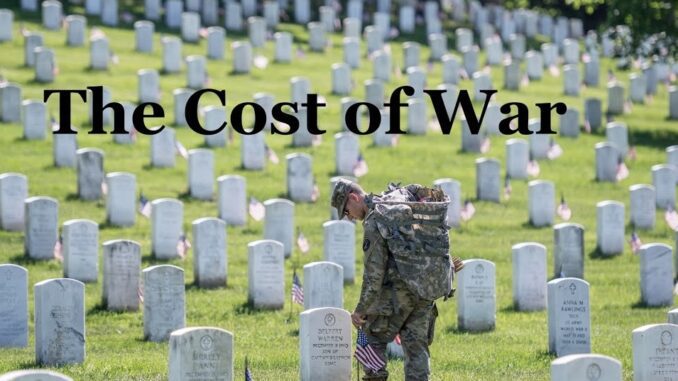
This article is dedicated to my brother, my mother’s son who now lives in the spaces of the memories of my mind.
For nations insulated from the immediate, physical horrors of battle, war can become an abstract concept – a distant game of chess narrated by politicians and media. This abstraction is a dangerous luxury. It allows for the framing of conflict as a clear-cut battle of “Good vs. Evil,” a narrative that makes the killing of others palatable and obscures the true, perpetual price paid long after the final shot is fired.
Having never experienced the devastation of modern war on their own soil, a generation of armchair experts has emerged, viewing conflict through a sanitised lens. This article seeks to replace that lens with a clear-eyed accounting of the real, enduring costs of war since WWII.
The Unsettled Ledger: A Multigenerational Debt
The financial cost of war is staggering, but its true impact is measured in what is foregone. Trillions of dollars funneled into defense budgets represent a simultaneous divestment from a nation’s own people.
- The Triad of Neglect: Every dollar spent on a missile or a tank is a dollar not spent on healthcare, not building affordable housing, and not funding education. This creates a silent, domestic casualty list: the patient who couldn’t get treatment, the family trapped in insecure housing, the student denied a world-class education. War doesn’t just destroy infrastructure abroad; it prevents its creation at home.
- The Fracturing of the Human Spirit: Beyond the economy, the human cost is imprinted on the very fabric of society.
- Family Structures: The deployment of parents, the return of loved ones with physical and psychological trauma, and the creation of gold-star families all place immense, often unbearable strain on the foundational unit of society.
- Mental Well-being: The trauma of combat extends far beyond the individual soldier, affecting families and communities for generations through conditions like PTSD, anxiety, and depression. The “invisible wounds” of war are some of its most persistent and poorly treated legacies.
- Social Cohesion: Wars fueled by overseas conflicts often breed suspicion and hatred at home. We see the creation of stereotypes and the “othering” of entire communities based on their ethnicity or religion, fracturing the multicultural harmony that defines nations like Australia.
The Hidden Architects: Who Profits from Perpetual Conflict?
War is not merely a failure of diplomacy; for some, it is a highly profitable enterprise and a tool for cementing power.
- The Redistribution of Wealth (Upwards): Conflict serves as one of the most effective mechanisms for the upward redistribution of wealth in history. Public funds are transferred via government contracts to a small cohort of arms manufacturers, defense contractors, and associated industries. Meanwhile, the general populace bears the cost through austerity and a hollowed-out public sector, dramatically increasing the gap between the rich and the poor.
- The Revolving Door: A corrosive symbiosis exists between the military, arms industry, and political class. The “revolving door” sees defense officials and politicians transition into lucrative roles in the companies they once regulated or funded, and vice-versa. This creates a powerful incentive for perpetual conflict and undermines good governance by prioritising corporate and personal advancement over the public good.
- Reinforcing the Patriarchy: The traditional narrative of war glorifies a specific, toxic form of masculinity – the unfeeling, violent problem-solver. This reinforces patriarchal structures and markets dysfunctional images of males, stifling emotional intelligence and devaluing traits like empathy, negotiation, and compassion, which are the actual bedrock of lasting peace.
The Takeaways: What Must We Avoid?
To break this cycle, we must consciously reject the myths that sustain it.
- Avoid Abstraction: Never allow war to be discussed as a game or a simple narrative. Force the conversation to include the real, long-term costs to healthcare, education, and social stability.
- Follow the Money: Scrutinise the defense budget and the lobbyists who shape it. Expose the networks of the “revolving door” that create a built-in constituency for war.
- Challenge the Narrative of Violence: Actively promote and value non-violent conflict resolution, diplomacy, and peace building. Reject the idea that violence is an effective or sophisticated problem-solver.
- Reframe Masculinity: Support and celebrate models of strength that are based on protection, creation, and emotional intelligence, not destruction and domination.
The real cost of war is a future diminished – a society that is less healthy, less educated, less united, and more unequal. It is a bill that comes due not on a battlefield overseas, but in the quiet struggles of our own communities, for generations to come. Recognising this is the first step toward demanding a different path.
Keep Independent Journalism Alive – Support The AIMN
Dear Reader,
Since 2013, The Australian Independent Media Network has been a fearless voice for truth, giving public interest journalists a platform to hold power to account. From expert analysis on national and global events to uncovering issues that matter to you, we’re here because of your support.
Running an independent site isn’t cheap, and rising costs mean we need you now more than ever. Your donation – big or small – keeps our servers humming, our writers digging, and our stories free for all.
Join our community of truth-seekers. Donate via PayPal or credit card via the button below, or bank transfer [BSB: 062500; A/c no: 10495969] and help us keep shining a light.
With gratitude, The AIMN Team


“..The Real Costs of War are Never-Ending…”
…..because we continually elect media hyped, industry supported politicians to create “forever” wars. Despite the moral and ethical teachings of all religions and the permanent physical reminders of war memorials in every town and city we perpetuate the continuity of human tragedy without meaningful consideration. God help us.
A friend sent me the list of wars ended by President Trump.
My response: Just because he was alive at the time does not mean Trump played a role of importance in “ending” any of these border skirmishes. For example, the Armenia-Azerbaijan conflict, which is also called the 2nd Nagorno – Karabakh war took place between September and November 2020. I am pretty sure Biden was President of the US at the time, and he did not play any role in the “peace”. Trump may think Armenia is America?
None of these border conflicts is resolved, or can be. The drawing of boundaries on maps, generally to ossify the old colonial territories, is meaningless to the people who actually live in the places, and
those locations will probably still be erupting into fighting in a hundred years’ time.
I suspect the Israel/Palestine conflict has a long unfolding yet to be seen. What’s another 1000 years to these people? God gave this land to …
Not a bad sumnation, at all?
And yet anther intelligent comment from Lyndal.