By Maria Millers
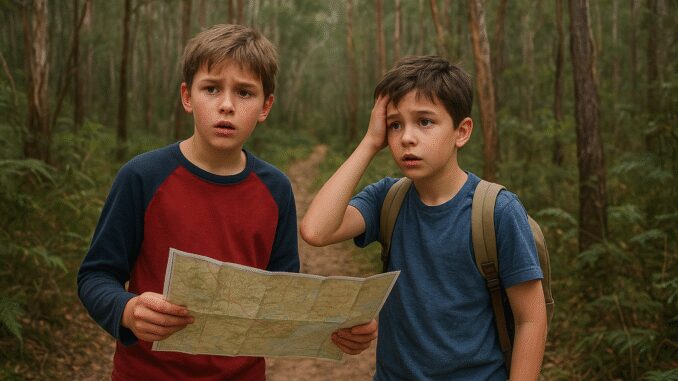
Every parent’s worst nightmare is having a child wander off whether in a busy supermarket, street or while out in parks or bushland. Mercifully they are usually quickly reunited with a frantic parent and all is well.
But this is not always so.
When at 5pm on September 27th little 4-year-old Augustus (Gus) Lamont vanished from his family’s remote sheep station he became the last in the long list of missing and lost children and at the time of writing had not been found.
Cases of lost children span decades back to colonial times and have deeply affected how Australians think about childhood safety, freedom, and trust. Think Beaumont children, Daniel Morcombe, William Tyrell, Siraboon Bung and many more. Of the above names only the tragic fate of Daniel Morcombe is known.
The lost child in the bush is an Australian trope and has continued to haunt the Australian imagination, a living symbol of Australian unease that has spanned centuries and is a recurring theme in art, folklore, song and later films.
In the nineteenth century the idea of losing one’s child to a strange country reflected white settlers’ distrust of their new land and its Aboriginal inhabitants. Today the lost child continues to torment the national consciousness, but no longer as lost in the bush. Instead the lost child of modern Australia is more likely a victim of abuse, abandonment or abduction.
Colonial poet, Henry Kendall’s poem, The Lost Child was written in 1869, not long after several cases of children vanishing in the wilderness, and it captures both colonial anxiety and awe of an alien unpredictable landscape.
Excerpt:
Seven miles from Sydney’s roaring town,
In the place where the station fences end,
A child went lost – and the tempests brown
Beat on the bush with a roaring sound,
While the mother wailed for her darling friend.
The Dandenongs have their own stories of lost children. Writing in the Celebrating the Dandenongs edition of the Woorilla Magazine, historian Margaret McInnes told the stories of twelve year old Clara Crosby and six year old Louis Vieussieu. Clara became lost in 1885 after taking a wrong turn on Macclesfield Rd. Marooned in dense scrub she survived by drinking from the Cockatoo Creek Louis was not so lucky having wandered away from a family picnic in what is now known as Lower Fern Tree fully, never to be seen again.
The trees are kind, they cradle him from harm,
the tall grasses whisper around his hair,
but man’s world passes by without alarm,
forgetting the child that is lying there.
In 1953 Judith Wright transformed the myth of the lost child in the bush into something symbolic where the lost child stands for White Australia and its alienation from the land and indigenous belonging.
From “South of My Days” by Judith Wright
Old Dan, with the cracked hands and full belly,
Remembers the old tales.
The lost child, the bushranger,
The droughts that bring the cattle down to water.
The creek’s gone dry. The day’s a dust haze.
Long-gone fathers ride through sleep to mine them.
Through Dan’s reminiscences, the poem preserves the legends of Australia’s colonial past: lost children, bushrangers, droughts, endurance. Australia becomes a land that tests resilience and courage – an environment that shapes character.
It was no longer about a literal lost child – but about a people adrift in a landscape they claimed but didn’t understand.
From The Gateway
The child went wandering once, and cannot call;
his cry was lost in the long bush years.
Now his bones are dust, but we – we fall
through the silence he left, through our own fears.
From Kendall’s bush ballads to Judith Wright to our current crop of poets this trope continues to shape how Australians imagine loss, belonging, and connection to the land.. The motif reinforces the idea that the Australian landscape is central to identity.
Today poets are rewriting this national myth. None more so than some Indigenous and multicultural voices.
Three of the most powerful contemporary indigenous Australian poets revisit the lost child theme, but in modern, emotionally and politically charged ways.
For Ali Cobby Eckermann the lost child becomes the stolen child taken by government policy and not the bush. She herself was part of the Stolen Generations, taken from her mother and later reunited as an adult. Her poems often blend maternal yearning, loss, and reconnection with Country. Eckermann turns the myth of the innocent child lost in nature into the state’s taking of children from indigenous families.
Excepts from “Inside My Mother”
I am the child inside my mother
the one who was taken away
her arms are empty
her eyes still search the roads
where government cars drove.
I am the child inside my mother
the ache that never left her bones
the silence that fills her house
when others sleep.
and
I tell you true
I am not the mother I thought I’d be
my children are scattered
like seeds from a pod
blown by a wind I did not call.
The image of children scattered like seeds speaks to forced separation – a devastating reworking of the lost child myth from within Indigenous experience.
For Ellen Van Neerven what is lost is language, not physical disappearance. Her poem speaks of finding one’s way home through words – the lost children of language.
She connects language loss and cultural displacement to the lost child motif. The child is the speaker, seeking their way back through story and kinship. This poem reclaims the lost child image through language revival and survival.
Mother Tongue
our tongues were taken,
rolled and pressed,
turned into paper,
printed in someone else’s words.
still we find each other,
voice by voice,
whisper by whisper,
in the dark.
From “Throat,” 2020
Evelyn Araluen similarly uses language loss as a form of disappearance.
each word is a child I cannot hold
but still I learn their small names,
trace their tracks through white noise
and broken grammar.
The lost children here are words, ancestors, and the poet’s own younger self reclaiming them.
The bush myth becomes an act of language survival
The reimagining is not just confined to Indigenous voices, the lost child can also be a migrant child adrift in a country and lost between worlds.
We are an immigrant nation and Maxine Beneba Clarke reminds us in Evening Song of the displacement and feelings of not being accepted that some migrants experience. Her lost child becomes a migrant child in a country that doesn’t see her.
The child at the bus stop / forgets her mother’s tongue.
Her mouth is full of foreign air.
She hums to remember / the sound of home.
Clarke relocates the motif to the suburbs which becomes the cultural wilderness of migration and racism.
The child is lost between worlds.
The lost child tropes move from literal to symbolic and always reflect Australia’s evolving consciousness It speaks to uncomfortable questions: How do we belong to this land? Who gets to call it home? And it addresses Australia’s on going search for identity.
Meanwhile a little boy is still missing under what seems more and more to be mysterious circumstances.
Keep Independent Journalism Alive – Support The AIMN
Dear Reader,
Since 2013, The Australian Independent Media Network has been a fearless voice for truth, giving public interest journalists a platform to hold power to account. From expert analysis on national and global events to uncovering issues that matter to you, we’re here because of your support.
Running an independent site isn’t cheap, and rising costs mean we need you now more than ever. Your donation – big or small – keeps our servers humming, our writers digging, and our stories free for all.
Join our community of truth-seekers. Donate via PayPal or credit card via the button below, or bank transfer [BSB: 062500; A/c no: 10495969] and help us keep shining a light.
With gratitude, The AIMN Team

Every parent’s worst nightmare is having a child wander off …
I’d have thought that every parent’s worst nightmare is having a child abducted by a sadistic paedophile ring, but I’m childfree by choice so what would I know?
The list is extensive:
[1] Sexually abused by (a) a relative, (b) an educator, (c) a random stranger, (d) a member of a church or the scouts;
[2] Hit by a moving vehicle and critically or fatally injured;
[3] Contracting a fatal or critically debilitating illness;
[4] Getting lost, or running away from home and never being found or returning;
[5] Being ruthlessly abused on social media to the point where suicide seems the only escape from the nightmare;
[6] Being born with a critically life-limiting condition, e.g. Dandy-Walker Syndrome;
[7] Being mauled by a dog, bitten by a snake, trampled by a horse etc.;
[8] Being strip-searched by the NSW police at a music festival despite having no contraband on your person;
[9] Getting sucked into some weird cult that insists on cutting all ties to family & relatives;
[10] Being a hard & fast supporter of Trump, MAGA, Murdoch and the general ecosystem of the FRWNJ community.
Well, the lost white child trope. Prolific Australian author Carmel Bird’s contemporary classic novel ‘The Bluebird Café’ (1988) deserves an honourable mention.
Great article Maria, beautifully written and formed. I enjoyed reading it, even though the subject was sad. Thank you.