By James Moore
“Hunger in America is not a matter of scarcity but of political will. We have the food. We have the programs. What we lack is the national commitment to end the suffering.” – Loretta Schwartz-Nobel (Author of Growing Up Empty: The Hunger Epidemic in America).
The memories, when they come, arrive unbidden. I do not care for the imagery, etched into our family history with the sharp tool of shame. The booming Post-World War II decade of the 50s was nearing the end but in the midst of all that prosperity my Ma waited tables at a burger joint up on the Dixie Highway in Michigan for .65 cents an hour. While she earned nickel and dime tips, her husband, my father, who had walked across Europe shooting bad guys, earned a little over $1.50 hourly bending his back on an automotive assembly line. If there had been more hours to a day, they would have taken the additional work. There was never enough money to feed and clothe their six children, and the mortgage payment, only $65 monthly on a VA loan, created a household crisis every thirty days.
My parents needed assistance, as millions of Americans still do in our high-tech, AI- driven economy. Food supplements were available from the federal government. The United States Department of Agriculture (USDA) offered blocks of pale, waxy cheese, powdered milk, and chalky powdered eggs. Accepting the commodities was a tangible admission of failure in a state where shining new automobiles were rolling off onto the streets of America as symbols of a rising middle class. The food was packaged in brownish boxes with USDA labeling, which was a cultural scarlet letter for recipients. My Ma was a proud immigrant, though, and discovered a technique to preserve her family’s dignity through the endless hard times.
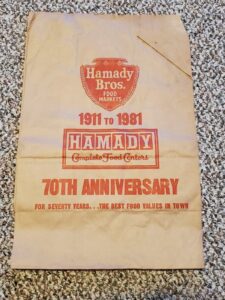
Not yet ten years old, I understood my mother’s tactic. Behind our refrigerator, she kept neatly-folded, paper bags from the local grocer. They carried the bright, red brand of the surname of the store’s owners and were referred to as, “Hamady Sacks.” I remember the first time Ma enlisted my participation in her attempt to fool our neighbors, whose judgment of my parents’ failures would be as corrosive and painful as hunger.
“Get me a Hamady sack from behind the ‘fridge, son, and put on your coat,” she said, that gray Michigan winter day.
“What do you need it for, Ma?”
“Never mind. Fold it up so I can put it in my purse and go put on your jacket.”
“Where are we going, Ma?”
“To get groceries.”
“We have to bring our own bags?”
“Never mind, I said, son.”
Ma put on a pair of sunglasses before we arrived at the county assistance offices, not more than a mile from the Buick plant where my father worked. There was a line and we waited a half hour as I watched her peeking over the tops of her sunglasses like she was looking for someone she might know. Eventually, we got to the counter and she signed papers and was handed tickets before being directed to another window where we were given long blocks of cheese, boxes of cereal, powdered eggs and milk, and cans of soup. Ma took the Hamady sack out of her purse, unfolded the heavy, brown paper, placed the food inside, and led me out the door. When I was a boy, I cannot recall that there was anything to be said about a family that was more demeaning than, “They’re on Welfare,” and that described our circumstances.
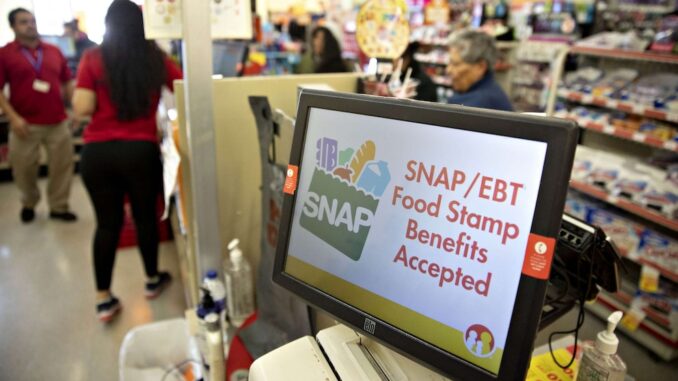
The same quiet drama of humiliation and necessity is still playing out in millions of American households, though the sets and props have changed. The stark, utilitarian packaging of the past has been replaced by the discreet, state-issued Electronic Benefit Transfer (EBT) card, which enables food purchases under the Supplemental Nutrition Assistance Program (SNAP). The EBT card, though, can feel just as heavy with judgment as my mother’s hidden block of cheese. The struggle to feed a family in the wealthiest nation on earth remains a profound and personal crisis, layered with bureaucratic hurdles, economic brutality, and a persistent, aching shame that bridges generations. Whispers still follow families. The distinctive commodities of my parents’ era were a beacon announcing your status to neighbors, to shopkeepers, to your children’s friends. My Ma’s act of concealment in the Hamady sacks was a defense mechanism against this social humiliation. She was not just hiding food; she was hiding our family’s perceived inadequacy from a world she believed was watching and judging, which it was.
The transition from that time to 2025 is prescribed by a shift from the shame of the community to the anxiety of the individual. The EBT card has, in theory, digitized and anonymized the process. Any cardholder who has stood in a checkout line, though, fumbling with the distinctively colored plastic, feeling the impatient gaze of the person behind them, knows anonymity in the process is a fiction. The moment of payment is an equally tortuous version of my mother’s Hamady sack sadness, a public revelation of private struggle. I’ve heard cashiers often ask the shopper loudly enough to be heard: “EBT?” The card might be declined, which broadcasts an empty account balance to a line of waiting strangers. There is also the checkout’s careful calculus of separating EBT-eligible food from taxed, ineligible items like toothpaste or soap. This happens as the rest of us wait and watch. The sorting becomes a performative display of poverty for an audience of unknown observers.
All that humiliation is, of course, preceded by the gauntlet of the application process. Qualifying for SNAP requires a detailed burden of proving your own desperation. Applicants enter a labyrinth of paperwork, requiring pay stubs, bank statements, rent receipts, and utility bills. You must lay bare your financial soul to a usually overwhelmed and understaffed state agency. If you have a family of four, gross monthly income must typically be at or below 130% of the federal poverty line, which is $3,500 a month. That modest dollar amount leaves families perched on the precipice of catastrophe. A single car repair or a missed week of work due to illness can shatter a fragile equilibrium. The process designed to weed out the “unworthy” is also very accomplished at demeaning the truly needy, forcing them to repeatedly justify their existence and their hunger.
And what does this hard-won benefit provide? The average SNAP payment per person is a starkly insufficient $6 per day. Imagine navigating the modern American grocery store with those few crumpled dollars in your pocket or purse. This is barley a budget for survival, and instead a constant exercise in triage. Fresh fruits and vegetables become luxuries. Lean proteins like chicken breast or fish are often passed over for cheaper, fattier cuts or calorie-dense, nutrient-poor processed foods. The goal shifts from “What will nourish my family?” to “What will fill their stomachs until tomorrow?” The diet becomes a monotony of carbohydrates and fillers, a direct contributor to the graphic health disparities that plague low-income communities. The choice is not between brand names and generics, however; families must pick either food or the light bill, or maybe decide between a gallon of milk and the bus fare to a job that still doesn’t pay enough.
The causes of this widespread food insecurity are a complex and damning tapestry. Stagnant wages for decades have decoupled hard work from financial security. The rising, relentless cost of housing, healthcare, and education has squeezed family budgets beyond the breaking point while tax breaks further enrich corporations, executives, and billionaires. The gig economy, meanwhile, might offer flexibility but rarely a living wage or benefits. We have constructed a dynamic where millions of Americans who play by the rules, working forty, fifty, sixty hours a week, still cannot afford the most basic human necessity of food.
The cultural response to this crisis, however, has evolved. The communal shame of the 1950s has been supplanted by a more insidious, politically charged narrative. Where my mother feared the judgment of our neighbors, today’s struggling families face the judgment of a political discourse that often caricatures them as lazy, dependent, or fraudulent. The term “welfare queen,” a grotesque political phantom from the 1980s, still haunts the debate, creating a climate where assistance is viewed with suspicion rather than compassion. This external scorn internalizes itself, creating a deep-seated feeling of failure that is passed down through generations. Children often learn to be silent about the EBT card, to feel the heat in their cheeks when their friends want to split a grocery bill they cannot contribute to equally. Meanwhile, no cultural shame arises from billions spent on bombs and bullets.
The landscape of struggle has shown a flicker of change, however. The destigmatization of food pantries, the rise of mutual aid networks during the pandemic, and the honest conversations about economic hardship happening more openly online suggest a slow, painful reckoning. People are beginning to understand that food insecurity is not a moral failing but a systemic one, not a character flaw, but a policy choice.
I will not ever lose the image my mother holding that Hamady sack, her hands quick and furtive in disguising the government food. She was not hiding from hunger; she was hiding from the verdict of a society that had already decided her worth. The only difference today is that shame is rendered in the silent swipe of an EBT card, the anxious scanning of a receipt, or in the hollow ache of a stomach that is full but malnourished. The same verdict is being digitally read by computers.
America has chosen to see failure instead of profound humanity in the struggle for food security. Instead, we must recognize that the need for food assistance is a crisis of our economy, not of our people. I think until we understand those distinctions, the United States of America, the breadbasket of the world, will remain filled with the hidden shame of its own citizens. The journey from my Ma’s Hamady sack to the EBT card is not one of progress in dignity, but merely a change in the method of concealment. The hunger remains.
And so does the quiet, desperate need to conceal it.
This article was originally published on Texas to the world.

James Moore is the New York Times bestselling author of “Bush’s Brain: How Karl Rove Made George W. Bush Presidential,” three other books on Bush and former Texas Governor Rick Perry, as well as two novels, and a biography entitled, “Give Back the Light,” on a famed eye surgeon and inventor. Mr. Moore has been honored with an Emmy from the National Academy of Television Arts and Sciences for his documentary work and is a former TV news correspondent who has traveled extensively on every presidential campaign since 1976.
He has been a retained on-air political analyst for MSNBC and has appeared on Morning Edition on National Public Radio, NBC Nightly News, Last Word with Lawrence O’Donnell, CBS Evening News, CNN, Real Time with Bill Maher, and Hardball with Chris Matthews, among numerous other programs. Mr. Moore’s written political and media analyses have been published at CNN, Boston Globe, L.A. Times, Guardian of London, Sunday Independent of London, Salon, Financial Times of London, Huffington Post, and numerous other outlets. He also appeared as an expert on presidential politics in the highest-grossing documentary film of all time, Fahrenheit 911, (not related to the film’s producer Michael Moore).
His other honors include the Dartmouth College National Media Award for Economic Understanding, the Edward R. Murrow Award from the Radio Television News Directors’ Association, the Individual Broadcast Achievement Award from the Texas Headliners Foundation, and a Gold Medal for Script Writing from the Houston International Film Festival. He was frequently named best reporter in Texas by the AP, UPI, and the Houston Press Club. The film produced from his book “Bush’s Brain” premiered at The Cannes Film Festival prior to a successful 30-city theater run in the U.S.
Mr. Moore has reported on the major stories and historical events of our time, which have ranged from Iran-Contra to the Waco standoff, the Oklahoma City bombing, the border immigration crisis, and other headlining events. His journalism has put him in Cuba, Central America, Mexico, Australia, Canada, the UK, and most of Europe, interviewing figures as diverse as Fidel Castro and Willie Nelson. He has been writing about Texas politics, culture, and history since 1975, and continues with political opinion pieces for CNN and regularly at his Substack newsletter: “Texas to the World.”
Keep Independent Journalism Alive – Support The AIMN
Dear Reader,
Since 2013, The Australian Independent Media Network has been a fearless voice for truth, giving public interest journalists a platform to hold power to account. From expert analysis on national and global events to uncovering issues that matter to you, we’re here because of your support.
Running an independent site isn’t cheap, and rising costs mean we need you now more than ever. Your donation – big or small – keeps our servers humming, our writers digging, and our stories free for all.
Join our community of truth-seekers. Donate via PayPal or credit card via the button below, or bank transfer [BSB: 062500; A/c no: 10495969] and help us keep shining a light.
With gratitude, The AIMN Team

For as long as l can remember l have never understood the American passion for putting down those more needy than themselves. Is it a way of feeling a few rungs further up? “We must be OK coz we’re not as poor as they are?” So much of American culture seems to run on rumour and innuendo. People are “Grifters”. Thieves. Gypsies. “Unwed mothers. Not Christians. Not church folk. And yet a majority voted for by far the world’s biggest grifter??? Stuns me.
The paradox of America once again described in stark relief by James Moore; a country that repeatedly proclaims its alpha status to the rest of the planet’s denizens and yet tolerates the appalling fact that millions of its citizens live below the poverty line and are forced to rely on welfare for their very existence.
Doesn’t happen in China, or in European countries, or Australia for that matter.
The smoke & mirrors that is the capitalist artifice, that insidious myth that only if you work hard enough you can rise to the top of the pile… as if the pile were a natural condition of the human experience, as if the dog-eat-dog soulless competitiveness that is the core of the American experience is a proper and appropriate set of circumstances to be navigated within the framework of one’s life. Hint: It’s not.
Count your blessings and that you were not born in the USA is my gentle advice to all that sit within that parameter.
Don’t be so insular as to think this couldn’t happen here in Australia.
Couldn’t happen in Australia ? Is happening in Australia now with millions living below the poverty line, pensioners, unemployed, homeless. Meanwhile the number of Millionaires and billionaires grows weekly. The US of A might be, technically, the richest country in the world but on a per-capita basis we are not far behind yet our government, supposedly the government of the people, finds ways to further enrich the already obscenely wealthy while finding ways to not help the vast majority of its citizens.