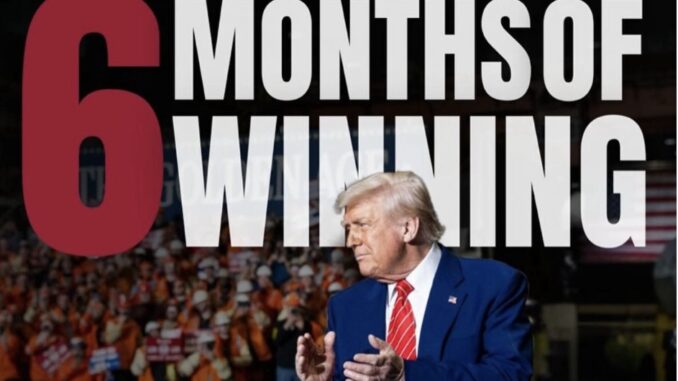
Why die-hard Trump voters are still cheering in 2025 – and why their enthusiasm might be misguided
When Donald Trump reclaimed the White House as the 47th president in November 2024, his victory sparked jubilation among millions who saw him as a champion against economic woes, unchecked immigration, and political elites. Seven months later, a significant – but diminishing – portion of these voters remain steadfast in their support, convinced that Trump is delivering on his vision of a stronger, safer America. Their collective enthusiasm, visible in rallies and echoed across platforms like X, centres on bold policies like mass deportations and sweeping tariffs, which they view as proof of promises kept. Yet, a closer look reveals a troubling reliance on political spin, with many supporters embracing narratives – such as the idea that all deportees are criminals or that foreign countries are footing the bill for tariffs – that don’t fully align with reality. As Trump’s second term unfolds, the question looms: is this collective optimism rooted in tangible progress, or are voters buying into a carefully crafted mirage?
A United Base, Fuelled by Hope and Defiance
For Trump’s supporters, the sense of vindication in 2025 is palpable. A Pew Research Center survey from 2024 found that 85% of Trump voters felt satisfied with their candidate choice, far outpacing Biden voters in 2020. On X, this enthusiasm manifests in posts hailing Trump’s “lightning speed” in tackling corruption, securing borders, and boosting the economy. Supporters describe a shared pride, with many feeling the 2024 campaign restored their faith in America’s future – half of Trump voters in the Pew survey said it made them proud of the country, compared to just 8% of Harris voters. They see Trump as a disruptor, dismantling a system they believe failed them under prior administrations. Whether it’s deregulation, energy production, or rejecting progressive policies, the collective mood is one of defiance against critics and optimism for a “Golden Age.”
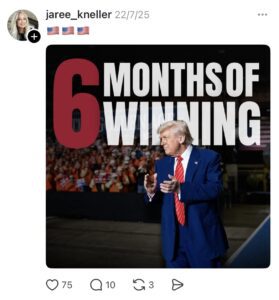
This unity is driven by Trump’s ability to resonate with a diverse coalition – working-class voters, rural communities, and those disillusioned with establishment politics. His rhetoric, delivered through rallies and amplified by friendly media, paints every move as a victory, from border security to trade deals. Even when policies falter – like unfulfilled promises on Social Security or transparency on the Epstein files – many supporters remain unshaken, dismissing setbacks as media bias or temporary hurdles. On X, users celebrate a president they believe is “winning” for America, with some shrugging off economic concerns by pointing to rising stock markets and cryptocurrency gains. Yet, this collective faith often glosses over complexities, with supporters prioritising symbolic wins over policy details, a dynamic that becomes starkly clear when examining two of their most celebrated policies: deportations and tariffs.
Deportations: Celebrating a Crackdown on “Criminals”
One of the loudest cheers from Trump’s base is for his aggressive deportation campaign, seen as fulfilling his pledge to secure the border and restore law and order. Supporters proclaim that deportations have reached “record levels,” believing, as Trump stated, that the policy targets murderers, drug dealers, and some of the worst people on Earth. The collective narrative is that these actions are purging dangerous criminals, making communities safer. High-profile moves, like the March 2025 deportation of over 200 alleged Venezuelan gang members to El Salvador under the 1798 Alien Enemies Act, are hailed as decisive victories. ICE data supports the intensity of the push, with nearly 13,000 immigration arrests in February 2025, far surpassing Biden’s 2023 daily average of 467. Supporters tie this to claims of reduced overdose deaths and safer streets, with some on X insisting that “more deportations will be nice” as enforcement ramps up.
But the belief that all deportees are criminals is a product of spin that oversimplifies a complex reality. While the administration prioritises those with criminal records or suspected gang ties, ICE operations have swept up non-criminals, including long-term residents and workers in industries like agriculture and hospitality. A New York Times investigation found little evidence to support gang affiliations in some deportations, and human rights groups have criticised the lack of due process. For example, deportations to countries like Guatemala and Honduras include families and individuals with no criminal history, with over 1.4 million non-citizens facing removal orders. The case of Kilmar Abrego Garcia, a Maryland resident mistakenly deported to El Salvador despite protections, highlights the broader net, sparking legal battles and accusations of a constitutional crisis. Yet, Trump’s base remains largely unmoved, dismissing such criticisms as “liberal whining,” convinced the policy is saving America from chaos.
Tariffs: Believing in a Foreign-Funded Windfall
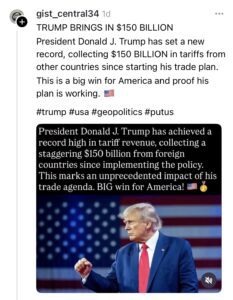
Equally central to Trump voters’ enthusiasm is the belief that tariffs are flooding the U.S. with billions, paid by foreign countries. Supporters on X celebrate a June 2025 budget surplus, attributing it to $27 billion in tariff revenue and projections of $2 trillion in investments. They echo Trump’s claim that tariffs force nations like China and Canada to “pay big” for market access, seeing it as a triumph of “America First” economics. The collective sentiment is one of economic empowerment, with posts praising tariffs for “working in Americans’ favor” and boosting jobs. Trump’s declaration of trade as a national emergency, followed by a 10% universal tariff (and 145% on China), is viewed as a bold move to protect American workers, with some supporters linking it to market rallies and a thriving economy.
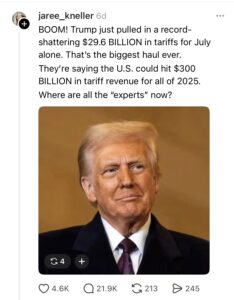
The reality, however, is far less rosy. Economists, including analyses from the Tax Foundation and NPR, confirm that tariffs are paid by U.S. importers, not foreign governments, with costs passed to consumers through higher prices. These increases can reduce GDP and wages, contradicting the narrative of foreign-funded prosperity. For instance, Trump’s tariffs on Canada and Mexico, tied to fentanyl crackdowns, have raised prices on imported goods like produce, where 40% of U.S. fresh fruit comes from abroad. Retaliatory tariffs from China, imposing 125% duties on U.S. goods, threaten a trade war that could disrupt markets further. Some supporters acknowledge the limits, with one X user noting that “tariffs aren’t as effective” as promised, yet many remain steadfast, buoyed by Trump’s rhetoric of economic victory. The University of Michigan’s consumer survey in April 2025 reported a nosedive in confidence, signaling that tariff-driven price hikes are hitting households – a fact often overshadowed by the narrative of a foreign-paid windfall.
The Power of Narrative Over Reality
The collective joy among Trump voters reflects a deep trust in his vision, amplified by a media ecosystem that reinforces his messaging. Deportations and tariffs, framed as unqualified successes, resonate with a base that feels empowered by his defiance of critics. Yet, the gap between perception and reality is stark. Deportations, while significant at 18,000 in February 2025, fall short of Trump’s goal of 1 million annually, compared to Biden’s 685,000 in FY 2024. Economic indicators are mixed, with market gains tempered by warnings of tariff-driven inflation and potential recessions. The belief that deportees are all criminals or that other countries pay tariffs reveals a reliance on spin, where symbolic wins trump policy nuances.
As Trump’s second term progresses, the durability of this enthusiasm will be tested. Supporters remain united, with many dismissing doubts as “hater” rhetoric and celebrating a president they believe is reshaping America. But economic pressures, like rising prices from tariffs, or community disruptions from deportations, could erode this optimism if promises continue to outpace results. For now, Trump’s base sees a country on the rise, driven by policies they believe are working. Whether that belief endures depends on whether they continue to embrace the narrative or confront the realities behind it.
Also by Michael Taylor:
Australia to chart its own course on Palestinian statehood, without Trump’s say-so
Dear reader, we need your support
Independent sites such as The AIMN provide a platform for public interest journalists. From its humble beginning in January 2013, The AIMN has grown into one of the most trusted and popular independent media organisations.
One of the reasons we have succeeded has been due to the support we receive from our readers through their financial contributions.
With increasing costs to maintain The AIMN, we need this continued support.
Your donation – large or small – to help with the running costs of this site will be greatly appreciated.
You can donate through PayPal or credit card via the button below, or donate via bank transfer: BSB: 062500; A/c no: 10495969


Just a bunch of ignorant plebs who are too dumb to know they are being fed a pile of Taurus excreta by a prime exponent of the art.
Cognitive dissonance is the mental discomfort experienced when holding conflicting beliefs, ideas, or values. This conflict creates psychological tension, motivating individuals to reduce the dissonance by aligning their thoughts or behaviors. It’s a common phenomenon that can influence decision-making and behavior. ….
…..Unethical behavior:
Someone who considers themselves ethical but engages in an unethical action will experience dissonance. They might reduce this by minimizing the harm caused, blaming others, or justifying their actions.
Yes political systems need a shakeup. We at least get that periodically with democratic elections.
However, be wary of the ones who say they will shake up the system. They are more likely to destroy it like Trump is doing.
T-Rump’s rolling wrecking ball is so well on the move, it will be almost impossible to stop. The determination to wreck, come-what-may, is an essential m.o. in T-Rump’s lifetime as a chronic loser.
His low self-worth, narcissistic sociopathy, demand for loyalty and retributory lashing out, make him the perfect Punch-like marionette for the hateful brutal oligarchs that have driven America into the ground. Oligarchs now joined by ring-kissing techbros and drugged-up cowboy currency manipulators that provide the rancid phlegm that temporarily holds America together.
The brainless MAGAts love the performative trashing, failing to realize that it has driven abject fear and stultification into the broken GOP, Congress, and T-Rump’s minions of the executive branch, and discombobulated the Democrats and the judiciary.
The big question remains, will the MAGAts still be cheering as the trashing takes its early tangible effects between now and the mid-terms. Though that may not matter as the T-Rump crime-gang has already in advance started waging war on the electoral processes.
As America collectively soils its underwear, the rest of the world gets stained.