Conclusion
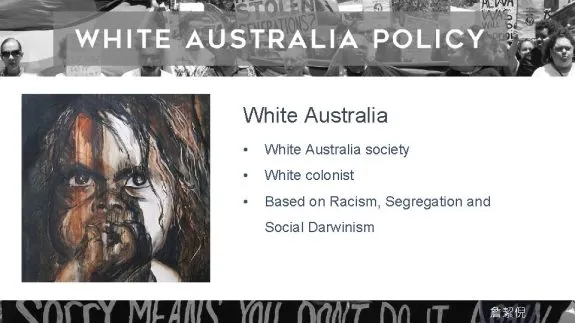
Intellectual fashions in Social Darwinism and eugenics sought to ‘purify’ and secure a white Australia. The Indigenous population (and what was seen as the hordes of Chinese entering the colony from the 1850s) were perceived as a threat to this ‘purity’. This thesis has reviewed a number of writers who conclude that the ideology of Social Darwinism was to become dominant in the public discourse, and that the ideology shaped the White Australia Policy.
Prior to colonisation, yet amid aggressive imperial expansion, much of the European knowledge of Indigenous people was constructed in their absence. In Australia, as in other colonial frontiers, Europeans imagined the indigenes as the Other and a collective identity was forged through a discourse that set them apart from Europeans. However it is recognised that the discourse of racism does not consist simply in descriptive representations of others. It included a set of hypothetical premises about humankinds (eg the Great Chain of Being and the aforementioned Social Darwinism) and about the differences between them both mental and physical. Such racial ideas went hand in hand with British imperialism and were to be embedded in colonial thought.
It is understood that early in colonisation the succession of British Governments declared Aborigines their subjects, and as British subjects, were entitled to all the rights of protection, as well as the responsibilities afforded by British law. However the rhetoric of the British Government was to become “ineffectual” (Kalantzis, 1998a) in the Australian colony with an opposing and dominant ideology. To the colonial observer Aborigines were certainly not British subjects. They were perceived as something far less superior.
Social Darwinism, based on Darwin’s concept of natural selection (The Origin of Species, published in 1859) provided validation for this perception of inferiority and subsequently for the predicted extinction and destruction of such ‘inferior races’ in the wake of colonial progress. The colonists readily accepted themselves as superior and considered Aborigines far less travelled along the evolutionary path. As such, this thesis has examined the argument that under the pretext of Social Darwinism the extinction of Aborigines was proclaimed and that this became the underlying basis for government policy in the shadows of Federation, and was ultimately justification of a perceived strong and ‘pure’ white state in the young Australian nation.
However the real strength of the idea of inevitable extinction lay not in the empirical evidence but in the theoretical constructs of evolution. Fuelled by this doctrine, the Australian colonists were anxious to maintain ‘white purity’ which was considered to be under threat from the Indigenous population and the growing population of non-Europeans. This perceived threat to the emerging Australian type was an active agent in promoting the discourse of Social Darwinism in popular consciousness. During the latter half of the nineteenth century, it was increasingly to the writing of natural science that Europeans turned to find the most credible and compelling support for their racist suppositions. In this regard, the Aborigine was the victim of an intellectual “hiatus” (Kearney, 1973:12). The task was not to find out whether the Aborigine was inferior to the European, it was instead a task of confirmation. Scientific applications such as craniology and phrenology provided conclusive evidence to the colonial observer that the Aborigines were indeed lowly in terms of evolution.
‘Race’ as a biological issue in the Australian colonies structured class inequality and an ideology justifying the colonial situation. In its most strident form, Australian racism argued that Aborigines and other non-Europeans were not only inferior but would debase the white population. Thus, the opposition to non-white immigration and hostility to the Indigenous residents in the latter half of the nineteenth century, both based exclusively on racial grounds, laid the basis of Australian racism. The popular press in the latter part of the nineteenth century was active in promoting the discourse that the Australian type and Australian society had evolved into something worth protecting. The beliefs, attitudes and values which underpinned the White Australia Policy were such things as Social Darwinism and feelings of racial superiority.
Markus, Pettman, and Evans are among a large group of historians who attest that the need to maintain a British ethnicity was the prime motive for the colonies to federate. Identification as British and as a part of a great empire was obviously a convenient basis upon which to define the identity of Australians at the time of Federation. White (1981:64, 71) argues that this racial element formed the belief in the emergence of the Australian type and the maintenance of racial purity or homogeneity. These racist attitudes and sentiments towards non-Europeans were similar to the already existing racist attitudes towards the Aboriginal people. Unlike the indigenous Australians, who nature had supposedly chosen for extinction, the Chinese threat came not only from the racial conflicts that inspired the doctrine of Social Darwinism, but from a media inspired regime of propaganda.
In summary, this thesis examined that the desire to remain one people without the admixture of other ‘races’ was one of the most powerful forces that impelled the colonists towards Federation and the ‘pure race’ that could be codified. Historians are in no doubt that a central policy of the movement towards Federation was the exclusion of all people considered inferior and unfit for a white country. Federation was the rationale to maintain white superiority and racial homogeneity, and subsequently the first act of the new parliament was the Commonwealth Immigration Restriction Act (1901). Racial discrimination in entry, residence and citizenship provisions were sanctified, and a unified White Australia established. This policy confirmed the racist ideologies based on white supremacy and the dominant perception of Indigenous inferiority and their low evolutionary progress.
References
Akmeemana, S; and Dusseldorp, T. (1995), ‘Race discrimination: where to from here?’ in Alternative law journal, Volume 20, Number 5, pp 207-211.
Bird, Greta (1992), editor Racial harassment, Aristoc Press, Melbourne.
Evans, Raymond; Saunders, Kay; and Cronin, Kathryn (1993), Race relations in colonial Queensland: a history of exclusion, exploitation and extermination, University of Queensland Press, St Lucia.
Goldberg, David (1990), editor Anatomy of racism, University of Minnesota Press, Minnesota.
Goodwin, Craufurd (1964), ‘Evolution theory in Australian social thought’ in the Journal of the history of ideas, Volume 25, pp 393-416, in Knowledge, Ideology and Social Science (Level 1) Readings, University of South Australia, Adelaide.
Hollinsworth, D. (1998), Race and racism in Australia, 2nd edition, Social Science Press, Katoomba, NSW.
Jupp, James (1991), Immigration, Sydney University Press, NSW.
Kalantzis, Mary (1998a), ‘Reconsidering the meaning of our Commonwealth (part 2)’ on the Women’s constitutional convention website (Online, accessed 9 Apr. 2001). URL:http://www.womensconv.dynamite.com.au/kalantz2.htm
Kearney, G. (1973), editor The psychology of Aboriginal Australians, John Wiley and Sons, Sydney.
Markus, A. (1979), Fear and hatred: purifying Australia and California 1850-1901, Hale and Iremonger, Sydney.
McConnochie, K; Hollinsworth, D; and Pettman, J. (1993), Race and racism in Australia, Social Science Press, Australia.
McGrath, Ann (1995), editor Contested ground: Australian Aborigines under the British crown, Allen and Unwin, St Leonards.
Pettman, Jan (1988), ‘Whose country is it anyway?: cultural politics, racism and the construction of being Australian’, Journal of intercultural studies, Volume 9(1), Pages 1-24, in Race Relations in Australia: Theory and History Readings Part 2, University of South Australia, Adelaide.
White, R. (1981), Inventing Australia, Allen and Unwin, Sydney.
Yengoyan, Aram (1999), Racism, cultural diversity and the Australian Aborigine, University of California, Davis.
Links to previous instalments:
Dear reader, we need your support
Independent sites such as The AIMN provide a platform for public interest journalists. From its humble beginning in January 2013, The AIMN has grown into one of the most trusted and popular independent media organisations.
One of the reasons we have succeeded has been due to the support we receive from our readers through their financial contributions.
With increasing costs to maintain The AIMN, we need this continued support.
Your donation – large or small – to help with the running costs of this site will be greatly appreciated.
You can donate through PayPal or credit card via the button below, or donate via bank transfer: BSB: 062500; A/c no: 10495969


Social Darwinism needs to revisit the question of “superiority”, given the environmental degradation we have caused all over the world, with our ruthless extraction and exploitation of resources. In the long run, Aboriginal Australian culture and practices would have been far less harmfual and, thus, contribute to a higher likelihood of future survival.
Thanks Michael for posting your (thesis) ‘Conclusion’
Yes Leefe, well said.
I responded to Part 4 giving reference to ‘1858-9 VICTORIA REPORT OF THE SELECT COMMITTEE OF THE LEGISLATIVE COUNCIL ON THE ABORIGINES’, which very much reveals the prevailing (pseudo) sciences and mixed attitudes of the day.
Today, I have just read a book review (Hayek’s Bastards: The Neoliberal Roots of the Populist Right – Quinn Slobodian (Allen Lane)) article in The Conversation Au a thesis on the rise of the populist right.
It would seem more and more we are obtaining a handle on the progression of arcane race/intellect biases of convenience inhabiting politics from the Greko/Romans vs Scythians, through the Magna Carta, Pope Alexander VI, the colonizing imperialists of the ‘West’, politically corrupted Darwinism, the Mont Pelerin Society and on to today’s neoliberal/neoconservative onslaught and the T-Rumpian regime.
“… the visions of capitalism interwoven with these views, helps shed important light on “the mystique of evolutionary psychology in the work of right-wing gurus like Jordan Peterson”, the pronouncements of “so-called race realists on the radical right”, and the obsession with IQ among Silicon Valley techno-libertarians.”
Thank you, Clakka. That was very kind of you.
Two years ago I was accepted to do a PhD on this topic, but at the last minute pulled out, thinking I’m too bloody old for this.
Ha ha haar, MT,
Life and AIMN is an ongoing PhD, a banquet of observations, stimulations and ideas, not ever bringing indigestion.
Agreed Clakka.
As for PhD’s, you have already done so Michael – and more besides.
What else would you call this enterprise?